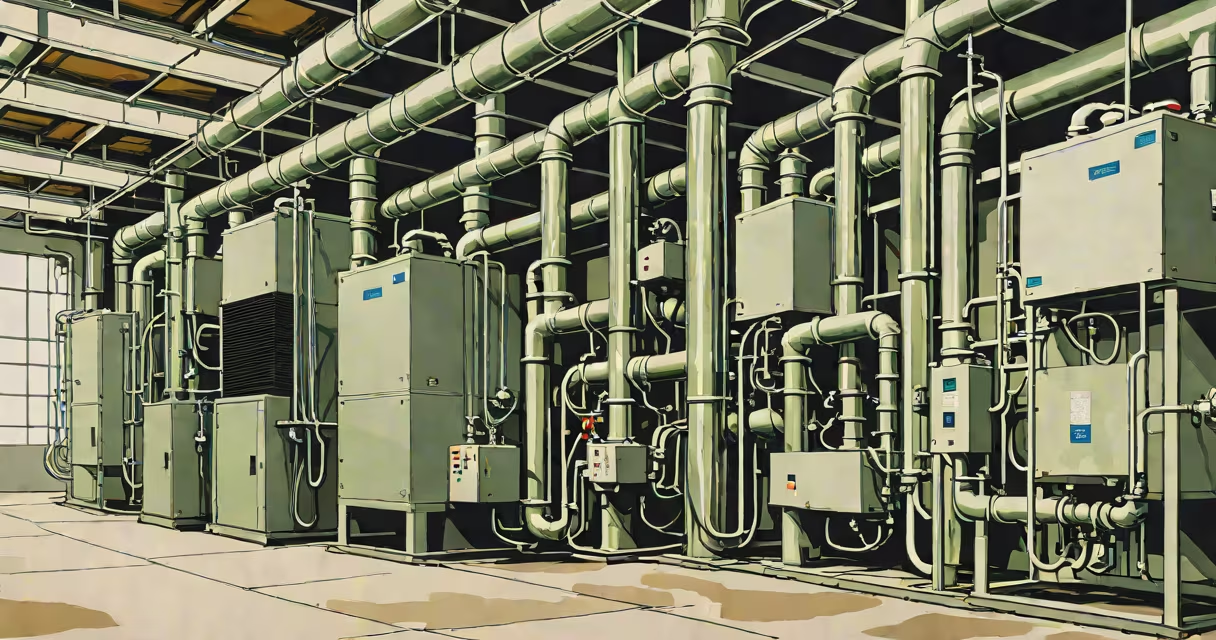
An air handling unit (AHU) is a mechanical system that conditions and distributes air throughout a building as part of an HVAC system. It controls temperature, humidity, and air quality by filtering, heating, cooling, and circulating air through ducts.
Modern buildings rely on AHUs to maintain indoor comfort and meet energy efficiency standards. They serve both residential and commercial spaces, from office towers to hospitals. The core function is to deliver treated air to different zones based on demand.
According to ASHRAE Standard 62.1, which sets guidelines for indoor air quality, AHUs must provide adequate outdoor air intake and filtration to reduce airborne contaminants. This standard applies to all mechanically ventilated buildings in the U.S., making AHUs essential for health and safety compliance.
An AHU draws in return air from the space and mixes it with fresh outdoor air. The blended air passes through filters that remove dust, pollen, and larger particles. A cooling coil lowers the air temperature using chilled water or refrigerant, while a heating coil raises it when needed.
A fan then pushes the conditioned air through ducts to supply diffusers in rooms. The process repeats continuously, adjusting based on thermostat inputs and occupancy sensors. Some units include humidifiers or dehumidifiers for precise moisture control.
In a typical office building, an AHU processes 10,000 cubic feet per minute (CFM) of air. It maintains a constant temperature within ±0.5°F of the setpoint, ensuring consistent comfort. During peak summer months, the cooling load can reach 15 tons-equivalent to running 15 window AC units simultaneously.
Each AHU contains several critical components:
There are three main types of AHUs:
| Type | Use Case | Efficiency Range |
|---|---|---|
| Single-duct | Basic heating/cooling; common in older buildings | 60-70% |
| Two-duct | Independent heating and cooling zones; used in labs and hospitals | 75-85% |
| Variable Air Volume (VAV) | Energy-efficient; adjusts airflow based on zone demand | 80-90% |
VAV systems reduce fan energy by up to 40% compared to constant volume setups. The U.S. Department of Energy reports that retrofitting older buildings with VAV AHUs cuts annual HVAC energy use by 25% on average.
Commercial buildings such as schools, hotels, and data centers depend on AHUs for climate control. A hospital operating room requires continuous air exchange-typically 20 changes per hour-achieved through high-efficiency AHUs with HEPA filtration.
Data centers use AHUs to manage heat generated by servers. A single rack can produce 3 kW of waste heat. An AHU with precision cooling maintains server room temperatures below 72°F, preventing overheating and downtime.
Residential applications are less common, but some large homes use packaged AHUs connected to ductwork. These units are smaller, usually under 5,000 CFM, and may integrate with smart thermostats for automated control.
Many people mistake AHUs for standalone air conditioners. A split AC unit cools a single room. An AHU manages entire floor zones, integrating heating, cooling, ventilation, and filtration in one system.
Another misconception is that AHUs only cool. In reality, they handle heating, dehumidification, and air purification. A hospital in Chicago reported a 30% drop in respiratory infections after upgrading to AHUs with MERV 16 filters and UV-C lights-proving their role in infection control.
Some assume AHUs are purely mechanical. Modern units include digital controls and remote monitoring. A facility manager in Dallas uses a cloud-based BMS to track AHU performance in real time, reducing maintenance calls by 50%.
A 12-story office building in Denver replaced its outdated single-duct AHUs with VAV systems in 2022. The project included installing VFD fans, upgrading filters to MERV 13, and adding CO₂ sensors to adjust outdoor air intake.
Results after one year:
The upgrade paid for itself in 3.2 years through reduced utility bills and lower sick days. The building now meets LEED v4.1 standards for indoor environmental quality.
Understanding ahu hvac meaning clarifies why these systems are foundational to safe, efficient, and comfortable indoor environments. They're not just equipment-they're part of a building's operational nervous system.