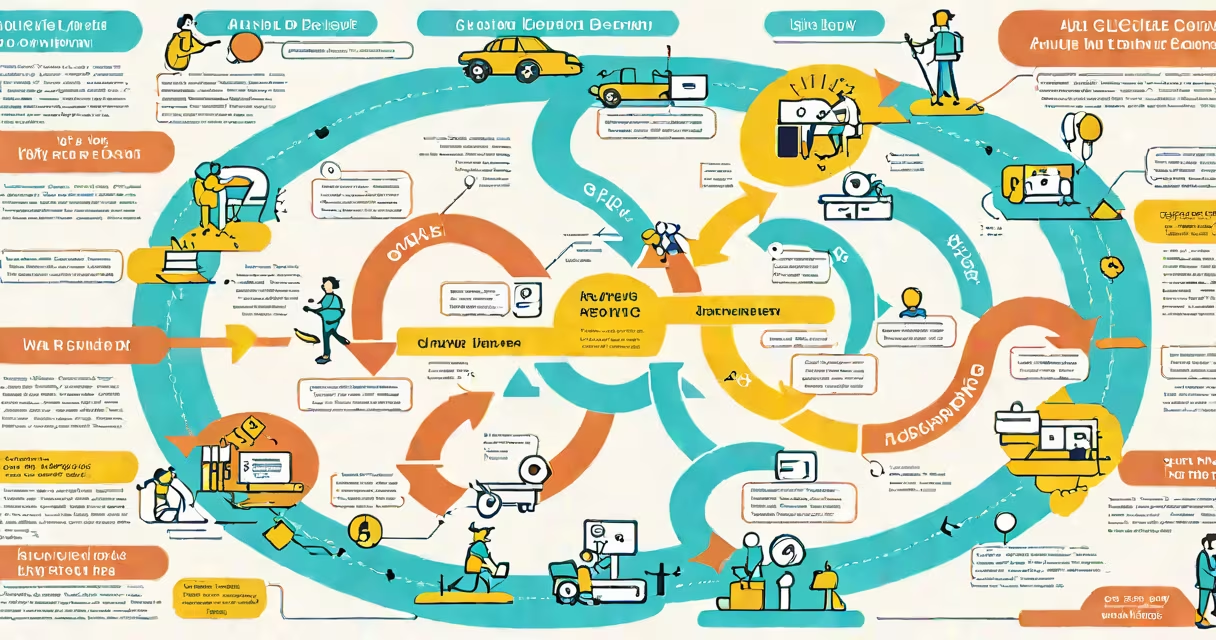
The life cycle of agile software development is an iterative, incremental approach to building software that emphasizes collaboration, adaptability, and continuous delivery. It unfolds in repeating cycles called sprints, each producing a potentially shippable product increment. This model prioritizes customer feedback and team responsiveness over rigid upfront planning.
Unlike traditional waterfall models, which move linearly from requirements to deployment, agile software development treats project progress as a series of short, time-boxed iterations. Each iteration lasts between one and four weeks and includes planning, design, coding, testing, and review. Teams inspect results at the end of each sprint and adjust priorities based on stakeholder input.
According to the Agile Manifesto, individuals and interactions matter more than processes and tools. This principle underpins the entire life cycle: teams work closely with customers, adapt quickly to change, and focus on delivering working software early and often. The structure supports rapid response to shifting requirements, reducing risk of building features that don't meet user needs.
Each sprint begins with a planning session where the product owner presents the highest-priority user stories. The development team estimates effort using story points and commits to completing a set of tasks within the sprint timeframe. Daily stand-up meetings ensure alignment and surface blockers in real time.
Development proceeds in small, integrated increments. Code is continuously tested and reviewed. Automated builds run after every commit. By the end of the sprint, the team demonstrates the completed work to stakeholders during a sprint review. Feedback collected informs the next sprint's backlog.
A sprint retrospective follows the review. The team reflects on what went well, what didn't, and how they can improve their process. These sessions drive continuous improvement. For example, a team that consistently missed deadlines due to unclear acceptance criteria began adding explicit test cases to each user story. Over three sprints, their velocity increased by 30%.
The life cycle consists of five recurring phases:
| Phase | Duration | Primary Goal | Deliverable |
|---|---|---|---|
| Backlog Grooming | Before each sprint | Refine and prioritize user stories | Ready-to-develop backlog |
| Sprint Planning | Start of sprint (1-2 days) | Select work for the sprint | Sprint goal and task breakdown |
| Execution | 1-4 weeks | Develop, test, integrate | Working software increment |
| Sprint Review | End of sprint | Demonstrate progress to stakeholders | Feedback and acceptance |
| Retrospective | Immediately after review | Improve team process | Action items for next sprint |
These phases are not sequential in a single path. They repeat every sprint. A team may complete ten sprints in six months, each cycling through all five phases. This repetition enables consistent delivery and steady learning.
Teams using Scrum-a common agile structure-follow this structure strictly. But even teams using Kanban or XP (Extreme Programming) adhere to the core idea: build in small batches, validate frequently, and adapt quickly. The difference lies in how the phases are scheduled and measured.
Many assume agile means "no documentation" or "no planning." That's incorrect. Agile requires less documentation than waterfall, but it still demands clear user stories, acceptance criteria, and technical specifications. A study by VersionOne found that 76% of agile teams maintain some form of documentation, though it's concise and updated regularly.
Another confusion is equating agility with speed. Speed is not the goal. Value delivery is. A team can move slowly but consistently deliver features that solve real problems. One fintech startup reduced release cycles from 12 weeks to two weeks. But the first release contained a critical bug because the team skipped integration testing. After fixing the process, they stabilized quality while maintaining fast delivery.
Agile is not limited to software. The principles apply to marketing campaigns, product launches, and internal operations. However, the life cycle of agile software development specifically focuses on software artifacts-code, APIs, user interfaces-and measurable outcomes like performance, reliability, and security.
A mobile banking app needed to add biometric login. The product owner listed the feature in the backlog. During sprint planning, the team selected three user stories: "As a user, I want to log in with my fingerprint," "I want to see a success message," and "I want to be prompted to enable biometrics if not set up."
Over two weeks, developers implemented the feature using iOS and Android SDKs. Testers ran automated and manual tests. The team held a daily stand-up and adjusted tasks when a dependency on a third-party authentication library delayed progress.
At the sprint review, users tested the feature in a staging environment. Feedback revealed that the success message was too vague. The team revised the wording and added a confirmation animation. The updated version passed QA and was deployed to 10% of users via canary release.
After collecting usage data and feedback, the team decided to roll out the feature to all users in the next sprint. No major changes were needed. The entire process-from idea to full rollout-took seven weeks, compared to 18 weeks under the old waterfall model.
This example shows how the life cycle of agile software development enables teams to respond to real-world behavior, reduce risk, and deliver value faster.
Organizations using the life cycle of agile software development report higher customer satisfaction and faster time-to-market. A 2023 McKinsey survey found that companies with mature agile practices delivered products 2.5 times faster than those using traditional methods.
Best practices include maintaining a stable product backlog, limiting work-in-progress, and ensuring cross-functional teams. Teams should avoid overcommitting during sprint planning. One team consistently overestimated capacity and failed to meet goals. After adopting a velocity-based forecasting model, their sprint completion rate rose from 58% to 89% in three months.
Understanding the life cycle of agile software development is essential for anyone involved in software delivery. It's not a one-time event-it's a continuous loop of creation, evaluation, and refinement. Teams that master this rhythm gain the ability to adapt, innovate, and deliver consistently.
When applied correctly, the life cycle of agile software development transforms how software is built. It shifts focus from rigid plans to responsive action, from long waits to frequent wins. The result is software that evolves with users, not against them.