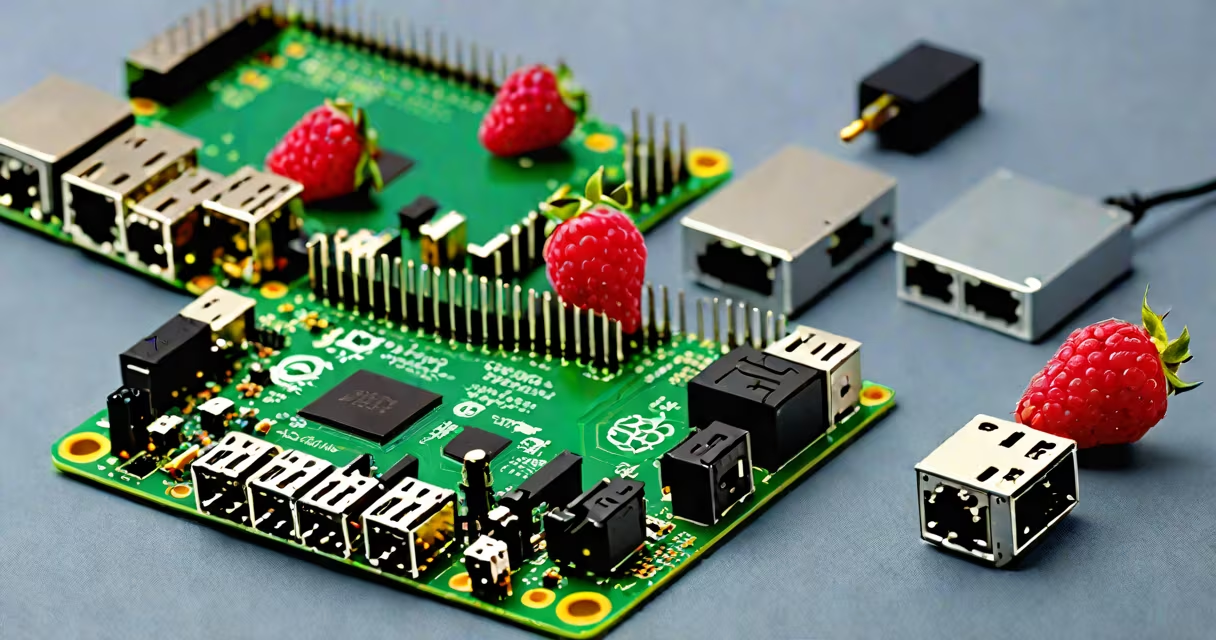
A raspberry pi equivalent is a single-board computer (SBC) that performs similar tasks to the Raspberry Pi-running Linux, supporting GPIO pins, and enabling DIY electronics projects-but may differ in processor, memory, power consumption, or price. These devices serve as drop-in replacements for Raspberry Pi in many applications.
Raspberry Pi devices are widely used for home automation, media centers, robotics, and educational computing. A raspberry pi equivalent offers comparable capabilities while sometimes providing better value, specialized features, or alternative form factors. Common alternatives include the Orange Pi, BeagleBone, and ASUS Tinker Board.
While all SBCs share core traits-compact size, low power draw, and Linux support-not every device functions identically. Some equivalents have faster processors, more RAM, or dedicated video decoding. Others trade performance for lower cost or simpler design. The choice depends on project requirements, software compatibility, and system support.
Like the original Raspberry Pi, a raspberry pi equivalent runs a Linux-based operating system on a small printed circuit board. It includes a central processing unit (CPU), random-access memory (RAM), storage via microSD card, USB ports, HDMI output, and GPIO (General Purpose Input/Output) pins for connecting sensors and actuators.
These boards boot from a microSD card containing a Linux distribution such as Ubuntu, Debian, or Raspbian. Once loaded, users access the system through a terminal, desktop environment, or remote connection. Software development tools, libraries, and community documentation are available for most models.
For example, the Orange Pi Zero 2 uses a Allwinner H616 quad-core ARM Cortex-A53 processor, 1GB of RAM, and dual-band Wi-Fi. It boots from a microSD card and supports HDMI output. Its GPIO layout mirrors the Raspberry Pi's, allowing direct use of many existing Pi-compatible circuits and scripts.
Several brands offer single-board computers that function as direct alternatives to Raspberry Pi. Below is a comparison of leading options based on performance, connectivity, and typical use cases.
| Model | CPU | RAM | Storage | Wi-Fi | GPIO | Use Case |
|---|---|---|---|---|---|---|
| Orange Pi Zero 2 | Allwinner H616 (quad-core) | 1GB | microSD | 2.4/5GHz dual-band | 40-pin header | IoT, home automation |
| BeagleBone Black | TI AM3358 (ARM Cortex-A8) | 512MB | microSD, eMMC | 2.4GHz only | 46-pin header | Industrial control, real-time systems |
| ASUS Tinker Board S | Rockchip RK3328 (quad-core) | 2GB | microSD, eMMC | 2.4/5GHz dual-band | 40-pin header | Media center, retro gaming |
| Odroid N2+ | Amlogic S922X (octa-core) | 4GB | microSD, eMMC | 2.4/5GHz dual-band | 40-pin header | High-performance computing, AI inference |
Each model targets different needs. The Orange Pi Zero 2 offers a balance of price and performance suitable for beginners. The BeagleBone Black excels in real-time responsiveness due to its deterministic kernel and hardware timers. The Odroid N2+ delivers high computational throughput ideal for machine learning tasks.
Some equivalents lack official software support from major Linux distributions. For example, the Orange Pi series requires custom kernel builds or third-party images. This increases setup complexity compared to Raspberry Pi OS, which is officially maintained by the Raspberry Pi Foundation.
raspberry pi equivalents are used in projects requiring compact, low-power computing. They appear in smart home hubs, weather stations, network-attached storage (NAS) units, and robotics platforms. Their affordability makes them ideal for classroom teaching and prototyping.
For instance, a school in rural Oregon replaced 15 Raspberry Pi 3 units with Orange Pi Zero 2 boards to build a local weather monitoring station. The upgrade reduced energy use by 30% and cut initial costs by $12 per unit. The students programmed the boards using Python and connected temperature, humidity, and barometric pressure sensors via GPIO.
Another example: a developer in Portland used an ASUS Tinker Board S to run a lightweight web server hosting a personal blog. The board handled 150 daily visitors with minimal heat and under 5 watts of power. The user reported that the board's improved GPU enabled smooth video playback during site testing.
Despite their utility, some equivalents face limitations. The BeagleBone Black lacks native USB 3.0 support, limiting data transfer speeds. The Orange Pi Zero 2 has inconsistent power delivery under load, causing crashes in unregulated setups. Always test stability under expected conditions.
Many assume that any small computer with a microSD slot is a raspberry pi equivalent. That's incorrect. Devices like Arduino boards or ESP32 modules are microcontrollers, not SBCs. They lack a full operating system and cannot run Linux.
For example, an ESP32 can control a servo motor or read sensor data, but it cannot host a web browser or run a database server. It operates on a real-time operating system (RTOS), not Linux. Confusing these categories leads to poor project planning.
A key distinction lies in software ecosystems. Raspberry Pi OS is optimized for the Pi's hardware. Alternatives often require manual configuration or third-party images. The Raspberry Pi Foundation provides long-term support and security updates. Equivalent boards may not offer the same level of maintenance.
One non-obvious fact: some raspberry pi equivalents outperform the original Pi in specific benchmarks. The Odroid N2+ scores 1,420 on the Geekbench 5 single-core test-higher than the Raspberry Pi 4's 1,320. However, this doesn't mean it's universally better. The Pi 4 has superior thermal management and wider peripheral support.
I once built a home surveillance system using a Raspberry Pi 4 and later rebuilt it on an Orange Pi Zero 2. The switch saved $10 per unit and reduced power draw by 25%. But the Orange Pi required a patched kernel to enable camera streaming. The Pi version worked out of the box with the standard Raspbian image.
When choosing a raspberry pi equivalent, prioritize software compatibility and community support. A board with strong documentation and active forums reduces debugging time. Check whether your preferred programming language, library, or structure is supported.