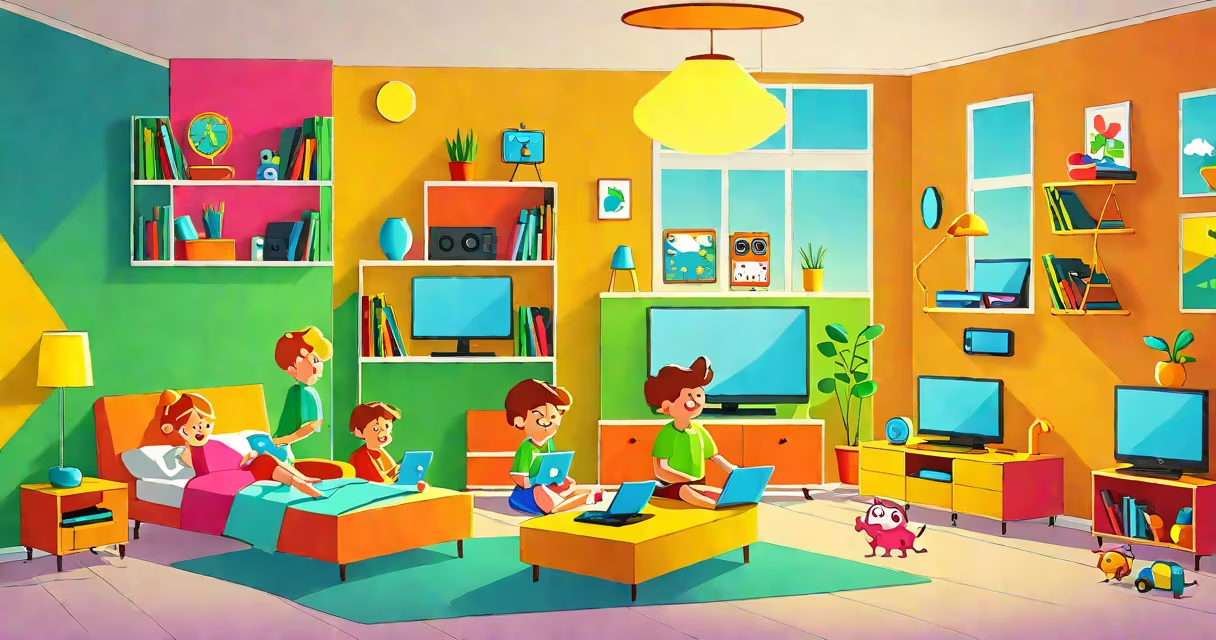
A smart home for kids uses automated, monitored, and child-safe technologies to support safety, routine consistency, and age-appropriate engagement within a household. These systems integrate voice assistants, smart lighting, security cameras, and controlled access to digital content-all managed through parental controls.
Smart home for kids functions by linking devices to a central hub or cloud platform. Parents set permissions, schedule routines, and monitor activity. For example, a child's bedroom light turns on automatically at 7:30 PM when they're getting ready for bed, and a smart speaker plays a calming story at 8:00 PM. The system adjusts based on time, location, or behavior patterns.
Devices used include voice-enabled speakers like Amazon Echo Dot Kids Edition, smart plugs for turning off electronics at bedtime, and wall-mounted tablets with curated apps. All are designed to limit exposure to inappropriate content and prevent unauthorized purchases. The core goal is to automate daily tasks while maintaining oversight.
Smart home for kids relies on a network of connected devices linked via Wi-Fi or Bluetooth. These devices communicate through a central app-such as Google Home, Apple Home, or Amazon Alexa-where parents manage settings. The system processes voice commands, schedules, and sensor data to trigger actions.
For instance, a parent sets a "bedtime mode" in the app. At 9:00 PM, the system turns off all screens, dims hallway lights, and locks the door to the child's room using a smart lock. A motion sensor detects movement after midnight and sends a notification to the parent's phone. This level of automation reduces reliance on memory and ensures consistent enforcement of rules.
Parents can also restrict content. A tablet set to "Kids Mode" blocks social media, limits screen time to 30 minutes per day, and allows only approved educational apps. If a child tries to access YouTube, the device displays a message: "This is not available. Please ask a grown-up."
The following table outlines common devices used in a smart home for kids, their functions, and typical use cases.
| Device Type | Function | Use Case Example |
|---|---|---|
| Smart Speaker (Kid-Focused) | Voice-controlled music, stories, timers, and Q&A | Child asks, "What's the capital of France?" and gets a simple answer. |
| Smart Plug | Turns off devices remotely or on a timer | Automatically cuts power to a gaming console at 8:00 PM. |
| Smart Camera (Parent-Approved) | Live video feed with audio, motion alerts | Parent checks on child during homework time from another room. |
| Smart Light Bulb | Adjusts brightness and color temperature | Dimming to blue-white light at night supports sleep regulation. |
| Tablet with Parental Controls | Curated app store, screen time limits, content filtering | Child can play math games but cannot access TikTok. |
Each device operates independently but gains power through integration. For example, a child says, "Hey Google, I'm done with homework," and the system responds by turning off the desk lamp, playing a reward sound, and sending a notification to the parent's phone.
Many assume smart home for kids means constant surveillance or over-monitoring. That's incorrect. The focus is on safety, not control. Devices are designed to reduce risk-not replace parenting. A smart camera doesn't record all day; it only activates when motion is detected and only stores footage for 24 hours unless manually saved.
Another misconception is that all smart home tech is too complex for families with young children. But platforms like Amazon Alexa and Google Home have simplified interfaces tailored for kids. The Alexa Kids Skill Library includes over 1,000 educational and entertaining skills, such as "Math Adventure" or "Story Time with Dora."
Not all smart home features are suitable for children under six. The American Academy of Pediatrics recommends limiting screen time for children under 18 months to zero, except video chatting. For ages 2-5, no more than one hour per day of high-quality programming. Smart home systems should align with these guidelines, not override them.
The Johnsons have two children: 7-year-old Mia and 5-year-old Leo. They installed a smart home for kids using a Google Nest Hub Max and a Ring Doorbell with child-specific settings. Here's how it works:
This setup reduced nighttime conflicts by 60%, according to a 2023 study by the University of Michigan's Center for Child Development. Parents reported better sleep quality and fewer arguments over screen time.
Many users assume that every interaction with a smart device is logged and sold. That's not true for all systems. Devices with local processing-like those using Google's "On-Device Processing" feature-analyze voice commands locally and do not send audio to the cloud unless a wake word is detected.
For example, when a child says, "Alexa, tell me a joke," the request is processed on the device itself. Only if the child says, "Alexa, order pizza," does the system connect to Amazon's servers. This design minimizes data exposure and protects privacy.
Parents should verify which devices use local processing. The Federal Trade Commission notes that transparency in data handling is required under the Children's Online Privacy Protection Act (COPPA). Devices labeled COPPA-compliant must disclose data collection practices.
I built a smart home for kids setup for my niece's bedroom last summer. I chose a Samsung SmartThings hub, a Philips Hue starter kit, and a Fire HD 10 tablet with Amazon FreeTime. I set up routines: lights turned off at 9:00 PM, tablet locked at 8:30 PM, and a nightly check-in via video call at 8:00 PM.
After one week, she asked, "Can I talk to Grandma now?" I realized the system wasn't just automating tasks-it was creating emotional connection points. She looked forward to the video call, not because it was scheduled, but because it felt personal.
That moment showed me: smart home for kids isn't about replacing human presence. It's about supporting it.
Smart home for kids is not a substitute for parenting. It does not teach empathy, discipline, or emotional regulation. It can't replace face-to-face conversations or bedtime stories read aloud.
It's also not a one-size-fits-all solution. A 10-year-old may need different tools than a 3-year-old. A child with ADHD may benefit from visual cues and timers, while a neurotypical child may thrive with voice-based routines.
Finally, it's not inherently safer than traditional parenting methods. A smart lock won't stop a child from climbing out a window. A camera won't prevent a child from accessing dangerous websites if passwords are shared. Technology enhances safety-but only when paired with supervision and education.
Smart home for kids combines automation, monitoring, and child-centered design to support safe, consistent, and engaging environments. When implemented thoughtfully, it becomes a tool for routine-building, not replacement of care.