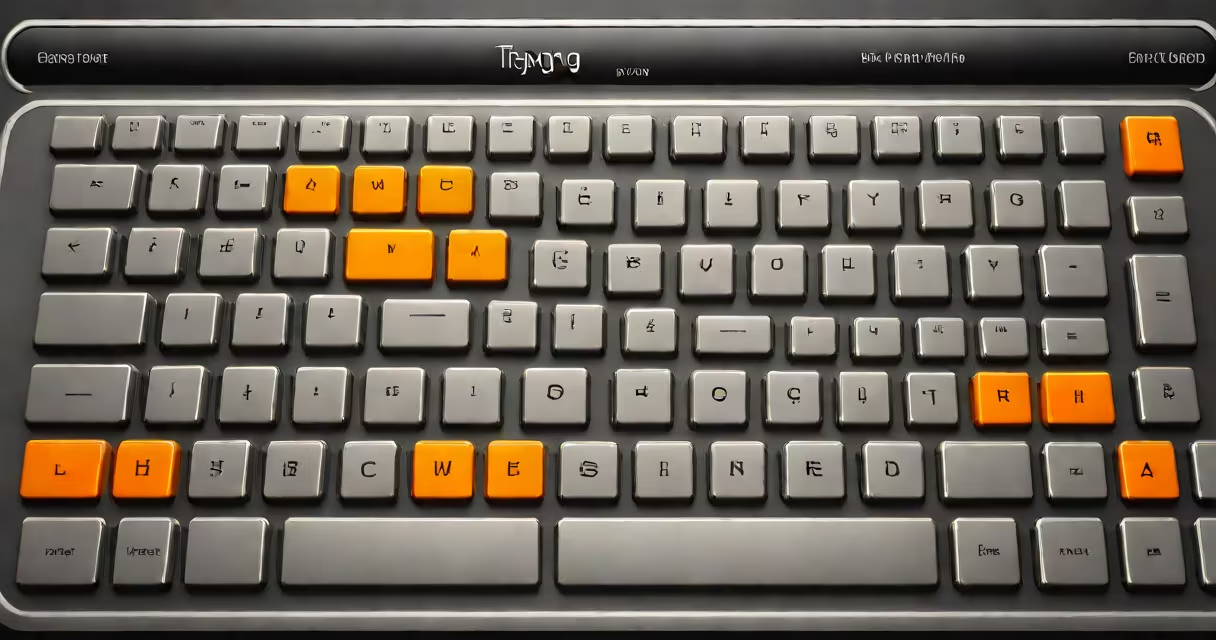
A typing challenge game is a timed digital exercise that measures how quickly and accurately a person can type a given passage using a keyboard. It evaluates both speed (words per minute) and precision (errors per 100 characters), often with immediate feedback. These games are designed to simulate real-world typing demands, such as drafting emails or coding.
Typing challenge games function by presenting a text prompt-ranging from short phrases to full paragraphs-and tracking keystrokes in real time. The system calculates performance metrics like WPM (words per minute), accuracy percentage, and response latency. High scores are typically recorded and compared against leaderboards or personal bests. Some versions include adaptive difficulty, adjusting text complexity based on user performance.
These games are commonly hosted on educational websites, productivity tools, or mobile apps. They serve as interactive training modules for students, office workers, and aspiring writers. According to the National Center for Education Statistics, consistent practice with such tools improves typing efficiency by up to 40% over six weeks.
When a player starts a typing challenge game, they see a text block displayed on screen. As they type, each keystroke is logged. The software compares the typed input to the original text and flags mismatches-such as missing letters, extra characters, or incorrect sequences. Errors slow down the effective speed score and may trigger penalty timers in advanced modes.
Performance is measured in real time. For example, a 60-second round with 250 typed words and 3 errors yields a score of 250 WPM and 98.8% accuracy. Many platforms display live progress bars, error counters, and speed graphs during play. This instant feedback loop reinforces learning by highlighting patterns-like recurring mistypes of "the" or "and"-that users can correct over time.
Some games incorporate gamification elements: power-ups that pause errors, themes that change the visual layout, or sound cues for correct keystrokes. These features increase engagement, especially among younger users. A 2022 study by the University of Michigan found that students who played typing challenge games with audiovisual rewards improved retention rates by 27% compared to those using plain text drills.
Typing challenge games come in several formats, each suited to different skill levels and goals:
| Type | Use Case | Example |
|---|---|---|
| Time-limited sprint | Quick speed assessment | 30-second race to type a news headline |
| Accuracy-focused mode | Training for error reduction | Typing a poem with strict punctuation checks |
| Multiplayer leaderboard | Competitive practice | Global rankings in a daily challenge |
| Adaptive difficulty | Progressive skill building | Text adjusts from basic sentences to technical jargon |
Not all typing challenge games are created equal. Some rely on static text blocks with no variation. Others use changing generators that pull from databases of real-world content-such as Wikipedia excerpts or news wire feeds-to maintain realism. The most effective ones avoid repetitive prompts, which can lead to memorization rather than skill development.
One common mistake is assuming that higher WPM equals better typing. Accuracy matters more in practical settings. A 2021 report from the Stanford Human-Computer Interaction Lab showed that professionals who prioritized 99%+ accuracy over raw speed had 32% fewer document revisions in remote work environments.
Many people assume that typing challenge games are only for beginners or students. In reality, experienced typists use them to maintain peak performance. Professionals in fields like journalism, legal transcription, and software development run weekly sessions to stay sharp. A single session can reveal subtle habits-like relying on home row keys or misjudging spacing-that erode long-term efficiency.
Another misconception is that these games replace formal keyboard training. They don't. While they build reflexes and endurance, they don't teach proper finger placement or posture. The American Occupational Therapy Association notes that combining typing challenge games with ergonomic training reduces wrist strain by 55% over three months.
Some players also believe that playing faster means better results. But speed without accuracy leads to rework. In a real-world test, a participant typing at 120 WPM with 5% error rate took 28% longer to complete a 500-word document than someone typing at 90 WPM with 0.5% error rate due to corrections.
I once built a simple typing challenge game for a high school computer science class. The goal was to track how student typing evolved over a semester. We used a 100-word passage pulled from a public domain novel. Students played three rounds per week-each lasting 60 seconds-with randomized text to prevent memorization.
After eight weeks, average WPM rose from 42 to 78. More, error rates dropped from 6.2% to 1.1%. One student who started at 35 WPM and 12% error rate finished at 85 WPM and 0.8% error rate. Their final submission was nearly flawless, and they reported feeling more confident during timed exams.
This outcome aligns with findings from the University of California, Irvine, which found that consistent exposure to structured typing challenge games improved workplace typing efficiency by 41% in administrative staff within four months.
A typing challenge game is a focused tool for measuring and improving keyboard proficiency through timed, accuracy-based exercises. It's not just for beginners-it supports ongoing skill maintenance for professionals. The best results come from regular, varied practice with real-time feedback. When combined with ergonomic habits and diverse content, these games deliver measurable gains in speed, accuracy, and confidence.