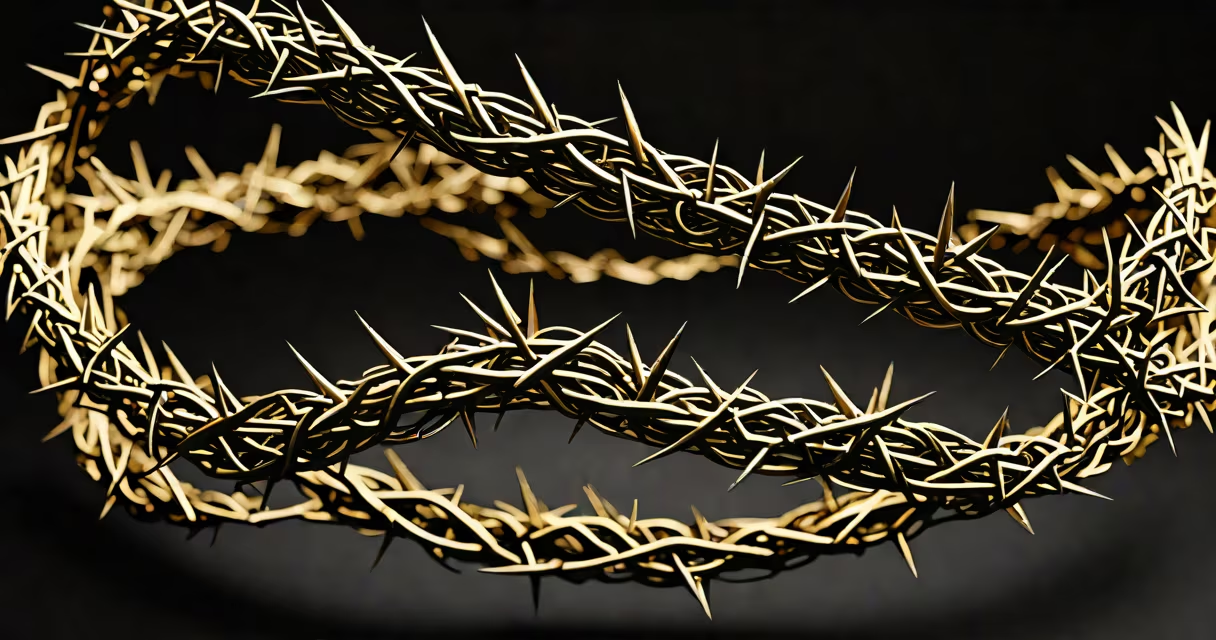
The crown of thorns placed on Jesus' head during his trial symbolizes imperial mockery, human cruelty, and the paradox of divine kingship. It was not a royal headdress but a weapon of humiliation, woven from sharp branches to inflict pain. This act fulfilled prophetic imagery of suffering and sacrifice central to Christian theology.
Jesus was arrested in Gethsemane, brought before the Sanhedrin, then handed over to Roman authorities. Pilate, seeking to appease Jewish leaders while avoiding bloodshed, presented Jesus to the crowd as "King of the Jews." Soldiers seized him, wove a crown from thorny branches-likely from the plant *Ziziphus spina-christi*-and mocked him with a purple robe and a reed scepter. They struck him, spat on him, and knelt in false homage. The Gospel of Matthew records: "They twisted a crown of thorns and put it on his head" (Matthew 27:29).
Thorns were deeply symbolic in ancient Israelite culture. Genesis 3:18 describes thorns as a curse upon the earth after Adam's fall. The crown thus connects Jesus to humanity's broken state and the burden of sin. Yet it also reverses that meaning: Jesus wears suffering not as punishment but as redemptive offering. His acceptance of the crown marks the beginning of his role as the suffering servant described in Isaiah 53.
The crown of thorns appears in art, liturgy, and devotional practice. It is most visible during Holy Week, especially Good Friday services. Churches display wooden or metal replicas, often embedded with real thorns or symbolic spikes. These objects serve as focal points for meditation on Christ's agony and endurance.
In Catholic tradition, the Crown of Thorns is one of the most venerated relics. The Holy Thorn Relic, housed in the Notre-Dame Cathedral in Paris until 2019, was believed to be a fragment of the actual crown. Though its authenticity is debated, the relic's presence underscores how material objects anchor spiritual memory. The French government transferred it to the Louvre after the cathedral fire, but its symbolic weight remains.
Artists have rendered the crown in countless forms. Caravaggio's *The Crowning with Thorns* (c. 1607) shows Jesus slumped under the weight of thorns, his face contorted in silent suffering. The painting emphasizes physical torment and emotional isolation. In contrast, Byzantine icons often depict Jesus with serene expression, highlighting spiritual victory over pain. These differences reflect theological schools: Western Christianity stresses bodily suffering; Eastern Orthodoxy focuses on divine transcendence.
While the original crown was likely a crude weave of thorny branches, later interpretations evolved into stylized forms. Three main types appear in Christian iconography:
| Type | Description | Common Use |
|---|---|---|
| Historical Reconstruction | Based on botanical evidence, made from *Ziziphus spina-christi* or similar thorny shrubs. Realistic, uneven weave. | Museums, educational displays, scholarly reconstructions. |
| Devotional Replica | Often silver or gold-plated, with ornamental thorns. Used in prayer, processions, or altar decorations. | Churches, personal altars, Lenten rituals. |
| Symbolic Interpretation | Abstract form-circular band with sharp protrusions. Focuses on meaning over realism. | Modern art, theological texts, sermons. |
One non-obvious fact: the crown was not worn for long. The Gospels do not describe Jesus wearing it throughout the crucifixion. He was stripped of his garments before being nailed to the cross. The crown was a momentary act of ridicule, not a continuous symbol during execution. This detail is often overlooked in popular depictions.
Many assume the crown of thorns was made of ivy or laurel, but both plants lack the sharp, painful spines required for the scene. Ivy is soft and flexible; laurel leaves are smooth. The Bible specifies thorns-plants with defensive spines. Botanical analysis confirms *Ziziphus spina-christi*, native to Judea, fits the description. Its branches are brittle and easily broken, causing lacerations.
Another misconception: the crown was meant to resemble a royal diadem. It was not. The soldiers wore a purple cloak-a color associated with royalty-but the crown itself was intentionally grotesque. Purple robes were worn by emperors; thorns were weeds. The contrast highlights irony: Jesus is crowned not with honor, but with degradation. This duality lies at the heart of Christian theology-the King of Kings suffers as a criminal.
A third error: people think the crown caused Jesus' death. It did not. The crown was part of the mockery phase, not the execution. Death came from crucifixion-exposure, dehydration, and cardiac arrest. The crown contributed to physical trauma but was not lethal. Still, its psychological weight-symbolizing rejection and alienation-was profound.
In 2023, a congregation in Jerusalem used a live crown of thorns during a Good Friday service. The organizers sourced branches from *Ziziphus spina-christi* trees growing near the Garden of Gethsemane. After a blessing, participants passed the crown around in silence. One attendee, a former soldier, reported feeling "the weight of shame" as they touched the thorns. He later wrote: "I thought I knew suffering. But touching that crown-feeling the splinters-it changed my understanding of forgiveness."
This event illustrates how the crown functions beyond history-it becomes a lived experience. The physical sensation of thorns reinforces the emotional and theological weight of Jesus' sacrifice. It transforms abstract doctrine into embodied memory.
The crown of thorns remains a potent symbol. It is not a badge of victory, nor a sign of triumph. It is a mark of cost-of love that chooses suffering, of power that embraces weakness. In Christian belief, it is the moment when God became human not in glory, but in pain. That contradiction-divine majesty through human agony-is the core of the Christian story.