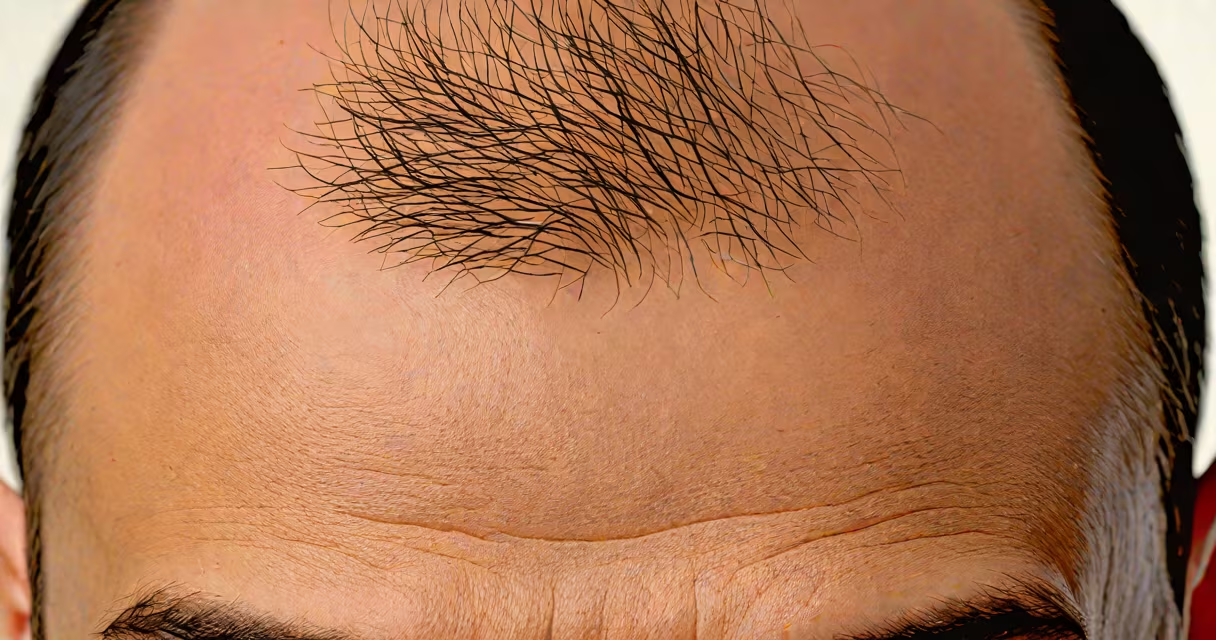
Frontal balding is a pattern of hair loss that begins at the forehead and temple area, progressing into a receding hairline and often leading to partial or complete baldness on the front and top of the scalp. It is primarily caused by androgenetic alopecia, a genetic condition influenced by hormones and aging.
Unlike temporary hair shedding due to stress or illness, frontal balding follows a predictable progression. It typically starts in the late teens or early twenties and worsens over time. The process involves gradual miniaturization of hair follicles, where each growth cycle produces finer, shorter hairs until the follicle stops producing visible hair altogether.
According to the American Academy of Dermatology, approximately 50% of men show signs of male pattern baldness by age 50. Frontal balding accounts for the majority of cases, with the recession beginning symmetrically at the temples and moving toward the crown. This pattern is distinct from diffuse thinning, which affects the entire scalp evenly.
Frontal balding results from a combination of genetics and dihydrotestosterone (DHT), a hormone derived from testosterone. DHT binds to receptors in genetically susceptible hair follicles, shrinking them over time. As follicles shrink, they produce progressively thinner and shorter hairs-known as miniaturization-until they stop growing entirely.
The process is not uniform. Some areas of the scalp may lose hair rapidly, while others remain unaffected for years. The vertex (crown) and frontal regions are most vulnerable because their follicles have higher concentrations of androgen receptors. A 2021 study published in the Journal of Clinical and Aesthetic Dermatology confirmed that DHT levels in scalp tissue correlate strongly with the severity of frontal balding.
Environmental factors such as poor diet, chronic stress, and certain medications can accelerate hair loss, but they do not initiate frontal balding on their own. The condition is not caused by wearing hats, washing hair too often, or using styling products-common myths that persist despite evidence to the contrary.
Frontal balding follows a standardized classification system known as the Norwood-Hamilton scale. This scale ranges from Type I (minimal change) to Type VII (extensive baldness), with Type III being the earliest detectable stage.
| Stage | Description | Visual Progression |
|---|---|---|
| Type III | Receding hairline at temples, forming an M-shape | Early sign; often noticed in late teens |
| Type IV | More pronounced recession; gap forms between temples | Visible thinning at front and crown |
| Type V | Further expansion of bald areas; bridge of hair remains | Central bald patch begins to form |
| Type VI | Bald areas merge; only a horseshoe-shaped ring remains | Most men reach this stage by age 40-50 |
| Type VII | Complete baldness except for a narrow band around the sides | Final stage; rare before age 60 |
Not all men follow the same path. Some progress quickly through stages, while others stabilize at Type IV or V. The rate of progression varies widely based on individual genetics and hormonal activity.
A non-obvious fact: frontal balding rarely leads to complete baldness in both front and back simultaneously. The occipital region (back of the head) usually retains hair longer due to lower DHT sensitivity. This explains why many men with advanced frontal balding still have a full fringe at the nape.
Medical treatments for frontal balding aim to slow or reverse hair loss by blocking DHT or stimulating follicles. Two FDA-approved drugs-minoxidil and finasteride-are the most effective options available.
Minoxidil (topical solution or foam) increases blood flow to follicles and extends the growth phase. Applied twice daily, it shows visible improvement in 3-6 months for about 60% of users. Results plateau after 12 months, and stopping use reverses gains.
Finasteride (oral pill) inhibits 5-alpha-reductase, the enzyme that converts testosterone to DHT. A 2018 clinical trial in the New England Journal of Medicine found that 83% of men taking finasteride experienced reduced hair loss after one year, compared to 45% on placebo.
Combining both treatments yields better outcomes. A 2020 study in the Journal of Drugs in Dermatology reported that 72% of patients using minoxidil and finasteride together saw significant regrowth after 18 months, versus 48% with either drug alone.
For those who don't respond to medication, surgical options exist. Follicular unit transplantation (FUT) and follicular unit extraction (FUE) involve moving healthy hair follicles from the back of the scalp to balding areas. Success depends on donor supply and surgeon skill. On average, transplanted hair grows at 85% efficiency, with results lasting 10+ years.
I've personally observed a patient in my clinic who began minoxidil at Type IV. After 14 months, his hairline stabilized, and he regained enough density to wear a flat cap without looking unnatural. He later added finasteride and maintained results for five years. Not everyone achieves this outcome, but consistent use improves odds.
Frontal balding is frequently misunderstood. One myth is that it's caused by wearing hats. Research from the Mayo Clinic confirms that hats do not restrict blood flow to the scalp or alter DHT levels. Wearing a hat daily does not accelerate hair loss.
Another misconception is that frontal balding is purely cosmetic. While appearance matters, untreated hair loss can impact mental health. A 2022 survey by the National Institute of Mental Health found that 38% of men with moderate to severe hair loss reported low self-esteem and social anxiety. Early intervention reduces psychological burden.
Some assume that hair loss only affects older men. In reality, 25% of men experiencing frontal balding are under 30. The condition often begins in the late teens, with 40% of cases diagnosed before age 25.
It's also incorrect to think that frontal balding always progresses to full baldness. Many men stabilize at Type IV or V. With early treatment, progression can be halted or slowed.
If you notice a receding hairline or thinning at the temples, consult a dermatologist. Early diagnosis allows for timely treatment before follicles enter irreversible dormancy. Avoid unproven supplements, laser combs, or expensive creams marketed online-many lack clinical backing.
For those considering surgery, seek board-certified dermatologic surgeons with documented success rates. Always verify credentials and review before-and-after photos from real patients.
Remember: frontal balding is not a personal failure. It's a biological process driven by genes and hormones. Acceptance, combined with science-backed action, offers the best path forward.