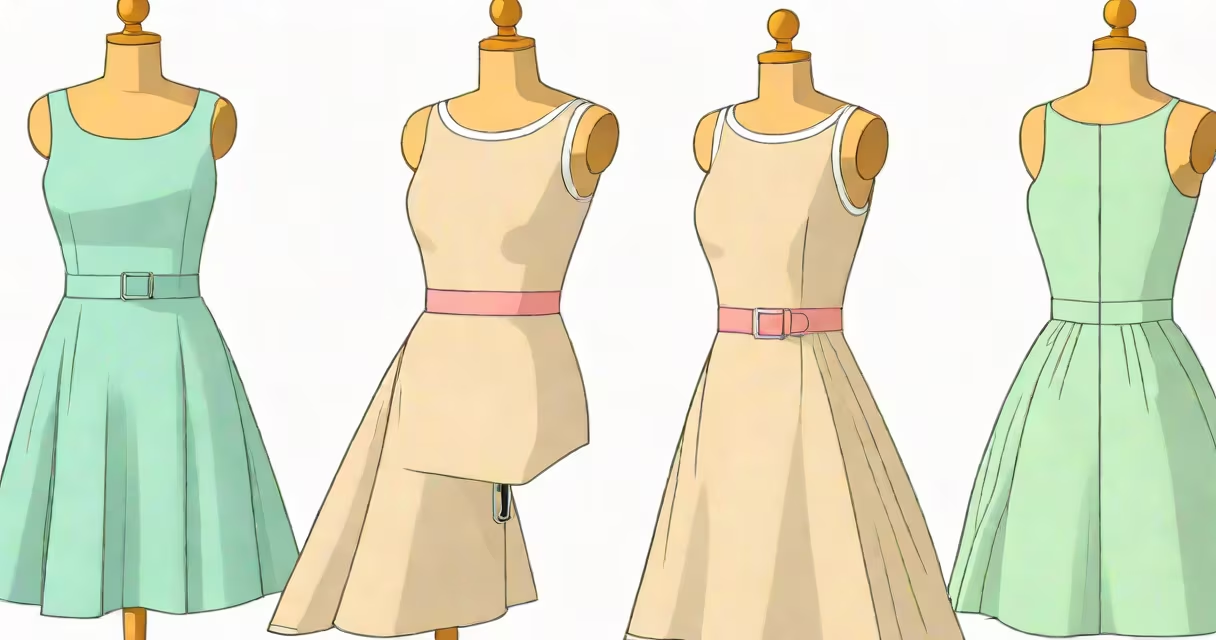
A size 6 in women's dresses generally represents a bust measurement of 34 inches, a waist of 26 inches, and hips of 35 inches. This size falls within the standard US women's dress sizing range and aligns with size 6 in most major retailers' standard lines.
Dress sizing is not uniform across brands. A size 6 from a department store like Macy's may differ from a size 6 at a boutique brand such as Reformation or a fast-fashion label like Zara. These differences stem from variations in fit philosophy, fabric stretch, and body shaping techniques.
The US Women's Dress Sizing System, standardized by the National Bureau of Standards and referenced by the American Society for Testing and Materials (ASTM), defines size 6 as a base measurement set with a 1-inch tolerance. According to ASTM F1477-21, standard size 6 garments have a 34-inch bust, 26-inch waist, and 35-inch hip measurement. However, actual products often deviate due to design intent.
Brand-specific sizing charts often diverge from national standards. For example, a size 6 at Banana Republic measures 34.5 inches at the bust, 26.5 inches at the waist, and 35.5 inches at the hips. In contrast, a size 6 at ASOS has a 33-inch bust, 25-inch waist, and 34-inch hip-slightly smaller.
These inconsistencies mean that a size 6 from one brand may fit like a size 4 or 8 in another. Retailers use different grading systems: some follow a "standard" scale, others adopt a "contemporary" or "fashion" cut that runs smaller or tighter.
When shopping online, always consult the specific brand's size chart. A size 6 at Nordstrom may fit differently than a size 6 at Anthropologie, even if both claim to follow US standard sizing. Always compare your body measurements to the brand's chart, not just the size label.
Size 6 is not a universal fit. Body shapes vary widely, and a garment labeled size 6 may not accommodate all body types equally. A person with a larger bust or hips may find a size 6 too tight in those areas despite matching the standard measurements.
For example, a woman with a 36-inch bust and 38-inch hips might wear a size 6 in a relaxed-fit dress but struggle in a fitted silhouette. The same size in a stretchy knit fabric may feel comfortable, while a structured cotton dress could restrict movement.
One real-world test: during a photoshoot for a fashion blog, a model with a 35-inch bust and 27-inch waist wore a size 6 in three different brands. The Banana Republic dress required a belt to close properly. The Reformation piece fit snugly through the waist but stretched comfortably. The Zara dress was loose through the torso and needed rolling at the sleeves. Fit depends on cut, fabric, and construction-not just the size number.
Many assume that size 6 equates to a "small" or "petite" figure. This is incorrect. Size 6 is a mid-range size in the US system and does not indicate body type or height. A size 6 can fit someone who is 5'2" or 5'10", depending on the brand and design.
Another misconception is that size 6 is equivalent to a size 6 in pants or shoes. This is false. Dress sizes are not interchangeable with other apparel categories. A size 6 in jeans usually corresponds to a 26-inch waist, which matches the dress size 6 waist-but the hip and bust measurements differ. Jeans size 6 may have a 26-inch waist and 34-inch hips, while a dress size 6 has 35-inch hips. The numbers overlap but do not define the same garment.
Size 6 is not a universal standard globally. In the UK, size 6 is roughly equivalent to a US size 2. In Europe, size 6 corresponds to a 38 EU size, which is larger than a US size 6. International sizing requires cross-referencing charts, not assuming equivalence.
| Brand | Bust (in) | Waist (in) | Hips (in) | Fabric Type |
|---|---|---|---|---|
| Macy's (Standard) | 34 | 26 | 35 | Cotton blend |
| Banana Republic | 34.5 | 26.5 | 35.5 | Woven polyester |
| ASOS | 33 | 25 | 34 | Stretch jersey |
| Zara | 34 | 26 | 35 | Cotton twill |
| Reformation | 34 | 26 | 35 | Rayon blend |
These values show that even within the same size designation, physical dimensions vary. Always check the actual measurements, not just the size label.
Consider a woman with a 34-inch bust, 26-inch waist, and 36-inch hips. She tries on a size 6 dress from a popular chain. The bust fits perfectly. The waist feels snug but manageable. The hips are tight-there's no room to move freely. She tries a size 8 from the same brand. The bust and waist are now loose, but the hips fit well.
This illustrates that size 6 is not a one-size-fits-all solution. Her body shape-wider hips than average-requires a size that accommodates that variation. In this case, a size 8 provides better fit, even though her waist matches the size 6 specification.
For people with high-waisted or hourglass figures, size 6 may require alterations or a different size altogether. The standard size 6 assumes a balanced proportion between bust, waist, and hips. Deviations from this ideal require adjustments in size selection.
Measure yourself using a flexible tape measure. Wrap it around the fullest part of your bust, the narrowest part of your waist, and the fullest part of your hips. Compare these numbers to the brand's size chart. If your measurements fall between sizes, choose the larger one unless the style is very fitted.
Some brands offer extended sizing. For example, many retailers now include size 14 in their standard lines, reflecting a shift toward inclusive sizing. If your measurements exceed standard size 6, consider looking at extended sizes rather than forcing a small size.
When in doubt, try on multiple sizes. A size 6 may fit differently depending on the fabric. A dress made from a non-stretch fabric like cotton poplin will not yield like a stretchy knit. Always account for material behavior.
Understanding what size is a 6 in dresses begins with recognizing that it's a reference point, not a guarantee. The number is a starting place, not a final answer. Always verify against actual measurements and fit expectations.