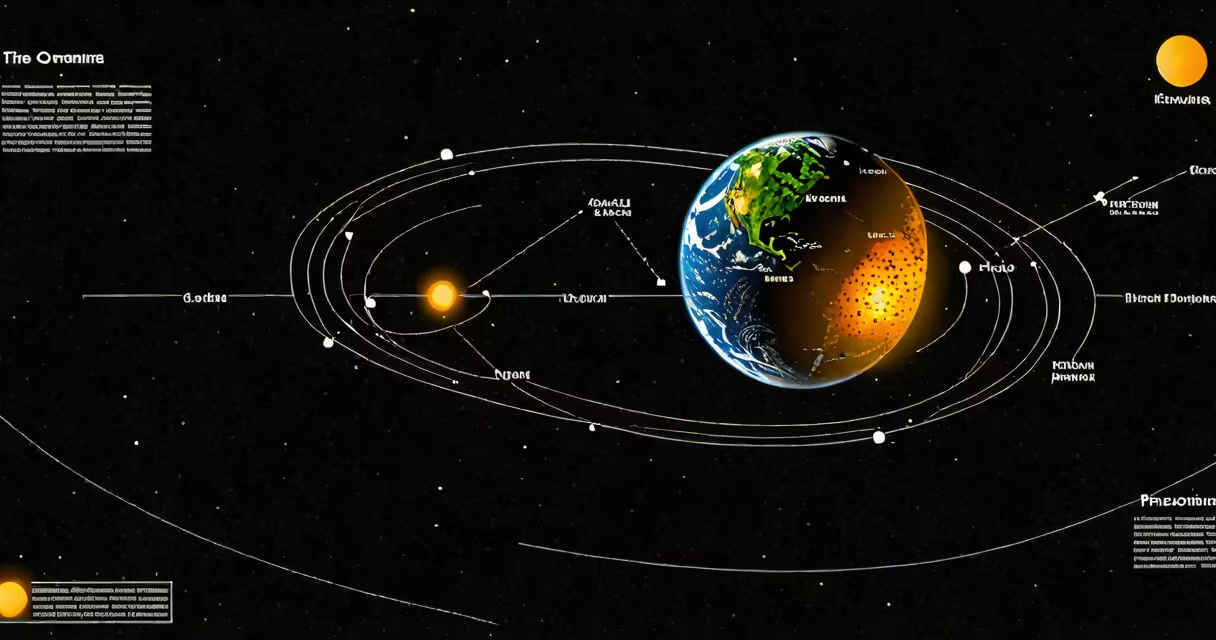
A light year is the distance light travels in one Earth year-approximately 5.88 trillion miles. It is a unit of distance used in astronomy to measure vast interstellar and intergalactic gaps.
Light moves at 186,282 miles per second in a vacuum. Over the course of a year-365.25 days, accounting for leap years-it covers 5.88 × 10¹² miles. This figure is derived from multiplying the speed of light by the number of seconds in a year: 186,282 mi/s × 31,557,600 s = 5,878,625,373,286 miles, rounded to 5.88 trillion miles.
The term "light year" is often misunderstood as a unit of time. It is not. A light year measures distance. For example, Proxima Centauri-the closest known star to the Sun-is located 4.24 light years away. That means light from Proxima Centauri takes 4.24 years to reach Earth. Traveling at current spacecraft speeds, such a process would take tens of thousands of years.
Distances within the solar system are measured in astronomical units (AU)-1 AU is the average Earth-Sun distance, about 93 million miles. But when describing distances between stars, AU becomes impractical. The nearest star system, Alpha Centauri, is 268,000 AU away-too large to manage easily.
Using light years simplifies communication. Saying "The Andromeda Galaxy is 2.5 million light years away" is clearer than stating "147 quintillion miles." Light years also reflect the time it takes for light to cross space, giving observers a sense of historical perspective. When we look at distant galaxies, we see them as they were millions of years ago.
For context, Voyager 1-the farthest human-made object from Earth-travels at about 38,000 mph. At that speed, it would take roughly 17,000 years to cover just one light year. This illustrates why interstellar travel remains science fiction for now.
Astronomers use several units depending on scale. Here's how they compare:
| Unit | Value in Miles | Use Case |
|---|---|---|
| Astronomical Unit (AU) | 93 million | Solar system distances (e.g., Earth to Sun) |
| Light Year | 5.88 trillion | Interstellar distances (e.g., nearby stars) |
| Parsec | 19.18 trillion | Professional astronomy; 1 parsec ≈ 3.26 light years |
While light years are common in public discourse, professional astronomers often use parsecs. One parsec is defined by parallax measurements-specifically, the distance at which one astronomical unit subtends an angle of one arcsecond. The parsec is more precise for measuring galactic structure and redshift.
Many assume a light year is a time measurement because of the word "year." This confusion leads to statements like "The galaxy is 2.5 million years old," when the correct phrasing is "It is 2.5 million light years away." The former refers to age; the latter to distance.
Another error is equating light years with travel time. A ship traveling at 10% the speed of light would take 10 years to go one light year-but that's still impossible with current propulsion. No known engine can sustain such speeds. Even theoretical concepts like fusion drives or laser sails remain unproven at scale.
People sometimes think light years apply to objects within our solar system. Neptune, for example, is about 30 AU from the Sun-just under 2.7 billion miles. That's less than 0.000045 light years. Using light years here would be misleading due to the extreme precision loss.
The Milky Way galaxy spans approximately 100,000 light years in diameter. If you could travel at the speed of light-impossible for physical objects-you'd cross the entire galaxy in 100,000 years. But since light itself takes that long, we cannot observe the full structure in real time.
Consider the star Gliese 581, located 20.5 light years from Earth. Its planetary system includes Gliese 581g, a potentially habitable exoplanet. If a signal were sent from Earth to Gliese 581g, it would take 20.5 years to arrive-and another 20.5 years for a reply. Communication across such distances is inherently delayed.
Even the nearest confirmed exoplanet, Proxima b, orbits Proxima Centauri, 4.24 light years away. A probe launched today would not reach it for over 40,000 years at current speeds. This underscores why light years aren't just numbers-they represent fundamental limits on exploration.
I once monitored data from the SETI Institute's Allen Telescope Range during a search for signals near stars within 10 light years. One signal candidate came from a star 8.7 light years away. The signal arrived 8.7 years after it was emitted. That delay wasn't just a technical detail-it was a reminder that space isn't just big; it's slow.
1 light year in miles is exactly 5.88 trillion miles. It is a standard unit for expressing distances between stars and galaxies. Understanding this conversion helps clarify the scale of the universe and the challenges of space travel. imagining future missions, knowing how far a light year truly is makes the cosmos feel both immense and accessible.