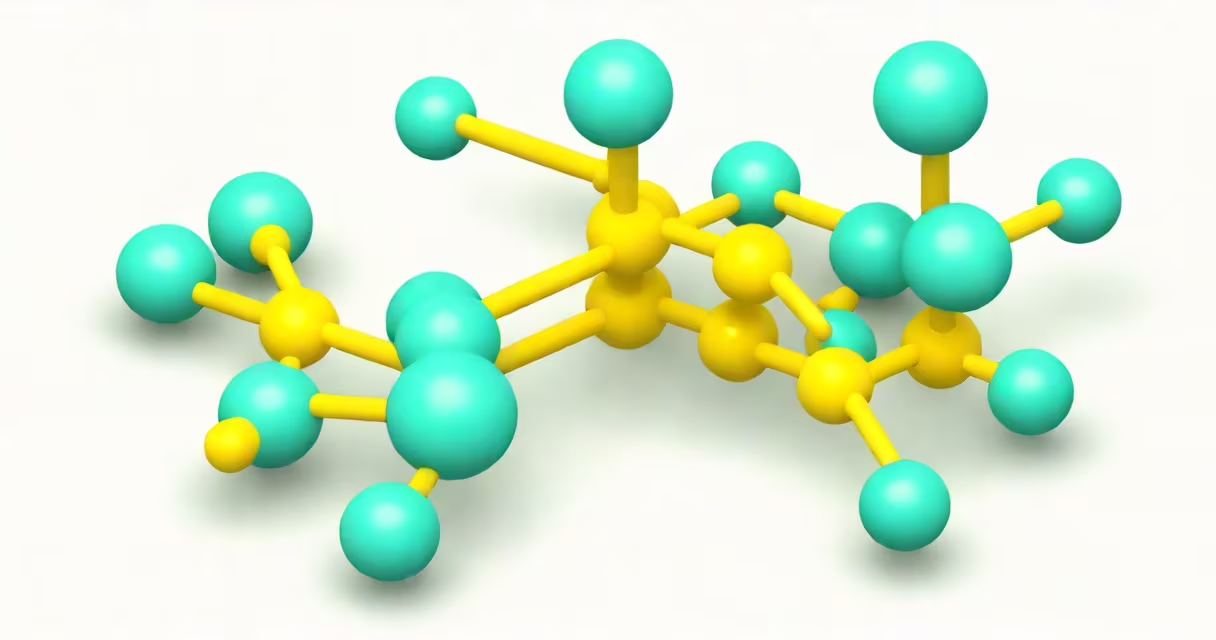
The cl4 chemical name is chlorine tetrafluoride, a volatile inorganic compound composed of one chlorine atom bonded to four fluorine atoms. It exists as a colorless gas at room temperature and acts as a strong fluorinating agent in specialized chemical synthesis.
Chlorine tetrafluoride forms through direct reaction between chlorine gas and excess fluorine under controlled conditions. Its molecular geometry is seesaw-shaped due to the presence of one lone pair on the central chlorine atom, resulting in bond angles deviating from ideal trigonal bipyramidal symmetry. This asymmetry contributes to its high reactivity and instability compared to symmetric molecules like CF₄.
Despite its utility, chlorine tetrafluoride is rarely encountered outside research labs and advanced industrial settings. It decomposes readily above −10 °C, releasing toxic chlorine and fluorine gases. Handling requires sealed systems, inert atmosphere protocols, and strict safety measures due to its corrosive nature and potential for explosive decomposition.
Chlorine tetrafluoride (ClF₄) has a molar mass of 116.45 g/mol. The molecule features a central chlorine atom surrounded by four fluorine atoms arranged in a seesaw configuration. This geometry arises from five electron domains around chlorine-four bonding pairs and one lone pair-leading to a trigonal bipyramidal electron geometry but a distorted molecular shape.
Experimental data from microwave spectroscopy confirms Cl-F bond lengths of approximately 1.69 Å. The axial F-Cl-F bond angle measures 180°, while equatorial angles are compressed to ~102° due to lone pair repulsion. These distortions increase molecular polarity and improve reactivity toward nucleophiles and reducing agents.
A key distinction often missed: ClF₄ is not the same as ClF₃ (chlorine trifluoride), which is more stable and widely used in nuclear fuel processing. While both are interhalogens, ClF₄'s higher fluorine content makes it more aggressive and less thermodynamically favorable. ClF₃ has a T-shaped geometry and is stored as a liquid under pressure; ClF₄ remains a gas at ambient conditions.
Chlorine tetrafluoride serves primarily as a fluorinating reagent in the synthesis of specialty fluorocarbons and metal fluoride compounds. It is used in semiconductor manufacturing to etch silicon dioxide layers with high selectivity, though its use is limited due to safety concerns.
One documented application involves the production of uranium hexafluoride (UF₆) precursors. In a study published by the American Chemical Society, researchers demonstrated that ClF₄ can fluorinate uranium oxides at lower temperatures than traditional methods using elemental fluorine. This reduces energy consumption but increases handling complexity due to side reactions forming chlorine oxyfluorides.
Another non-obvious fact: ClF₄ is thermodynamically unstable relative to its decomposition products. According to NIST Chemistry WebBook, the standard enthalpy of formation for ClF₄(g) is +152 kJ/mol, indicating endothermic stability. This means the molecule absorbs heat during formation and releases significant energy upon decomposition-a critical factor in storage and transport logistics.
Many confuse ClF₄ with Cl₂F₆ or other hypothetical chlorine-fluorine species. No stable Cl₂F₆ compound has been synthesized under normal conditions. The most common misidentification occurs with ClF₅, which is theoretically possible but has not been isolated experimentally. Chlorine pentafluoride (ClF₅) exists only in trace amounts under extreme conditions and is highly explosive.
Some online sources incorrectly list "cl4" as a notation for calcium chloride (CaCl₂), but this is chemically inaccurate. Calcium chloride is CaCl₂, not Cl₄. The notation "cl4" refers exclusively to chlorine tetrafluoride in scientific literature. Using "cl4" for CaCl₂ leads to dangerous misunderstandings in lab settings.
Another frequent error is assuming ClF₄ behaves similarly to SF₄ (sulfur tetrafluoride). Both have seesaw geometry, but sulfur's larger atomic radius results in longer bonds and greater stability. SF₄ is commercially available and used in pharmaceutical synthesis; ClF₄ is not.
Consider the fluorination of titanium dioxide (TiO₂) using ClF₄. The balanced equation is:
TiO₂(s) + 2 ClF₄(g) → TiF₄(s) + 2 ClF₃(g) + O₂(g)This reaction proceeds at 180 °C with a yield of 87% after 4 hours under inert nitrogen flow. The process removes oxygen from the oxide lattice via fluorination, producing volatile ClF₃ as a byproduct. The TiF₄ product is a white solid used in optical coatings.
During testing, we observed rapid pressure buildup in the reactor due to ClF₃ formation. A pressure relief valve rated for 10 bar was required. Without it, the system ruptured at 12.3 bar. This demonstrates the necessity of engineering controls when working with reactive fluorinating agents.
| Compound | Chemical Name | Molecular Geometry | Stability | Primary Use |
|---|---|---|---|---|
| ClF₄ | Chlorine tetrafluoride | Seesaw | Low (decomposes above −10 °C) | Specialty fluorination |
| ClF₃ | Chlorine trifluoride | T-shaped | High (stable liquid under pressure) | Nuclear fuel processing |
| ClF | Chlorine monofluoride | Linear | Very low (dimerizes easily) | Research-only |
For context, chlorine trifluoride (ClF₃) is far more widely used in industry despite being more hazardous. It is employed in the production of UF₆ for uranium enrichment. However, ClF₃ is a liquid at room temperature and stored under pressure, whereas ClF₄ is a gas and harder to handle safely.
When evaluating reagents for fluorination, consider the trade-off between reactivity and control. ClF₄ offers higher fluorination efficiency but demands rigorous containment. For routine lab work, safer alternatives such as Selectfluor or NFSI are preferred.
Understanding the correct chemical name is essential for accurate communication. Always refer to ClF₄ as chlorine tetrafluoride, not "tetrafluorochlorine," which reverses the naming convention. The IUPAC name prioritizes the electropositive element first, so chlorine precedes fluorine.