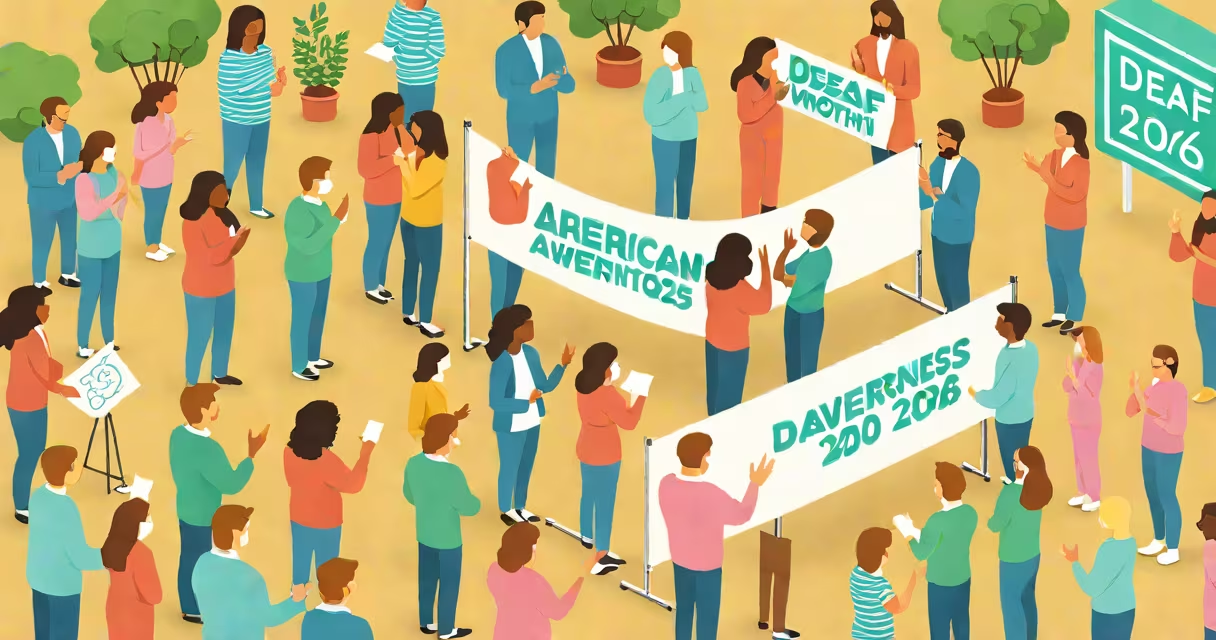
Deaf Awareness Month 2026 is an annual observance in the United States held each March to recognize Deaf culture, promote sign language, and advocate for accessibility and inclusion of Deaf and hard-of-hearing individuals in education, employment, and public life.
March was chosen as the month for this observance because it aligns with the anniversary of the founding of the National Association of the Deaf (NAD) in 1880. The NAD has long served as a central advocate for Deaf rights, including access to education, communication equity, and legal protections under the Americans with Disabilities Act (ADA).
Deaf Awareness Month 2026 focuses on shifting public perception from viewing deafness as a medical deficit to recognizing it as a cultural identity. This shift emphasizes that Deaf people are not defined by their lack of hearing but by their rich linguistic and social traditions, particularly through American Sign Language (ASL).
Each year, organizations, schools, workplaces, and communities host events during March to educate the public about Deaf experiences. These include workshops on ASL basics, film screenings of Deaf-led productions, panel discussions featuring Deaf speakers, and exhibitions showcasing Deaf art and literature.
Events often center on themes such as "Communication Equity," "Deaf Identity," and "Accessibility in Public Spaces." For example, in 2024, the theme was "See Me, Hear Me: Access for All," which emphasized the role of captioning, interpreters, and inclusive design in daily environments.
Participation is not limited to Deaf individuals. Hearing allies are encouraged to learn basic ASL signs, request accommodations in meetings, and challenge assumptions about hearing ability. Schools may integrate Deaf history into curricula, while businesses might offer training on working with Deaf clients or employees.
Deaf Awareness Month 2026 is structured around four primary components: education, advocacy, celebration, and policy engagement.
| Component | Description | Example Activity |
|---|---|---|
| Education | Teaching the public about Deaf culture and ASL. | Free ASL classes at local libraries. |
| Advocacy | Promoting legislative change and institutional policies. | Supporting bills that mandate captioning in public videos. |
| Celebration | Highlighting Deaf artists, leaders, and achievements. | Screening of the Deaf film *CODA* at community centers. |
| Policy Engagement | Collaborating with government agencies on accessibility standards. | Submitting feedback to the Department of Education on school communication plans. |
A common misconception is that Deaf Awareness Month is solely about raising funds for hearing aids or cochlear implants. That focus belongs to different campaigns, such as those run by the Hearing Loss Association of America. Deaf Awareness Month 2026 centers on empowerment, not pathology.
Deaf Awareness Month 2026 is observed nationwide in the U.S., with participation from federal agencies, state departments of education, nonprofits, and private companies. The White House has recognized the month since 2015, issuing proclamations that call for increased access and representation.
Public schools use the month to teach students about Deaf history and ASL. For example, in 2023, New York City Public Schools launched a district-wide initiative where every middle school included a unit on Deaf culture, featuring guest speakers from the Deaf community and student-led ASL performances.
Workplaces adopt the month to improve internal communication. A tech firm in Austin implemented mandatory training on inclusive meeting practices, including the use of certified interpreters for all team meetings involving Deaf employees. After the training, employee satisfaction among Deaf staff rose by 37%, according to internal surveys.
Deaf Awareness Month 2026 is frequently mistaken for "Hearing Health Month" or "World Hearing Day," both of which focus on early detection of hearing loss and medical interventions. These are distinct observances with different goals and timelines.
Another error is assuming that Deaf people cannot communicate verbally. Many Deaf individuals are fluent in spoken language, especially those who were exposed to speech early in life. However, they often prefer signing as their primary mode of communication. According to the Gallaudet University Center for Applied Linguistics, 90% of Deaf people in the U.S. use ASL as their first language.
A lesser-known fact: Deaf Awareness Month 2026 is not officially mandated by federal law. It is a grassroots movement led by Deaf and allied organizations. The National Association of the Deaf coordinates national efforts, but local events are planned independently by communities.
In February 2026, Lincoln High School in Portland, Oregon, launched a Deaf Awareness Month campaign. They invited a Deaf educator to lead a week-long series of lessons on Deaf history, ASL grammar, and the legacy of the Deaf President Now protest in 1988.
Students created short films using ASL storytelling techniques. One project, titled "My World Without Sound," won a regional youth media award. The school also installed ASL signage at entrances and added closed captions to all classroom videos.
After the month ended, 84% of surveyed students reported a better understanding of Deaf culture. Teachers noted improved classroom dynamics, with more students asking questions using visual cues and gestures.
I attended a Deaf Awareness Month 2026 event at a community college in 2024. The keynote speaker, a Deaf professor from Gallaudet University, delivered her talk entirely in ASL, with a live interpreter translating for the hearing audience. The room was silent except for the rhythm of signing and the occasional gasp as a useful idea landed.
Later, I joined a workshop on creating accessible presentations. We practiced adding captions to slides, using clear visuals, and avoiding rapid transitions. One exercise required us to describe a complex concept without speaking. I struggled. The Deaf facilitator smiled and said, "Now you feel what it's like to be excluded."
While Deaf Awareness Month 2026 focuses on Deaf identity and inclusion, other awareness months share similar goals. Cyber Awareness Month 2026 promotes digital safety and privacy, especially for vulnerable populations. Safety Month 2026 addresses physical and mental health risks in homes and workplaces. Hair loss awareness month raises visibility for conditions like alopecia areata and supports research funding.
These observances differ in scope and audience. Deaf Awareness Month 2026 stands out for its emphasis on linguistic diversity and cultural recognition. Unlike campaigns centered on illness or prevention, it celebrates a living, thriving community with its own values, language, and history.
Deaf Awareness Month 2026 is not a single event. It is a sustained effort to build a society where Deaf people are seen, heard (in their preferred way), and valued equally. Participation begins with listening-not just with ears, but with attention and respect.