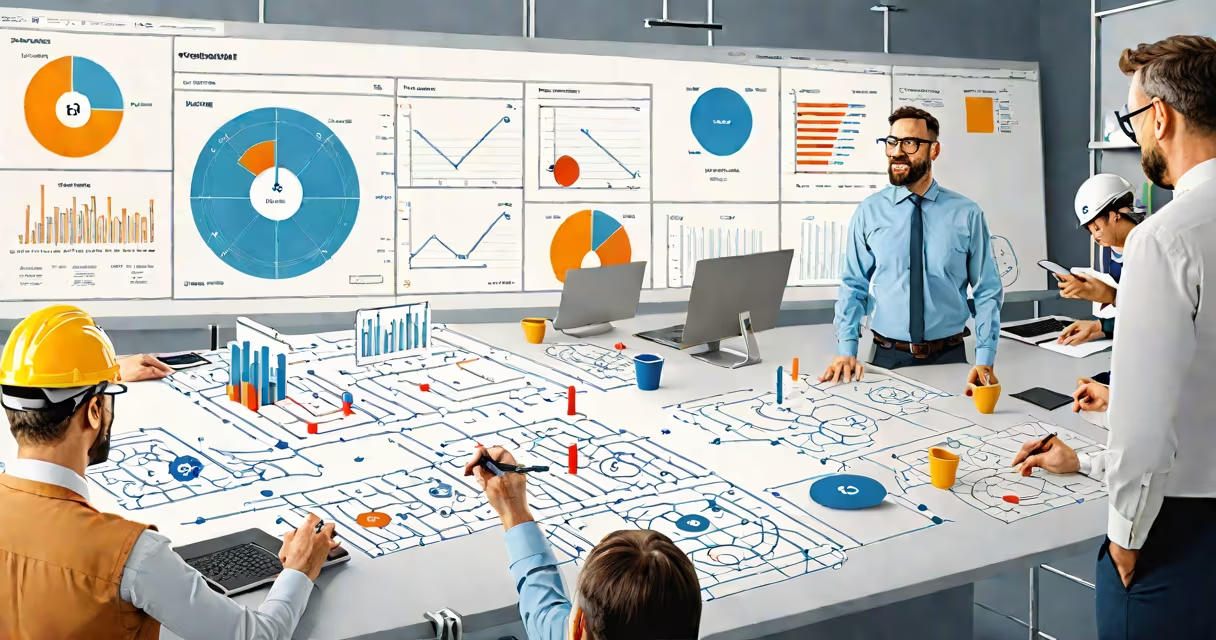
Project management is the disciplined application of processes, methods, skills, and tools to meet project objectives within defined constraints of time, cost, scope, quality, and risk. It helps work progresses predictably from initiation through closure.
At its core, project management involves breaking large goals into manageable phases: defining requirements, scheduling resources, tracking progress, adjusting course when needed, and delivering results. This structure prevents chaos in complex efforts such as building software, launching a product, or constructing infrastructure.
The Project Management Institute (PMI) identifies five process groups: initiating, planning, executing, monitoring and controlling, and closing. These form the core of standard methodologies like Agile, Waterfall, and Hybrid. For example, a team developing a mobile app uses project management to assign sprints, track bugs, and align releases with marketing campaigns.
Project management begins with a clear objective. A project manager defines deliverables, timelines, budgets, and success criteria during the initiation phase. This sets expectations and secures stakeholder buy-in.
During planning, the manager creates a detailed roadmap. Tasks are broken into smaller units, assigned to team members, and scheduled using tools like Gantt charts or Kanban boards. Dependencies are mapped-such as waiting for server setup before coding begins-to avoid bottlenecks.
Execution involves coordinating people, systems, and workflows. Daily stand-ups, status reports, and automated testing ensure alignment. Monitoring and controlling track actual progress against the plan. If a task slips by two days, the manager adjusts resources or shifts priorities to stay on track.
Final closure includes handover documentation, feedback collection, and lessons learned sessions. These insights inform future projects. For instance, after launching a website, the team reviews what delayed deployment-was it slow approval cycles or untested APIs-and updates their workflow.
Every project relies on five interdependent elements: scope, schedule, cost, quality, and risk. Managing these simultaneously prevents scope creep-the gradual expansion of features beyond original intent. A $500,000 website redesign that adds a live chat feature without budget adjustment risks failure unless formally approved.
Three major frameworks guide implementation:
| Structure | Best For | Key Feature |
|---|---|---|
| Waterfall | Linear, predictable projects | Sequential phases; changes hard to implement after launch |
| Agile | Fast-evolving requirements | Iterative delivery; regular feedback loops |
| Hybrid | Complex projects needing structure and flexibility | Combines phased planning with sprint-based execution |
For example, a hospital implementing electronic health records used a hybrid model. The initial design and vendor selection followed Waterfall steps. Once development began, teams delivered working modules every two weeks-using Agile principles-to test functionality with doctors and nurses.
Project management is not synonymous with general management. While both involve organizing work, project management focuses on temporary, goal-oriented initiatives with defined start and end dates. General management oversees ongoing operations-like customer service or payroll-where performance is measured over time, not completion.
A frequent error is confusing project control with project management. Project control is a subset focused specifically on measuring performance against plans. It's the mechanism that detects deviations early. For example, if a construction project exceeds its weekly concrete pour target by 15%, project control triggers a review of labor allocation or material delivery delays.
Another misunderstanding: project management is not just for IT or engineering. It applies to events, marketing campaigns, research studies, and even personal goals. A nonprofit organizing a fundraiser uses project management to manage venue booking, donor outreach, and volunteer shifts-all within a 60-day window.
Consider a company launching a smart thermostat. The project spans 18 months, costs $2.3 million, and requires cross-functional teams: engineering, design, supply chain, compliance, and sales.
Phase 1: Initiation - The product vision is approved. A business case shows a projected $4.1M revenue in Year 1. A project charter is signed by leadership.
Phase 2: Planning - The team maps out 12 milestones: prototype design (Month 3), regulatory testing (Month 6), pilot production (Month 10), and national rollout (Month 18). Budgets are allocated per milestone. Risks include component shortages and certification delays.
Phase 3: Execution - Engineers build prototypes. Suppliers deliver sensors. Marketing drafts launch materials. Weekly syncs ensure alignment.
Phase 5: Closure - Final products ship. Customer support training completes. A post-mortem report documents that sourcing from two suppliers reduced risk by 30%-a lesson applied to future hardware projects.
This example illustrates how define project management enables precision in uncertain environments. Without it, teams risk missing deadlines, overspending, or delivering features users don't want.
One non-obvious fact: successful project managers often have strong emotional intelligence. They resolve conflicts between departments, negotiate trade-offs under pressure, and motivate teams during setbacks. According to PMI's *Pulse of the Profession* report, projects led by emotionally intelligent managers are 2.5 times more likely to meet goals than those without.
Another insight: many organizations fail not because of poor planning, but because they skip the closure phase. A study by McKinsey found that 70% of companies do not conduct formal post-project reviews. As a result, they repeat mistakes-like underestimating integration effort-across multiple initiatives.
Define project management as a repeatable system for achieving results under uncertainty. It turns ambition into action through clarity, coordination, and accountability.