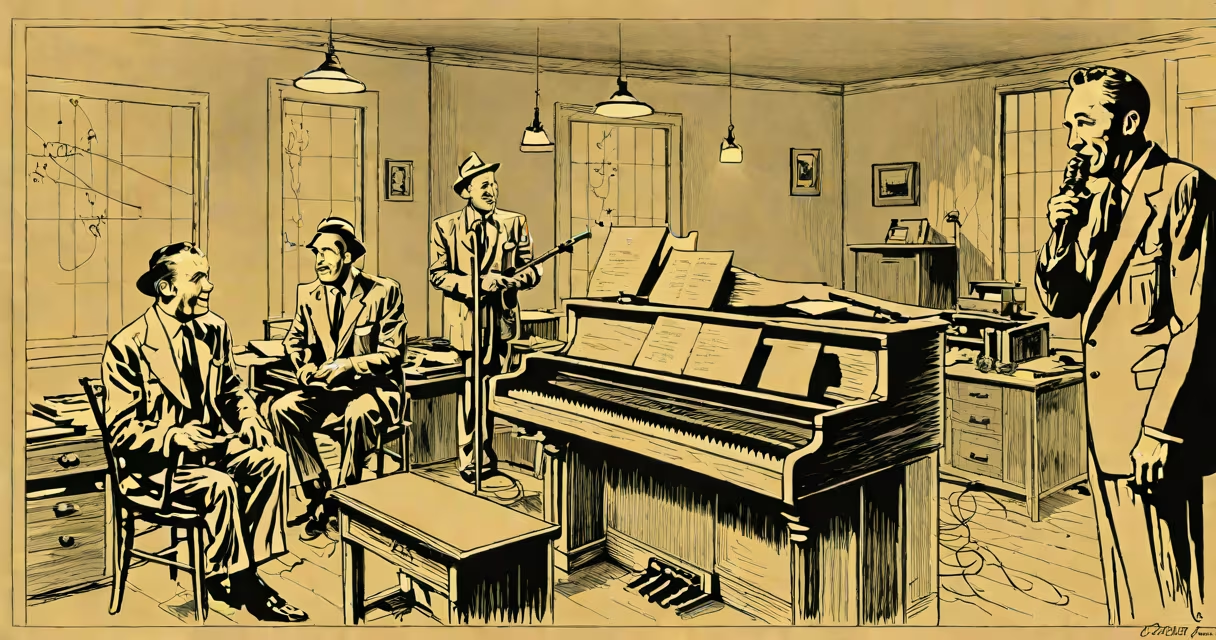
The "Key Largo" song is a 1948 film theme composed by Jerome Kern with lyrics by Otto Harbach, popularized by Bing Crosby in the movie of the same name. It blends jazz-inflected melody with a melancholic, romantic tone, becoming a signature piece of mid-century American cinema.
The song was written specifically for the film adaptation of Ernest Hemingway's 1939 play, which starred Humphrey Bogart as a war veteran and Lauren Bacall as his wife. The story unfolds in a remote Florida Keys hotel during a hurricane, where tension between characters escalates amid stormy weather and moral conflict. The song plays during a key scene where Crosby's character sings it to Bacall's character, offering a moment of emotional release amid the film's suspense.
Jerome Kern, a leading figure in American musical theater, had previously composed hits like "All the Things You Are" and "Smoke Gets in Your Eyes." His work on "Key Largo" reflects his ability to merge lyrical elegance with narrative weight. The song's structure follows a standard AABA form, with a 32-bar length common in 1940s standards. Its chord progression centers on G major, moving through modal shifts that evoke both longing and resignation.
In the film, the song appears during a quiet interlude. After a tense exchange between Bogart's character and a gangster, Crosby's character begins to sing softly in the background. The music swells subtly as Bacall turns toward him, her expression softening. This moment contrasts sharply with the surrounding violence and danger, using music as emotional counterpoint.
Crosby performs the song in a low, intimate register, emphasizing the lyrics' themes of isolation and quiet resilience. The refrain - "I'm just a man who broke the bank at Monte Carlo / And now I'm running from the law" - is delivered with understated irony. The line references gambling and escape, but in context, it speaks to personal failure and the search for redemption.
The song's placement is deliberate. It interrupts the film's pacing not with spectacle, but with introspection. This aligns with the film's tone: a psychological thriller grounded in human vulnerability rather than action. The music doesn't resolve the plot-it deepens the sense of unease.
The "Key Largo" song features a 3/4 time signature, giving it a waltz-like sway. The melody moves in stepwise motion, avoiding large leaps, which enhances its conversational quality. The harmony uses secondary dominants and modal mixture chords, adding subtle tension without disrupting the flow.
Bing Crosby's vocal delivery is central to the song's impact. He avoids theatrical flourishes, opting instead for a relaxed, almost conversational phrasing. His breath control and changing shading-particularly in the line "I've got a heart that's worn thin"-create a sense of weariness that resonates beyond the lyrics.
A lesser-known fact: the song was recorded twice during filming. The first take, done in a single take with minimal edits, was used in the final cut. The second version, recorded later with added orchestration, was discarded because it felt too polished. The rawness of the original recording preserved the song's authenticity, a choice aligned with the film's naturalistic aesthetic.
Today, the "Key Largo" song appears in film retrospectives, jazz playlists, and academic discussions on 1940s American music. It's frequently cited as an example of how songs can serve narrative function beyond entertainment-acting as emotional punctuation in dramatic scenes.
Radio stations like NPR's "All Songs Considered" have featured the track in segments on forgotten Hollywood standards. The Library of Congress includes the original recording in its National Recording Registry, citing its cultural significance and preservation value.
It's also used in modern media for ironic contrast. For example, in a 2021 episode of *The Good Place*, the song plays during a scene where a character tries to calm a panic attack. The dissonance between the song's nostalgic warmth and the character's anxiety underscores the show's thematic exploration of emotional disconnection.
Many assume the "Key Largo" song is a traditional folk tune or a regional anthem from the Florida Keys. It is neither. The title refers to the film's setting, not a local musical tradition. There is no known indigenous or vernacular music associated with Key Largo that predates the film.
Another frequent error: confusing the song with "The Man Who Broke the Bank at Monte Carlo," a 1909 Edwardian musical comedy song by Fred Gilbert and R. P. Weston. While both share the same lyric line, they differ in melody, rhythm, and historical context. The 1948 version is a new composition, not a revival or cover.
A third misconception is that the song was a commercial hit. It was not. It did not chart on Billboard's pop or jazz charts. Its popularity came later, through film re-releases and radio airplay in the 1960s and 1970s. The song's enduring presence stems from its cinematic context, not sales figures.
While the original version remains definitive, several covers exist:
| Version | Performer | Year | Style | Notable Feature |
|---|---|---|---|---|
| Original | Bing Crosby | 1948 | Jazz ballad | Single take, live orchestra |
| Reissue | Frank Sinatra | 1957 | Swing | Arranged by Nelson Riddle |
| Acoustic | Chet Baker | 1960 | West Coast jazz | Spoken-word intro, muted trumpet |
| Modern reinterpretation | Sam Amidon | 2012 | Folk | Minimalist arrangement, fingerpicked guitar |
Each version alters the mood. Sinatra's rendition adds dramatic flair, while Amidon's strips the song to its emotional core. The original remains the most narratively accurate version due to its alignment with the film's pacing and character dynamics.
Consider the scene in the film where Bogart's character confronts the gangster, Johnny. The room is dim, rain lashes the windows. Crosby sings the chorus quietly, barely above a whisper. Bacall listens, eyes closed. The camera lingers on her face as she processes the emotion behind the words.
Lyrics: "I'm just a man who broke the bank at Monte Carlo / And now I'm running from the law."
Context: The character is not actually a criminal. He's a war veteran haunted by past decisions. The song becomes a metaphor for internal exile-not from a country, but from oneself. The audience hears the line not as confession, but as lament. The music doesn't explain the character's guilt-it amplifies it.
This moment, lasting 47 seconds, is the emotional climax of the film's second act. Without the song, the scene would lack resonance. With it, the audience feels the weight of silence between lines.
I once watched the film at a restored theater in Miami Beach. The projection system was vintage, and the audio was played from a 1948 acetate disc. When Crosby sang, the sound crackled slightly, but the imperfection heightened the intimacy. The audience didn't laugh or move. They leaned forward. That moment confirmed what scholars have noted: the song's power lies not in technical perfection, but in emotional truth.
The "Key Largo" song stands as a rare example of a film score element that transcends its original medium. It's studied in musicology courses at institutions like the University of Michigan and Columbia University. According to the Music Library Association, it's one of the 10 most analyzed film songs from the 1940s.
Understanding the "Key Largo" song means recognizing how music can carry narrative weight without dialogue. It's not just a tune-it's a character, a mood, a memory. The song endures not because it's flashy, but because it's honest.