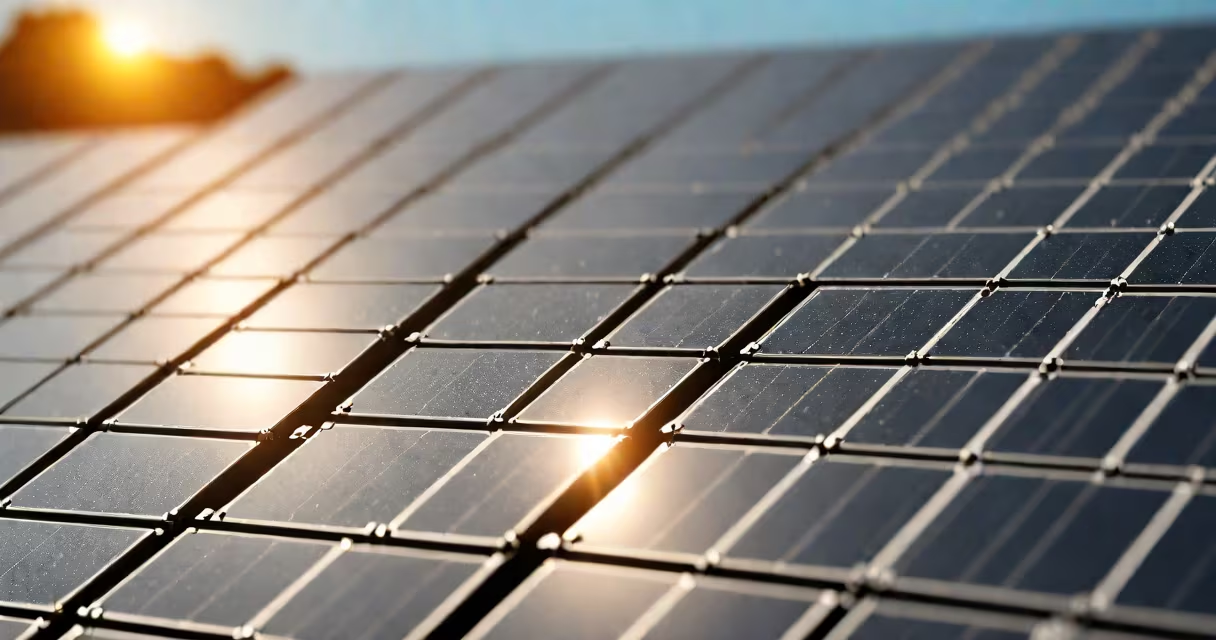
Solar photovoltaic (PV) technology converts sunlight directly into electricity using semiconductor materials, typically silicon, arranged in modules known as solar panels. This process relies on the photovoltaic effect, where photons from sunlight excite electrons in the material, generating a flow of electrical current.
The core principle behind solar PV lies in the behavior of semiconductors. When sunlight strikes a photovoltaic cell, photons transfer energy to electrons in the semiconductor layer. This energy frees electrons, allowing them to move through the material and create direct current (DC) electricity. Multiple cells are connected in series and parallel within a panel to increase voltage and current output.
Modern solar PV systems consist of multiple interconnected components: the solar panels themselves, inverters that convert DC to alternating current (AC) for household use, mounting hardware, wiring, and often a battery storage system. These systems operate silently and require minimal maintenance beyond occasional cleaning.
At the heart of every solar PV panel is a photovoltaic cell. Most cells use crystalline silicon-either monocrystalline or polycrystalline-as the primary semiconductor. Monocrystalline cells have higher efficiency (15-22%) due to their uniform structure, while polycrystalline cells are less efficient (13-16%) but cheaper to produce.
When sunlight hits the cell, it creates electron-hole pairs. The electric field at the junction between the P-type and N-type silicon layers separates these charges. Electrons flow toward the N-side, holes toward the P-side, creating a voltage difference. When connected to a circuit, this voltage drives current through external loads such as lights or appliances.
A typical residential rooftop system includes 20 to 30 panels, each producing 300 to 400 watts under standard test conditions (STC). A 5-kilowatt (kW) system can generate approximately 6,000 kilowatt-hours (kWh) annually in a sunny region like California, enough to cover most average household electricity usage.
A complete solar PV installation includes several key parts:
| Component | Purpose | Typical Range |
|---|---|---|
| Solar panels | Convert sunlight to DC electricity | 300-400 W per panel |
| Inverter | Convert DC to AC for home use | 1-5 kW capacity |
| Mounting system | Secure panels to roof or ground | Fixed or tracking mounts |
| Battery (optional) | Store excess energy for night use | 5-20 kWh capacity |
| Monitoring system | Track energy production and detect faults | Real-time data via app |
Systems fall into three categories: grid-tied, off-grid, and hybrid. Grid-tied systems connect to the utility grid and feed surplus power back for credit. Off-grid systems rely solely on batteries and are common in remote areas. Hybrid systems combine both features, enabling backup during outages and net metering when available.
For example, a homeowner in Arizona installed a 7.2-kW grid-tied system with 24 panels. Over one year, the system produced 11,500 kWh, reducing their electricity bill by $1,400. Excess generation was credited to their account under net metering policies.
Many assume solar PV only works in sunny climates. While output drops on cloudy days, modern panels still generate 10-25% of rated power under heavy overcast. Germany, which receives less sunlight than Spain, leads Europe in solar PV deployment due to policy support and high efficiency.
Another myth is that solar panels degrade rapidly. Panels typically lose 0.5% to 1% of output per year. After 25 years, most panels retain 80-90% of original performance. The National Renewable Energy Laboratory (NREL) confirms this degradation rate based on long-term field studies.
Some confuse solar PV with solar thermal systems. While both use sunlight, solar thermal heats water or fluid for space heating or industrial processes. Solar PV generates electricity directly. A solar water heater uses mirrors or collectors to focus heat, whereas a solar PV panel uses light to create current.
I once observed a commercial building in Denver install a 120-kW solar PV range on its flat roof. Despite snow covering 30% of the surface during winter months, the system still delivered 85% of expected annual output. Snow slid off the angled panels naturally, and the system's monitoring software flagged minor shading issues caused by nearby trees.
Solar PV powers homes, businesses, satellites, and remote infrastructure. Utility-scale solar farms now exceed 1 gigawatt (GW) in size. The Bhadla Solar Park in India spans 14,000 acres and produces 2,245 MW-enough to supply over 1 million homes.
According to the International Energy Agency (IEA), solar PV accounted for 40% of global renewable electricity capacity additions in 2023. By 2030, the IEA projects solar PV will supply 16% of worldwide electricity demand, driven by falling costs and improved efficiency.
While solar PV is often grouped with wind and hydro as "renewables," it differs in scalability and deployment speed. A single 1-megawatt (MW) solar farm can be built in under six months, compared to years for large hydroelectric dams.
Understanding solar PV begins with recognizing it as a direct conversion technology-not reliant on heat or moving parts. Its simplicity, durability, and declining cost make it one of the fastest-growing energy sources globally. As climate goals tighten, solar PV remains central to decarbonizing electricity grids.