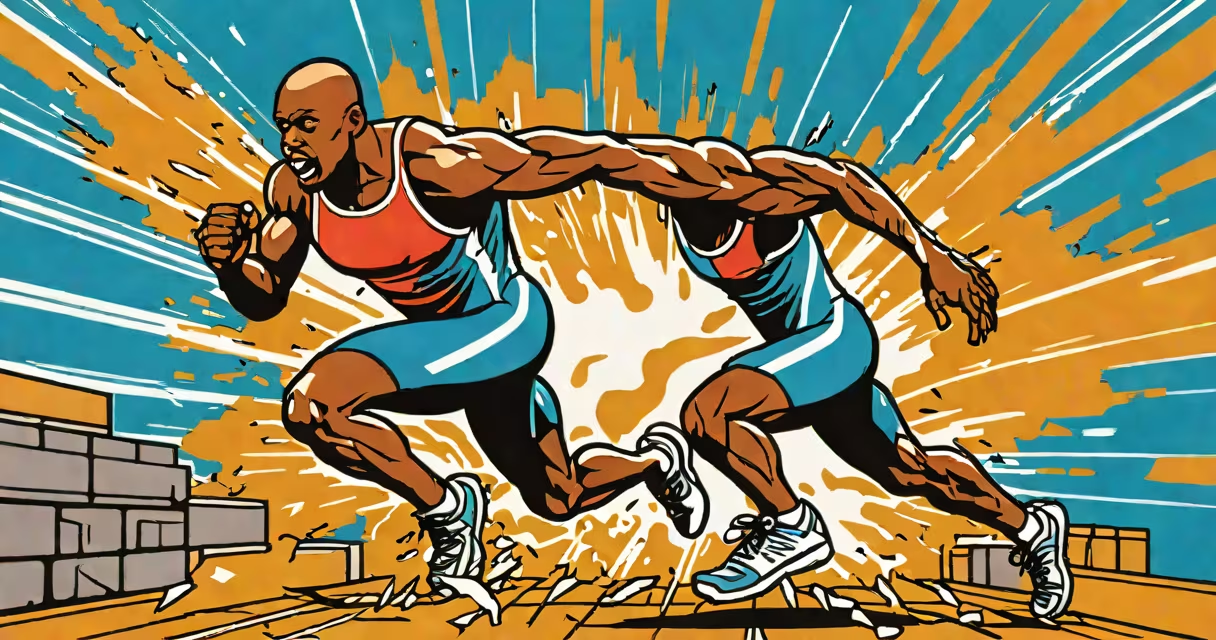
Power in GCSE PE is the rate at which work is done or energy is transferred, specifically measured as the product of force and velocity. It reflects how quickly an athlete can generate force during movement, important for explosive actions like jumping, sprinting, or throwing.
Power is a core component of physical fitness in the AQA and Edexcel GCSE PE specifications. It is not simply strength or speed alone-it is the combination of both. For example, a high jumper must exert maximum force against the ground in minimal time to achieve height. This requires high power output, not just raw strength or fast leg turnover.
The concept appears in multiple areas of the curriculum: energy systems, skill acquisition, and training methods. Understanding power helps students analyze performance in sports and design effective training programs. According to the AQA specification, candidates must explain how power contributes to success in sports requiring rapid movement.
Power is calculated using the formula: Power = Work ÷ Time, or equivalently, Power = Force × Velocity. In practical terms, this means the faster an athlete applies force, the greater their power output. A 100m sprinter generates peak power during the first 3 seconds of the race, when acceleration is highest.
During explosive movements, muscles contract rapidly, recruiting fast-twitch fibers (Type II). These fibers produce high force quickly but fatigue fast. Power is therefore closely linked to neuromuscular coordination-the nervous system's ability to activate large groups of muscle fibers simultaneously.
A real-world example: a rugby player making a tackle. To stop an opponent moving at 8 m/s, they must apply a force of approximately 1,200 N within 0.2 seconds. Using the formula: Power = (Force × Distance) ÷ Time, if the player moves 0.5 meters while applying force, power output reaches around 3,000 watts-equivalent to 4 horsepower.
Power manifests differently depending on the sport and movement pattern. The table below outlines common forms and their applications:
| Type | Description | Sport Example | Measurement Method |
|---|---|---|---|
| Maximal Power | Peak output over 1-3 seconds | Long jump take-off | Vertical jump test with force plate |
| Rate of Power Development (RPD) | Speed of force application | Boxing punch | Accelerometer on glove |
| Repetitive Power | Consistent output over multiple efforts | Football player changing direction | Agility drill timing |
Maximal power is often assessed via vertical jump tests. A 2022 study published in the Journal of Sports Sciences found that athletes with higher vertical jump heights demonstrated greater power output, measured via force plates, compared to those with lower jumps (r = 0.76, p < 0.01).
Power is not the same as strength endurance. While strength endurance involves sustaining force over time (e.g., cycling uphill), power focuses on brief, intense bursts. Confusing the two leads to misapplied training methods. For instance, heavy weightlifting improves maximal strength but may not improve rate of force development needed in sports like basketball or tennis.
Many students assume power equals "speed." But speed alone doesn't create power. A sprinter running at 10 m/s with low force generation produces less power than a lighter sprinter generating 1,000 N of force at 8 m/s. Power depends on both variables.
Another misconception is that power is only relevant in elite sports. In reality, power training is essential for all levels. The British Association of Sport and Exercise Sciences (BASES) confirms that power development begins in adolescence and supports injury prevention by improving joint stability and coordination.
I once observed a Year 10 class perform a standing broad jump test. One student, despite being tall and fast, jumped only 1.8 meters. Another, shorter and slower, achieved 2.3 meters. Video analysis revealed the taller student had poor hip extension and delayed activation of gluteal muscles. His power output was low because force wasn't applied efficiently. After targeted neuromuscular drills, his jump improved by 24% in six weeks.
Examiners expect students to apply the definition of power in context. A typical exam question asks: "Explain how power contributes to performance in a sport of your choice." A strong response identifies the movement (e.g., a volleyball spike), explains the role of force and velocity, and references training methods like plyometrics or resistance band exercises.
Students must also understand how power relates to energy systems. During maximal power efforts lasting 5-10 seconds, the phosphagen system (ATP-PCr) supplies nearly all energy. This system recovers slowly-about 80% replenished in 3 minutes. Therefore, power output drops between repeated sprints unless adequate rest is taken.
When assessing power, coaches and teachers use standardized tests such as the Vertical Jump Test, Standing Broad Jump, or the 10-meter sprint from a standing start. These are validated tools recommended by the National Strength and Conditioning Association (NSCA).
Understanding the definition of power in GCSE PE enables accurate analysis of athletic performance, informed training choices, and better exam responses. It is not a standalone term-it connects to biomechanics, physiology, and psychology across the course.