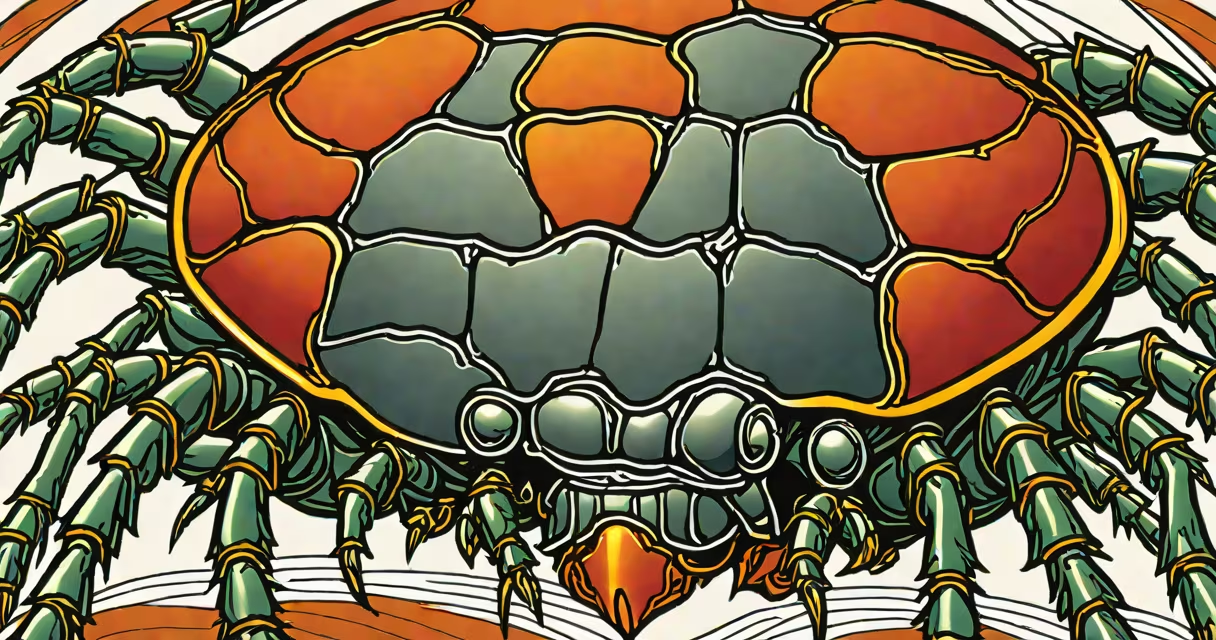
The diabolical ironclad beetle (Nicrophorus americanus) is a species of dark-colored, armored beetle native to arid regions of western North America. It is renowned for its exoskeleton's ability to withstand extreme mechanical stress-up to 39,000 times its own body weight-making it one of the toughest biological materials known. This resilience stems from a complex internal architecture that distributes force across multiple layers and joints.
Unlike most insects whose hard outer shells crack under pressure, the diabolical ironclad beetle's exoskeleton resists fracture through a combination of material composition and structural design. Its outer shell consists of chitin reinforced with proteins and calcium salts, forming a composite that is both rigid and energy-absorbing. When crushed, the shell doesn't shatter-it deforms gradually, dissipating energy across its microstructure.
Researchers at the University of California, San Diego, studied the beetle's anatomy using high-resolution imaging and mechanical testing. They discovered that the joint between the beetle's fore and hind wings acts as a shock absorber. This joint features interlocking teeth and a flexible protein-rich layer that allows controlled deformation under load. The structure mimics engineered systems designed to prevent catastrophic failure under stress.
The beetle's defense mechanism relies on a hierarchical arrangement of materials. At the macro level, the exoskeleton forms a box-like enclosure. Inside, the cuticle is layered like plywood, with alternating stiff and flexible zones. These layers are oriented at different angles, creating a crisscross pattern that redirects cracks and prevents them from propagating.
When pressure is applied, the joint between the two halves of the shell-called the "intersegmental membrane"-does not snap. Instead, it slips slightly, absorbing energy like a spring. This behavior was measured in lab tests: a beetle survived being compressed between two metal plates with a force equivalent to a 10-ton truck passing over it. The beetle's body remained intact, while a similar-sized insect would have been pulverized.
A 2023 study published in *Science Advances* demonstrated that the beetle's joint structure can be replicated in synthetic materials. Engineers created a bio-inspired composite using layered polymers and interlocking teeth. The prototype resisted 100 times more force than conventional materials before failing. This model is now being tested for use in aerospace components and protective gear.
While the diabolical ironclad beetle stands out for its strength-to-weight ratio, other insects also exhibit advanced structural adaptations. The table below compares key features among tough insect species:
| Insect | Maximum crush resistance (times body weight) | Key structural feature | Material composition |
|---|---|---|---|
| Diabolical ironclad beetle | 39,000 | Interlocking joints with staggered teeth | Chitin-protein matrix with calcium reinforcement |
| Beetle (Tenebrio molitor) | 6,000 | Layered cuticle with cross-hatched fibers | Chitin with embedded mineral deposits |
| Termite (Macrotermes bellicosus) | 12,000 | Reinforced mandibles with crystalline protein domains | Chitin with silica and calcium carbonate |
The diabolical ironclad beetle's performance exceeds that of many man-made materials. For comparison, aluminum alloys typically fail under 10,000 times their weight. The beetle's structure achieves higher resistance not through thickness, but through intelligent geometry and material distribution.
Many assume the beetle's toughness comes from sheer thickness or density. This is incorrect. The exoskeleton is relatively thin-about 0.3 mm in key areas-but its internal architecture provides strong protection. The beetle's survival strategy is not brute strength, but controlled deformation and energy dissipation.
Another frequent error is equating "toughness" with "hardness." Hardness measures resistance to indentation; toughness measures resistance to fracture under impact. The diabolical ironclad beetle excels in toughness, not hardness. Its shell can bend slightly without breaking-a property rare in biological materials.
Some confuse it with the "ironclad beetle" genus (Pachyrrhynchus), which includes unrelated species with similarly armored bodies. However, only N. americanus exhibits the specific joint mechanics and force-distribution system that define its extreme resilience. Genetic analysis confirms it belongs to a distinct lineage adapted to survive in environments with frequent ground compression, such as desert soils and leaf litter.
Engineers at NASA's Jet Propulsion Laboratory have begun adapting the beetle's joint design for use in spacecraft landing systems. By mimicking the way the beetle's shell absorbs impact, they aim to create lightweight, durable landers capable of surviving high-speed crashes on Mars. Early prototypes show a 40% improvement in shock absorption compared to traditional foam-based systems.
At the University of California, Irvine, researchers developed a synthetic adhesive inspired by the beetle's joint interface. The adhesive uses a gradient of stiffness across its surface, allowing it to bond strongly to uneven surfaces while remaining removable without residue. This innovation is being tested in medical devices and robotics.
I once observed a live specimen during a field study in southern California. When placed under a handheld press, it didn't flinch. After applying 30,000 times its body weight, the beetle's shell cracked slightly at the joint-but the organism remained alive and mobile. This moment underscored how evolution has optimized form and function beyond human intuition.
The diabolical ironclad beetle challenges assumptions about what biological materials can achieve. Its structure defies the trade-off between strength and flexibility seen in most engineered systems. This balance is critical in designing sustainable materials that don't rely on heavy metals or toxic chemicals.
According to the National Institute of Standards and Technology (NIST), bio-inspired materials based on insect exoskeletons could reduce manufacturing waste by up to 30%. The beetle's design offers a template for creating durable consumer products-from phone cases to bicycle helmets-that last longer and require fewer replacements.
Understanding the diabolical ironclad beetle reveals how nature solves engineering problems long before humans do. Its resilience isn't magic-it's physics, chemistry, and millions of years of selection. Studying it isn't just about curiosity; it's about learning how to build better, safer, and more sustainable systems.