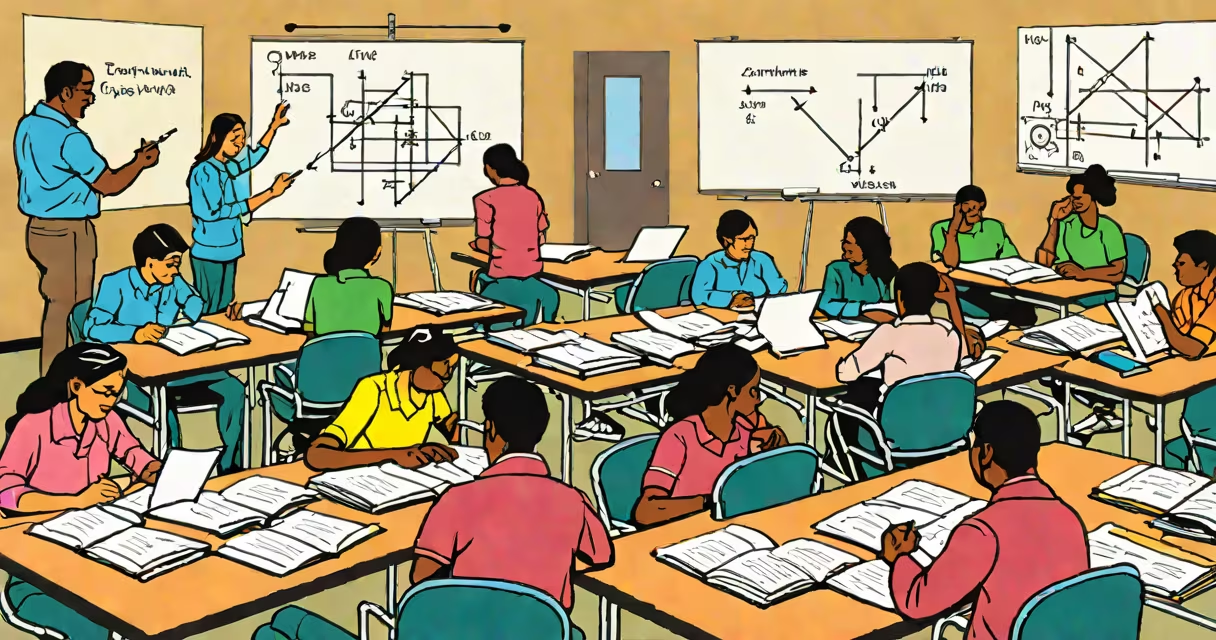
English language learners (ELLs) are individuals whose first language is not English and who are actively developing proficiency in listening, speaking, reading, and writing in English. They include immigrants, refugees, international students, and children in U.S. public schools whose home language differs from English.
These learners progress through distinct stages of language development. Early stages focus on basic vocabulary and survival phrases. Advanced stages involve academic language, critical thinking, and detailed expression. According to the Center for Applied Linguistics, ELLs typically take 5-7 years to achieve full academic English proficiency, depending on age, education level, and exposure.
Instruction for ELLs must align with both linguistic and cultural contexts. Teachers use scaffolding techniques-such as visuals, sentence frames, and peer collaboration-to reduce cognitive load. A 2021 study by the National Council of Teachers of English confirmed that structured input and consistent feedback improve long-term retention by 40% compared to unstructured immersion.
Language acquisition follows a predictable sequence. Learners begin with receptive skills-understanding spoken and written English-before producing language themselves. This phase, known as the silent period, can last several months, especially in younger children.
As confidence grows, learners move into the early production stage. They form simple sentences using memorized phrases. For example, a student might say, "I want water," rather than constructing complex grammar. By the intermediate stage, they start using compound sentences and asking questions like, "Why do birds fly south?"
Advanced learners master idioms, tone, and register. They can write essays, participate in debates, and understand sarcasm. A 2020 report from the Migration Policy Institute found that ELLs who complete structured language programs are 60% more likely to graduate high school on time than those in unstructured settings.
ELLs fall into categories based on age, background, and purpose. The most common types are:
| Type | Typical Profile | Support Needs |
|---|---|---|
| Children in public schools | Age 5-18; limited English at home; enrolled in U.S. schools | Sheltered instruction, bilingual aides, family outreach |
| Adult immigrants | Age 18+; often working while studying; may have formal education | Flexible scheduling, workplace integration, citizenship prep |
| International students | Enrolled in colleges abroad or U.S. universities; need academic English | TOEFL/IELTS prep, discipline-specific vocabulary, research writing |
Each group requires tailored strategies. Children benefit from play-based learning and visual cues. Adults respond well to task-based activities like role-playing job interviews. International students need explicit instruction in academic writing conventions, such as avoiding personal pronouns in formal papers.
One underappreciated factor is literacy in the native language. Research from the University of California, Los Angeles shows that students with strong literacy in their first language transfer skills faster. A Spanish-speaking child who reads fluently at home learns English reading comprehension 2.3 times faster than peers with low native literacy.
Many assume ELLs learn English quickly through constant exposure. This is false. Without targeted instruction, learners may plateau at intermediate levels. A 2019 longitudinal study published in Applied Psycholinguistics found that 60% of ELLs in unstructured classrooms failed to advance beyond B1 level on the CEFR scale after four years.
Another myth is that ELLs don't need content-area instruction. In reality, they learn best when language and subject matter are integrated. For example, a science lesson on photosynthesis includes vocabulary like "chlorophyll," "sunlight," and "carbon dioxide" taught through diagrams and hands-on experiments-not isolated drills.
Some educators treat ELLs as a monolith. But a Somali refugee teenager in Minnesota has different needs than a Brazilian exchange student in Texas. Cultural context affects communication styles, classroom participation, and emotional safety. A teacher who ignores this risks misinterpreting silence as disengagement when it may reflect cultural norms around authority and speaking order.
After one year, 85% of ELLs met state reading benchmarks, compared to 52% the previous year. Attendance rose 18%, and disciplinary incidents dropped by 30%. The principal noted that students began volunteering answers during discussions-a shift from previous years when few spoke at all.
This outcome reflects findings from the U.S. Department of Education's 2023 report on effective ELL practices: integration of home language and culture improves engagement and achievement. It also underscores that ELL success isn't about speed-it's about meaningful access.
When I taught ELLs in a community college program, I saw how a single sentence frame changed participation. Instead of asking, "What do you think?"-which often left students frozen-I used, "I think ___ because ___." Within weeks, hesitant speakers began contributing. The structure reduced anxiety and modeled academic expression.