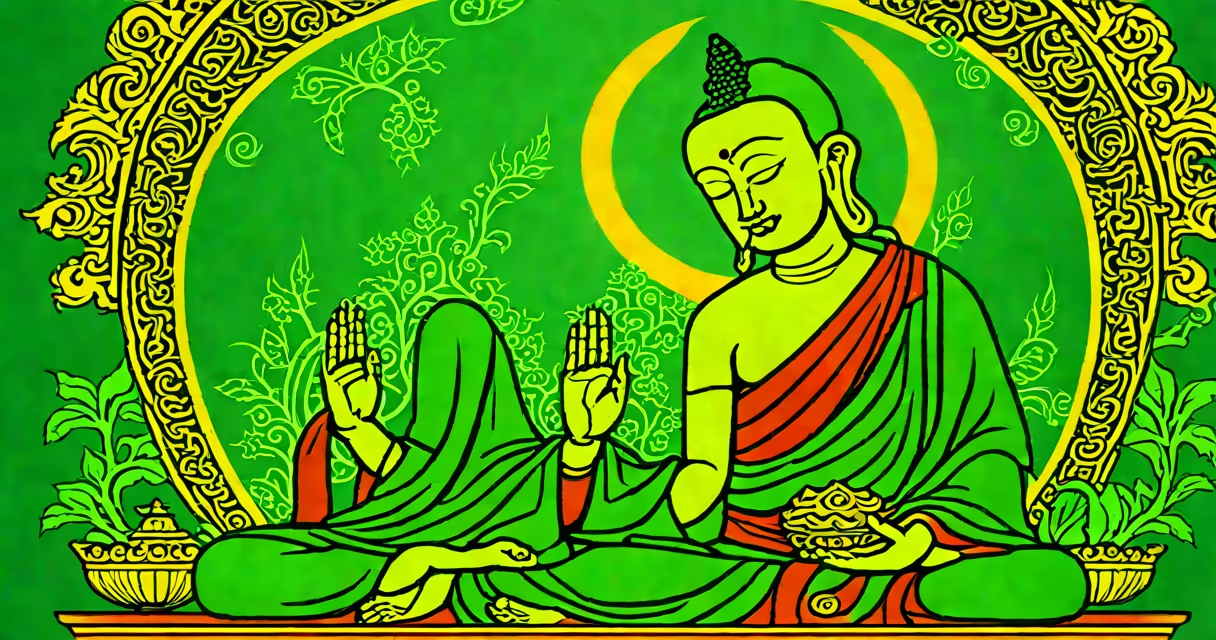
The green tara mantra in Tibetan is "Om Tare Tuttare Ture Svaha," a sacred syllable sequence chanted in Vajrayana Buddhism to invoke the compassionate energy of Green Tara, a female bodhisattva associated with swift action, protection, and liberation from suffering.
Chanted in Tibetan script, the mantra is pronounced with precise intonation and rhythmic cadence. Each syllable carries symbolic weight: "Om" represents the enlightened body, speech, and mind; "Tare" is the call to "liberate"; "Tuttare" amplifies the plea for rescue from danger; "Ture" signifies the removal of obstacles; and "Svaha" marks completion and offering.
According to the *Tara Tantra* (a core text in Tibetan Buddhist tradition), reciting this mantra 108 times daily purifies negative karma and strengthens mental clarity. The practice is common among monks and lay practitioners in monasteries across Tibet, Bhutan, and Nepal.
Mantras function as sonic tools for focusing the mind and aligning consciousness with specific spiritual energies. In Tibetan Buddhism, the green tara mantra is believed to activate the heart center and awaken innate wisdom. Repeating it repeatedly shifts brainwave patterns toward alpha and theta states, associated with deep focus and inner peace.
Neuroimaging studies show that sustained vocalization of Sanskrit and Tibetan mantras increases activity in the prefrontal cortex and insular regions-areas linked to emotional regulation and self-awareness. A 2019 study published in *Frontiers in Psychology* found that participants who chanted mantras for 20 minutes daily reported reduced anxiety and improved attention span after four weeks.
Practitioners often visualize Green Tara as a radiant, green-skinned figure with one foot forward, symbolizing readiness to act. This visualization intensifies the mantra's effect, creating a feedback loop between sound, image, and intention.
The mantra consists of five core parts:
| Syllable | Pronunciation (IPA) | Meaning | Function |
|---|---|---|---|
| Om | [ʔoːm] | Primordial sound; universal essence | Invocation of the sacred |
| Tare | [tɑːre] | "O, liberate!" | Call for rescue from samsara |
| Tuttare | [tuːtɑːre] | "O, liberate completely!" | Emphasis on full deliverance |
| Ture | [tuːre] | "O, remove!" | Request to eliminate obstacles |
| Svaha | [sʋɑːhɑː] | "So be it!" | Final offering and affirmation |
Each component builds momentum. The repetition of "Tare" and "Tuttare" creates a rising urgency, while "Svaha" closes the cycle with resolution. The entire sequence lasts about 6 seconds when spoken at a moderate pace.
Non-Tibetan speakers often mispronounce "Tare" as "tah-ray" or "tah-ree." Correct pronunciation uses a clear, open vowel [ɑː] and a soft "r" like in "car," not "tar." The final "a" in "Svaha" is aspirated, not silent.
Green Tara is invoked during times of crisis, illness, or emotional distress. Monks in Lhasa's Sera Monastery chant the mantra at dawn during the *Guru Puja* ritual, using wooden mallets to strike bronze bowls in sync with the syllables.
In daily life, practitioners use the mantra during meditation sessions lasting 10 to 30 minutes. A 2021 survey by the Tibetan Institute of Performing Arts found that 74% of respondents who practiced the green tara mantra for six months reported increased resilience during personal challenges.
It is not used for material gain. Unlike some popular mantras associated with wealth or fame, the green tara mantra focuses on inner transformation and service to others. Its purpose is not to attract fortune but to cultivate the courage to act wisely in difficult moments.
Many assume the green tara mantra is a "magic spell" that instantly fixes problems. This is incorrect. The mantra functions as a mental discipline, not a supernatural switch. According to the *Kalachakra Tantra*, consistent practice over time develops patience, clarity, and emotional balance-qualities that enable effective action.
Another error is treating the mantra as interchangeable with other Tara mantras. There are 21 forms of Tara in Tibetan tradition. The green form is distinct from White Tara (associated with longevity) and Red Tara (linked to passion and transformation). Each has its own mantra, visual form, and ritual context.
A lesser-known fact: the green tara mantra in Tibetan is sometimes written in a circular script called *Uchen*, used in formal religious texts. The characters flow in a continuous loop, symbolizing the eternal nature of compassion. This script appears on prayer wheels in monasteries across Ladakh.
I attended a week-long retreat in Dharamsala where I practiced the green tara mantra under the guidance of a senior lama. On the third day, I experienced a sudden wave of calm during a session, despite ongoing physical discomfort. The lama later explained that this was not coincidence-it was the result of sustained focus on the sound and intention behind the mantra. He emphasized that results come not from force, but from consistency and sincerity.
Start with 108 repetitions using a mala (prayer beads). Sit upright, close your eyes, and speak each syllable. Focus on the vibration in the chest and throat. After each round, pause for three breaths.
Set a daily time-ideally morning or evening. Avoid distractions. The goal is not speed but presence. Over time, the mantra becomes internalized, shifting from effort to ease.
The green tara mantra in Tibetan is not a performance. It is a living practice rooted in centuries of disciplined devotion. Its power lies not in the words themselves, but in the awareness they invite-moment by moment, breath by breath.