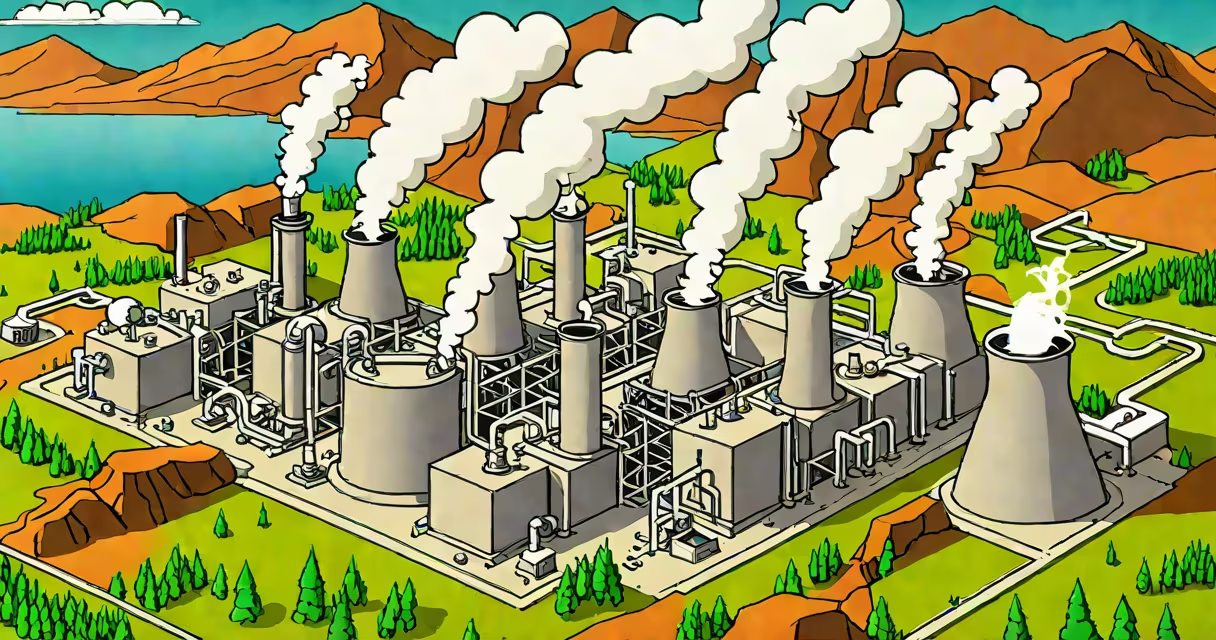
Geothermal energy is converted into electricity by harnessing underground heat to produce steam or hot fluid that drives a turbine connected to a generator. This process occurs in geothermal power plants located above reservoirs of heated water or steam beneath the Earth's surface.
Electricity generation begins when wells drill into geothermal reservoirs, typically 1 to 3 kilometers below ground. These wells tap into naturally occurring hot water or steam trapped in porous rock formations. The high-pressure fluid flows upward through pipes, where it powers a turbine. As the turbine spins, it turns a generator, producing electricity. After passing through the turbine, the fluid is cooled and reinjected into the ground to maintain pressure and sustain the resource.
The most common systems are dry steam, flash steam, and binary cycle. Dry steam plants use steam directly from the reservoir to turn turbines. Flash steam plants inject high-pressure hot water into low-pressure tanks, causing it to "flash" into steam. Binary cycle plants transfer heat from geothermal fluid to a secondary fluid with a lower boiling point, such as isobutane, which vaporizes and drives the turbine. Binary systems operate efficiently at lower temperatures and are increasingly used in regions with moderate geothermal gradients.
At a typical geothermal power plant, the process starts with drilling production wells into a hydrothermal reservoir. Water at temperatures between 150°C and 300°C is extracted under pressure. In flash steam plants, the hot water enters a separator where pressure drops suddenly, causing part of the liquid to vaporize into steam. This steam is directed to a turbine.
The turbine rotates at speeds up to 3,600 RPM, driving a generator that produces alternating current (AC) electricity. After exiting the turbine, the steam is cooled in a condenser, turning it back into water. This condensed fluid is then reinjected into the ground through injection wells to prevent depletion and reduce environmental impact.
Binary cycle systems differ in that the geothermal fluid never contacts the turbine. Instead, it transfers heat through a heat exchanger to a secondary working fluid with a boiling point below 150°C. This fluid vaporizes, expands through the turbine, and is then cooled and recycled. Because the working fluid remains sealed, binary systems have minimal emissions and can operate in areas with lower temperature resources.
Each system type suits different geological conditions and temperature ranges. The choice depends on subsurface heat levels, fluid chemistry, and environmental requirements.
| System Type | Operating Temperature Range | Efficiency | Best For |
|---|---|---|---|
| Dry Steam | ≥180°C | 10-15% | High-temperature fields like Larderello, Italy |
| Flash Steam | 180-300°C | 10-14% | Most U.S. plants, including The Geysers in California |
| Binary Cycle | 85-180°C | 10-17% | Low-to-moderate heat fields, e.g., Nevada's Raft River site |
Flash steam plants dominate global capacity due to widespread availability of high-temperature resources. However, binary cycle systems are growing rapidly because they can use lower-grade heat and have fewer maintenance issues. A 2022 report by the International Renewable Energy Agency (IRENA) noted that binary systems accounted for 40% of new geothermal installations in Europe and North America between 2015 and 2021.
One non-obvious fact: binary cycle plants can operate continuously at near-full capacity, unlike solar or wind, because heat from the Earth is stable and available 24/7. This makes them ideal for baseload power-supplying consistent electricity without relying on weather patterns.
Many assume geothermal energy requires volcanic activity. While volcanoes often indicate high heat flow, geothermal power plants function in tectonically active zones but also in stable crustal areas with sufficient heat from radioactive decay in rocks. For example, the Geysers field in California lies along a tectonic boundary, but projects in Utah and Idaho operate in less active regions.
Another misconception is that geothermal plants emit large amounts of greenhouse gases. In reality, emissions are low-typically 50 to 100 kg CO₂ equivalent per megawatt-hour (MWh), compared to 800-1,000 kg for coal plants. Most emissions come from dissolved gases in the geothermal fluid, such as hydrogen sulfide and carbon dioxide, which are captured and treated before release.
A key distinction: geothermal energy extraction is not the same as geothermal heat pump systems used for building heating and cooling. The latter uses shallow ground loops to transfer heat indoors, while power plants extract deep reservoirs for electricity. Confusing the two leads to misjudging scalability and energy output.
The Geysers is the largest geothermal complex in the world, located in Sonoma County. It began operations in 1960 and now hosts 22 power plants with a total capacity of 1.5 gigawatts (GW). The site draws steam from fractured granite rock heated by magma 5 to 7 kilometers below the surface.
Steam is piped directly from wells to turbines. After use, the spent steam is cooled and injected back into the reservoir. Since 1988, the operator has maintained reservoir pressure by injecting treated wastewater from nearby cities, preventing decline in steam production. This reinjection strategy extends the life of the field and supports long-term sustainability.
Over 30 years, the Geysers has produced over 50 terawatt-hours (TWh) of electricity-enough to power nearly 5 million homes annually. The average capacity factor is 85%, far higher than solar (20-25%) or wind (35-45%). This performance underscores geothermal's reliability as a clean baseload source.
Understanding how to convert geothermal energy into electricity reveals a mature, low-emission technology capable of providing continuous clean power. With proper site selection and system design, geothermal plants deliver reliable energy where conditions allow, supporting decarbonization goals worldwide.