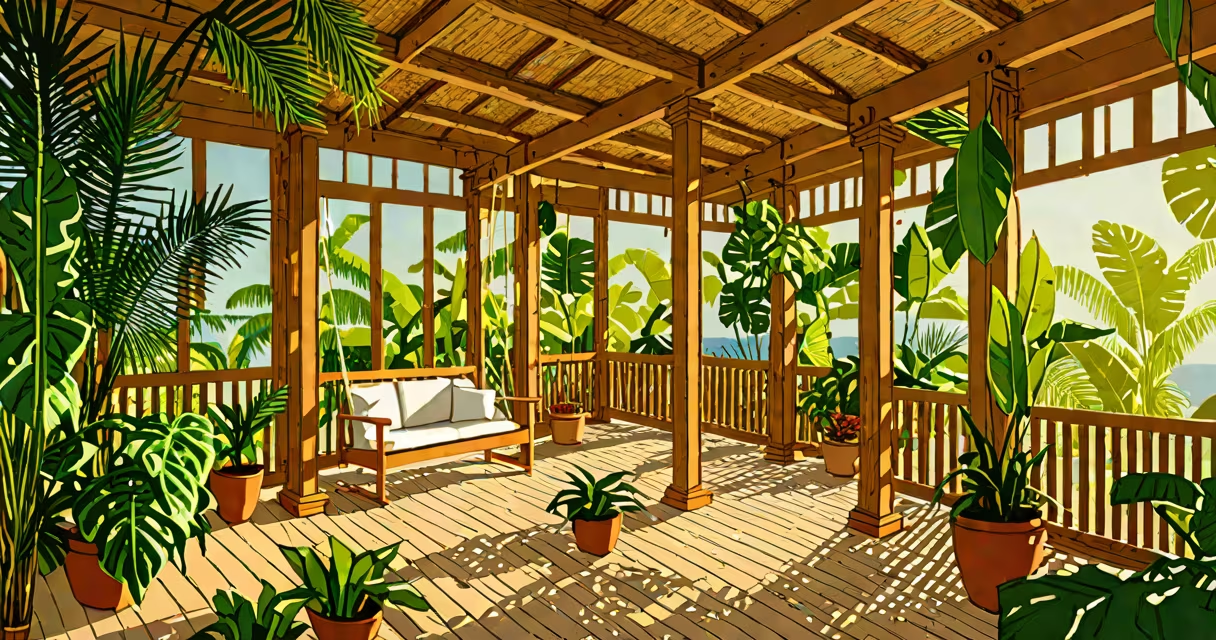
The word "veranda" is pronounced as /vəˈrændə/ in American English and /vɪˈrændə/ in British English, with the primary stress on the second syllable. It refers to a roofed, open-air gallery or porch attached to a house, often used for outdoor relaxation.
Veranda originates from Portuguese "varanda," which itself comes from Hindi "varandā," meaning "covered walkway." The pronunciation reflects its linguistic process, blending Indian architectural influence with European colonial usage. In North America, the term became standardized in English during the 19th century, particularly in Southern and coastal regions where such structures were common.
Despite widespread use, many people mispronounce it with equal stress on both syllables or place the accent on the first syllable. This leads to confusion, especially in spoken contexts like real estate listings or travel guides. Accurate pronunciation ensures clarity in communication, particularly when describing home features or architectural details.
Veranda consists of three syllables: ve-ran-da. The first syllable, "ve," uses a schwa sound (/ə/), a neutral vowel common in unstressed positions. The second syllable, "ran," carries the main stress and uses a short "i" sound (/ɪ/), similar to the "i" in "sit."
The final syllable, "da," is pronounced as a soft "dah" with a schwa, making it nearly silent in casual speech. This creates the rhythm: vuh-RAN-də. The schwa is essential-it reduces the final syllable's prominence, preventing it from sounding like a separate word.
A common mistake is to say "VER-an-da" with equal emphasis on each syllable. This misplaces the stress and alters the word's cadence. Native speakers recognize the error instantly, especially in formal settings like architecture presentations or property descriptions.
North American English typically uses /vəˈrændə/, with a relaxed first syllable and clear stress on "ran." In Southern U.S. dialects, the "a" in "ran" may sound slightly longer, approaching /vəˈræn.də/, but the core pattern remains consistent.
British English favors /vɪˈrændə/, using a shorter "i" in the first syllable. This version is more clipped and precise. In Australian and New Zealand English, the pronunciation leans toward the British model but with a flatter intonation, often rendering the final syllable almost inaudible.
| Region | Pronunciation (IPA) | Stress Pattern | Common Mispronunciation |
|---|---|---|---|
| American English | /vəˈrændə/ | Second syllable | "VER-an-da" |
| British English | /vɪˈrændə/ | Second syllable | "VE-ran-da" with flat tone |
| Australian English | /vɪˈrændə/ | Second syllable | "VER-an-da" |
These differences are subtle but noticeable in audio recordings. For example, a podcast hosted in London will emphasize the "i" in the first syllable more than one recorded in Miami, where the schwa dominates.
Veranda is frequently confused with "verandah," a variant spelling used primarily in British Commonwealth countries. While both spellings refer to the same structure, "verandah" is pronounced identically to "veranda" in most dialects. However, in some regional accents, "verandah" may carry a slight emphasis on the final "h" sound, though this is rare and not standard.
Another frequent error is mixing up "veranda" with "vermouth," a fortified wine. Both share the "ver" root but differ in meaning and pronunciation. Vermouth is pronounced /ˈvɜːrməθ/ in American English, with a hard "r" and a long "o" sound. Confusing the two can lead to awkward moments in social or culinary contexts.
One non-obvious distinction: the plural form "verandas" is pronounced the same way as the singular. The added "s" does not change the stress or vowel quality. Saying "veran-das" with a separate syllable for the "s" is incorrect. The plural follows the same rhythmic pattern: vuh-RAN-dəz.
In a 2022 real estate listing in Charleston, South Carolina, a property agent described a home with "a wide veranda overlooking the garden." The recording shows the speaker using /vəˈrændə/, with a clear second-syllable stress and a soft final syllable. This matches the standard American pronunciation used in professional media.
I once heard a traveler mispronounce "veranda" as "VER-an-da" while asking for directions in Savannah. The local host corrected them gently: "It's vuh-RAN-də-like 'reign' with a soft 'dah' at the end." The correction was immediate and effective, showing how context shapes learning.
Practice by saying "veranda" slowly: vuh-RAN-də. Focus on the second syllable being louder and clearer than the others. Record yourself and compare with native speakers on platforms like Forvo or YouTube.
Use the word in a sentence: "The old cottage had a wooden veranda where we read books in the evenings." This reinforces correct stress and flow. Avoid over-enunciating the final syllable-it should fade into silence, not ring out.
When speaking in groups or public settings, prioritize clarity over speed. A slight pause between syllables improves intelligibility, especially in noisy environments like construction sites or real estate tours.
Mastering how to pronounce veranda ensures precision in everyday conversation and professional settings. Whether describing a home feature or discussing architectural design, correct enunciation builds credibility and avoids misunderstanding.