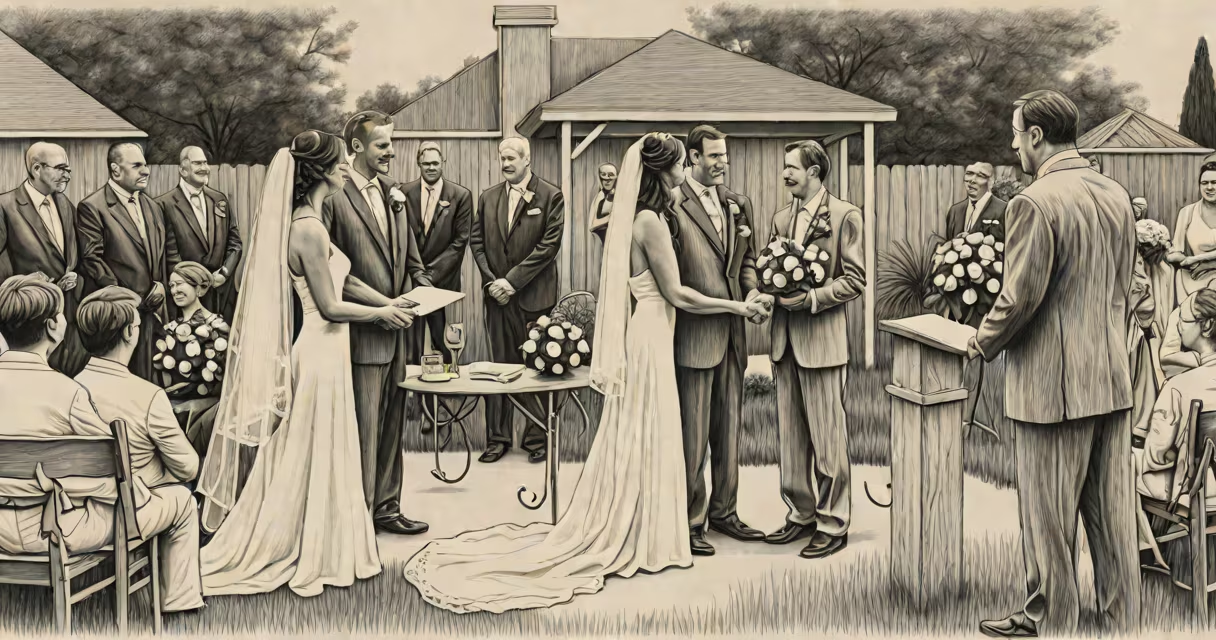
A marriage ceremony without a license is a union performed without formal state authorization. It lacks legal standing in most U.S. states and does not create enforceable marital rights or obligations under civil law.
Such ceremonies may occur in private settings-backyards, homes, or remote locations-with friends or family acting as witnesses. They often include vows, rings, and symbolic rituals, but no government-issued document confirms the union. These events resemble weddings in form but lack legal validity unless later validated through court action or specific state laws.
While some couples view this as a personal commitment, the absence of a license means no legal protection in divorce, inheritance, spousal benefits, or medical decision-making. In most states, marriage requires a license issued by a county clerk's office and a licensed officiant to perform the ceremony.
Without a license, a couple cannot marry in any jurisdiction that enforces civil marriage laws. A license is not merely a formality-it is a prerequisite for legal recognition. It ensures both parties meet age, identity, and relationship eligibility requirements. Without it, the marriage is void under state statutes.
For example, California Civil Code § 300 requires a marriage license for any valid marriage. Performing a ceremony without one results in a null union. Similarly, New York State Judiciary rules state that a marriage is invalid if not solemnized by a person authorized to perform marriages and accompanied by a valid license.
Even if a couple lives together for years and presents themselves as married, courts will not recognize their union as legally married unless they either obtained a license retroactively or qualified under common law marriage rules-which only apply in a few states.
Marriage ceremonies without licenses rely on symbolic acts: exchanging vows, wearing rings, signing a declaration. These actions carry emotional weight but no legal effect. The presence of witnesses or a celebrant does not substitute for official documentation.
Some assume that cohabitation or public acknowledgment creates a legal bond. This is false. In most states, living together for decades does not equate to marriage. Only a licensed ceremony or a court ruling can establish marital status.
One common misconception is that religious officiants can validate marriage without a license. While clergy may perform ceremonies, they cannot bypass state licensing requirements. Even if a priest or minister conducts the service, the marriage remains legally unenforceable without a license.
Couples may choose to hold a ceremony without a license due to cost, time, privacy, or personal beliefs. Some seek spiritual or cultural significance without state involvement. Others avoid bureaucratic hurdles, especially in states with restrictive marriage laws.
However, the risks are significant. Without a license, a spouse cannot claim survivor benefits, file joint taxes, or make medical decisions for a partner. If one dies intestate, the surviving partner has no automatic inheritance rights.
Consider a couple in Texas who held a beach ceremony with two friends as witnesses. They lived together for 15 years, referred to each other as "husband and wife," and shared assets. After one died, the surviving partner was denied access to the estate because no marriage license existed. The court ruled the union was not legally binding.
People often confuse marriage without a license with common law marriage. Common law marriage exists in only a handful of states-Colorado, Iowa, Kansas, Montana, New Hampshire (for probate only), Rhode Island, South Dakota, and Texas (under strict conditions). It requires cohabitation, mutual consent, and public representation as married. Not all states recognize it.
Another error is assuming that a marriage certificate from a foreign country or a religious institution grants U.S. legal status. A marriage performed abroad may be recognized if the couple resides in a state that honors it-but only if the ceremony met local legal standards. A certificate from a church in Mexico does not override U.S. state law.
One non-obvious fact: some states allow couples to file a "Declaration of Marriage" after cohabiting for a set period. This is not common law marriage. It's a statutory process in places like Indiana and Ohio that allows couples to retroactively register their union. But it requires proof of cohabitation and intent-documentation that many couples lack.
The table below outlines how different U.S. states treat marriage without a license.
| State | Valid Without License? | Common Law Marriage? | Retroactive Registration? |
|---|---|---|---|
| California | No | No | No |
| Texas | No | Yes (if formed before Sept 1, 2016) | No |
| Colorado | No | Yes | No |
| New York | No | No | No |
| Ohio | No | No | Yes (via affidavit) |
Only a few states permit common law marriage. Most require a license. In states without such provisions, a marriage ceremony without a license is legally void.
If a couple wants a meaningful ceremony without delay, they can obtain a marriage license first. The process takes 1-3 days in most states and costs $30-$100. Both parties must appear in person, provide identification, and pay a fee. After the ceremony, the officiant returns the signed license to the county clerk, who issues a certified marriage certificate.
For couples who have already held an unlicensed ceremony, the path to legal recognition varies. In some states, a court can validate the union through a petition for legal recognition. In others, couples must reapply for a license and remarry.
I once observed a couple in Vermont who had lived together for 12 years and held a small ceremony in their home. When one partner needed hospital authorization, the facility refused because no license existed. They later filed a legal declaration with the state and were granted retroactive recognition after submitting affidavits from neighbors and photos of their life together.
For those who want to preserve the intimacy of a private ceremony while ensuring legal validity, consider a symbolic vow renewal after obtaining a license. This honors tradition and protects rights.
A marriage ceremony without a license may feel authentic, but it offers no legal protection. To ensure rights in health, property, and inheritance, a licensed ceremony is required.