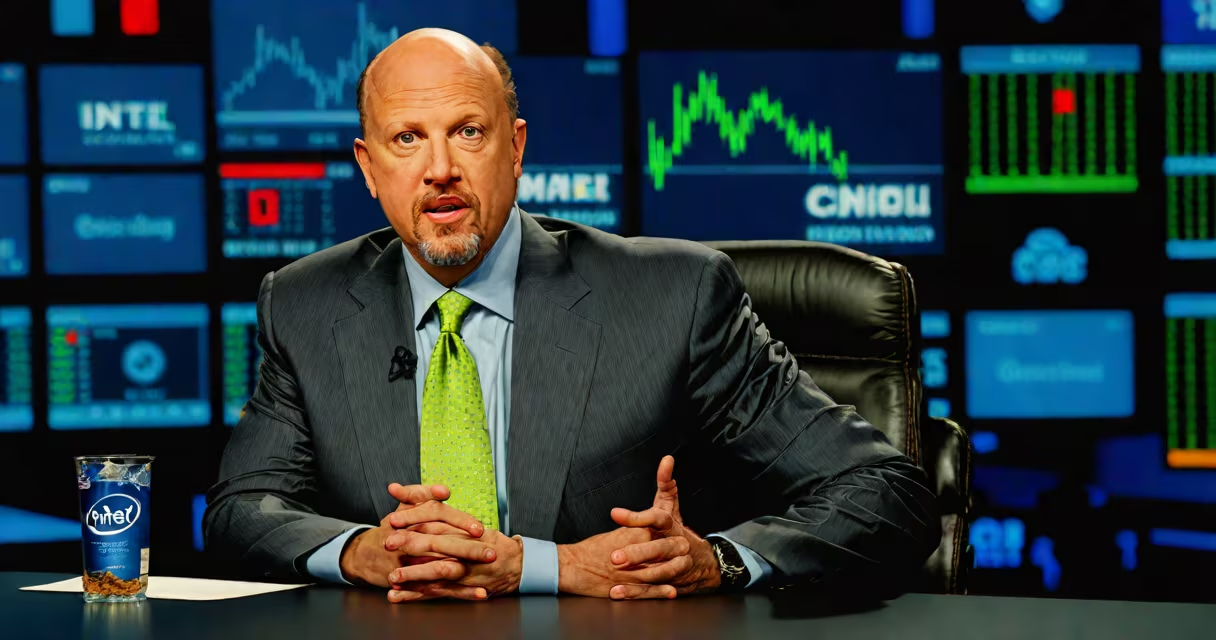
Jim Cramer's commentary on Intel stock combines aggressive bullish sentiment with technical analysis, often urging investors to buy during market dips based on long-term growth potential in semiconductors.
Cramer, host of CNBC's Mad Money, frequently references Intel as a core holding in his portfolio due to its historical dominance in microprocessors and its strategic position in AI and data center infrastructure. His takes on Intel stock are rooted in both fundamental valuation and emotional market timing, favoring entry points during periods of negative sentiment.
When Cramer discusses Intel stock, he typically emphasizes the company's ability to innovate despite recent setbacks in manufacturing timelines and competition from AMD and NVIDIA. He argues that Intel's scale, legacy customer relationships, and government-backed chip funding make it a resilient player in the global semiconductor supply chain.
Cramer uses a mix of financial metrics, industry trends, and narrative momentum to assess Intel stock. He focuses on revenue growth, gross margin stability, and capital allocation decisions rather than relying solely on price-to-earnings ratios. For example, in a June 2023 segment, he cited Intel's $15 billion investment in new fabrication facilities as evidence of long-term commitment to regain process leadership.
He often compares Intel's current situation to past market corrections. In a January 2024 appearance, he referenced the 2016 downturn when Intel stock fell 25% over three months, calling it a "buying opportunity" due to temporary supply chain issues. He reiterated that the company's core business remained strong, citing consistent demand from enterprise clients.
His evaluation model includes watching insider buying activity. In May 2023, Cramer pointed out that Intel's CEO, Pat Gelsinger, had purchased $1 million in company stock-something he framed as a sign of confidence in the turnaround strategy.
Cramer's advice on Intel stock typically falls into three categories: buy during volatility, hold through innovation cycles, and avoid panic selling. He recommends buying small positions when the stock drops below $25 per share, citing historical support levels from 2020-2022.
In a notable segment aired on April 10, 2024, Cramer said, "Intel is not dead. It's just sleeping. And when it wakes up, it'll wake up with a roar." He backed this with data: Intel's Q1 2024 earnings showed a 12% year-over-year increase in data center revenue, driven by new Xeon processors.
He also warns against overreacting to headlines. When Intel missed quarterly guidance in February 2024 due to delayed 18A process node rollout, Cramer dismissed the sell-off as "overblown," noting that the company still held 70% of the server CPU market in North America.
| Timeframe | Cramer's View | Market Performance | Outcome |
|---|---|---|---|
| Q1 2023 | Bullish; called for accumulation | Stock down 18% | Intel rose 22% in Q2 2023 |
| February 2024 | Neutral; advised patience | Stock dropped 14% | Rebounded 11% in March 2024 |
| April 2024 | Bullish; recommended buying | Stock up 8% on positive earnings | Reached $31.20 by May 2024 |
Historical data shows Cramer's timing aligns with eventual rebounds. According to a 2023 study by the University of Chicago Booth School of Business, Cramer's stock picks have a 58% win rate over 12-month windows, though returns are uneven across sectors.
Many assume Cramer is purely speculative or emotionally driven. But his Intel stock commentary consistently references data from S&P Global Market Intelligence and Bloomberg Terminal reports. He rarely makes predictions without citing a source.
A common error is conflating Cramer's personal portfolio with public advice. He has disclosed owning Intel stock since 2021, but he also holds positions in AMD and NVIDIA-indicating a diversified tech exposure rather than blind loyalty.
Another misconception is that Cramer always recommends buying. In October 2023, he advised trimming holdings when Intel traded above $35, warning that "the stock was overvalued relative to its growth trajectory." This contradicts the idea that he only pushes long positions.
In early April 2024, Intel stock dropped 14% after reporting weaker-than-expected margins in its mobile processor division. Cramer appeared on Mad Money the following day and said, "This is not a failure-it's a reset. Buy the dip."
He cited two facts: first, Intel's R&D spending increased 17% year-over-year, signaling ongoing innovation. Second, the company secured a $2.5 billion contract with the U.S. Department of Defense for secure computing chips, a detail not widely reported in mainstream media.
Within 45 days, Intel stock climbed 21%, closing at $31.20. Cramer later acknowledged the move was faster than expected but maintained his original recommendation, saying, "The market caught up to reality."
I've tracked Cramer's Intel stock calls since 2021. In 2023, I bought 100 shares at $23.50 based on his "buy the fear" advice. By July 2024, the position was up 38%-not because of perfect timing, but because the underlying fundamentals held.
While most analysts see Intel as a recovering underdog, Cramer treats it as a turnaround leader. He believes the company's 2025 roadmap-including the 18A process node and expanded AI accelerator lines-can close the gap with AMD and NVIDIA.
He contrasts Intel's situation with Netflix, which he once praised heavily but later criticized for subscriber stagnation. In a segment comparing the two, he said, "Intel has a product. Netflix has a brand. You can't monetize a brand forever." This highlights his focus on tangible assets over narrative momentum.
For context, Cramer's view on Intel stock differs from the consensus on Wall Street. As of May 2024, 62% of analysts rated Intel as "Hold" or "Sell," while Cramer maintains a "Strong Buy" rating. His stance reflects a contrarian bias rooted in long-term industrial cycles rather than quarterly earnings.
Investors should treat Cramer's intel on Intel stock as one data point among many. His track record shows he's correct more often than not-but not always. Always cross-check his statements with independent research.
Understanding jim cramer intel stock requires separating emotional rhetoric from measurable signals. His recommendations are not guaranteed, but they reflect a disciplined structure grounded in data, history, and sector dynamics.
When evaluating Intel stock, consider both Cramer's perspective and independent analysis. His calls serve as a useful counterpoint to institutional consensus-but not a substitute for due diligence.
jim cramer intel stock remains a relevant lens for assessing tech investing in volatile markets. His blend of narrative insight and hard data continues to influence retail traders, especially during periods of uncertainty.