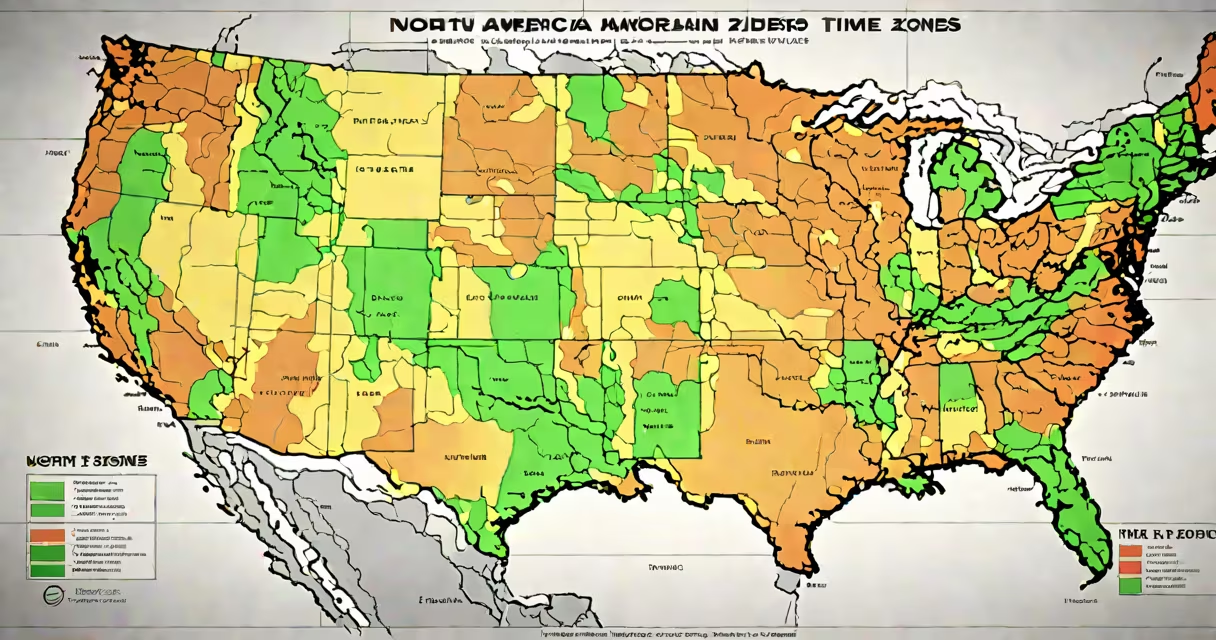
North American time zones are six standardized regional time divisions across the United States, Canada, and Mexico, each offset from Coordinated Universal Time (UTC) by whole hours or half-hours. They ensure consistent scheduling across vast geographic areas, adjusting for daylight saving time in most regions.
The system originated in the late 19th century to standardize rail schedules and prevent confusion from local solar time differences. Today, it supports commerce, transportation, and communication across a continent spanning over 5,000 miles from east to west.
Each zone operates on a specific UTC offset: UTC-8 (Pacific), UTC-7 (Mountain), UTC-6 (Central), UTC-5 (Eastern), UTC-4 (Atlantic), and UTC-3.5 (Newfoundland). These offsets change during daylight saving time in most U.S. and Canadian zones, shifting clocks forward by one hour between March and November.
Time zones are based on longitudinal segments, with each 15-degree band corresponding to one hour of Earth's rotation. However, political boundaries often override strict geography. For example, parts of Indiana and Arizona do not observe daylight saving time, creating exceptions within otherwise uniform zones.
Daylight saving time begins on the second Sunday in March and ends on the first Sunday in November in the U.S. and Canada. During this period, clocks move forward one hour. The shift resets at the end of October, returning clocks to standard time.
When it's 12:00 PM (noon) in New York City (Eastern Time Zone), it's 9:00 AM in Los Angeles (Pacific Time Zone)-a three-hour difference. This consistency allows events like live broadcasts, airline flights, and business meetings to be scheduled across regions without confusion.
North America uses six primary time zones, each with unique characteristics:
| Zone Name | UTC Offset (Standard) | UTC Offset (Daylight Saving) | Major Cities | Notes |
|---|---|---|---|---|
| Pacific | UTC-8 | UTC-7 | Los Angeles, Seattle, Vancouver | Observes DST; Alaska uses UTC-9/UTC-8 |
| Mountain | UTC-7 | UTC-6 | Denver, Phoenix, Calgary | Phoenix, Arizona, does not observe DST |
| Central | UTC-6 | UTC-5 | Chicago, Houston, Winnipeg | Most states observe DST; parts of Texas do not |
| Eastern | UTC-5 | UTC-4 | New York, Toronto, Miami | U.S. and Canadian zones align; Cuba uses UTC-5 year-round |
| Atlantic | UTC-4 | UTC-3 | Halifax, St. John's (Newfoundland) | St. John's uses UTC-3.5, not UTC-4 |
| Newfoundland | UTC-3.5 | UTC-2.5 | St. John's, Newfoundland | Only region in North America using a half-hour offset |
One non-obvious fact: the entire state of Arizona, except for the Navajo Nation, does not observe daylight saving time. As a result, during summer months, Arizona remains on Mountain Standard Time (UTC-7), while surrounding states shift to Mountain Daylight Time (UTC-6). This creates a one-hour gap between Phoenix and neighboring cities like Albuquerque.
Another distinction: Mexico uses three time zones-Pacific, Central, and Mountain-but only observes daylight saving in the northern states. The rest of the country stays on standard time year-round. This leads to inconsistent timing across federal regions, especially near borders.
Many assume that "EST" stands for Eastern Standard Time and applies year-round. In reality, EST is only used during non-daylight saving periods. During daylight saving, the correct designation is EDT (Eastern Daylight Time), which is one hour ahead of EST.
For example, when it's 1:00 PM EST (10:00 AM UTC), it's 2:00 PM EDT (11:00 AM UTC). Confusing the two can lead to missed appointments or incorrect flight connections. The U.S. National Institute of Standards and Technology (NIST) confirms that the term "EST" should not be used outside of standard time periods.
People often think time zones are rigid lines. In practice, they follow state and provincial borders. The city of Detroit, Michigan, lies in the Eastern Time Zone, but the nearby town of Port Huron is in the same zone despite being farther west than some Central Time locations. Boundaries are drawn for administrative convenience, not geography.
Consider a video conference scheduled at 9:00 AM Eastern Time (ET) for team members in New York, Toronto, and Miami. At that moment, participants in Denver (Mountain Time) see 7:00 AM, those in Los Angeles (Pacific Time) see 6:00 AM, and those in Halifax (Atlantic Time) see 10:00 AM.
If the meeting occurs during daylight saving time, ET becomes EDT (UTC-4), so the same 9:00 AM EDT corresponds to 7:00 AM MDT and 6:00 AM PDT. The time difference remains consistent, but the zone labels change.
I once coordinated a cross-border software deployment involving teams in Seattle, Toronto, and Mexico City. We used UTC as our reference point to avoid errors. When we set the go-live time to 15:00 UTC, it was 8:00 AM PST, 10:00 AM MST, 11:00 AM CST, 12:00 PM EST, 1:00 PM EDT, and 2:00 PM CDT. Using UTC eliminated ambiguity and ensured alignment across all teams.
Understanding north american time zones enables accurate planning across regions. Their structure balances geographic logic with administrative practicality, ensuring that timekeeping remains predictable and interoperable across borders.