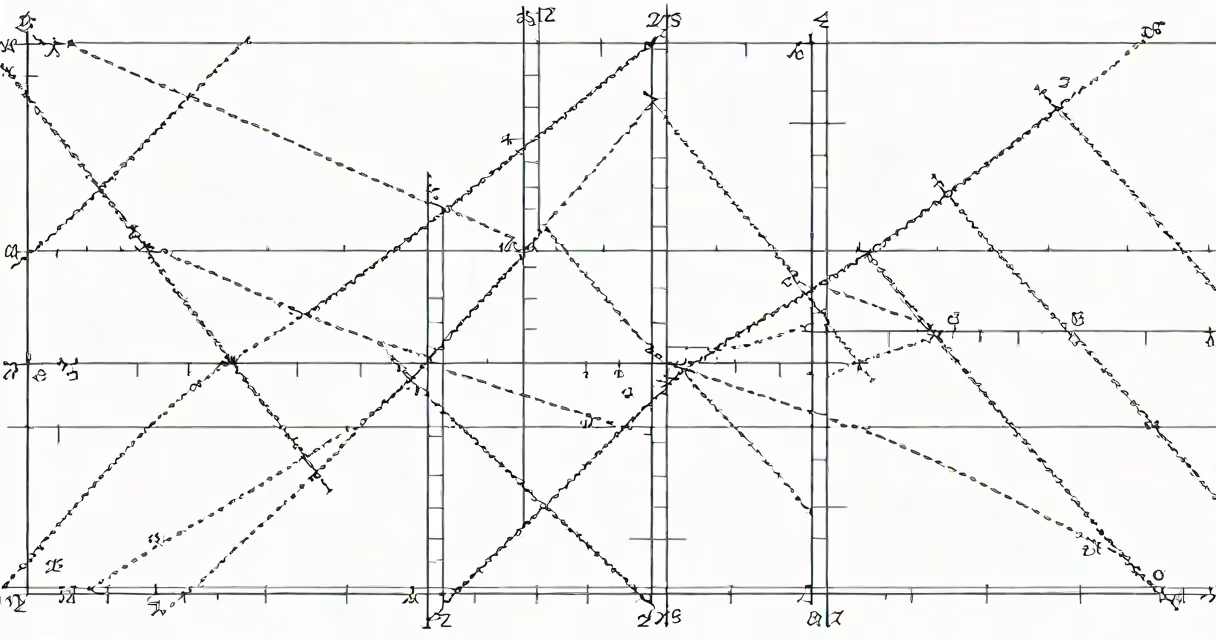
Solving simultaneous equations means finding values for variables that make all given equations true at the same time. This applies when two or more equations share the same variables and must be satisfied together. Common methods include substitution and elimination.
These problems arise when multiple conditions apply simultaneously. For example, if two people buy different combinations of apples and oranges, and their total costs are known, solving the system reveals the price per fruit. The solution is a single set of values that satisfies every equation in the system.
Systems can have one solution, no solution, or infinitely many solutions. A unique solution exists when the equations represent lines that cross at one point. Parallel lines yield no solution. Identical lines produce infinite solutions. The nature of the solution depends on the relationship between the equations.
The two primary techniques are substitution and elimination. Substitution involves solving one equation for one variable and plugging that expression into the other equation. Elimination adds or subtracts equations to cancel out a variable.
Substitution is effective when one equation is easily solvable for a variable. For example, if y = 2x + 1 appears in a system, substitute that expression for y in the second equation. This reduces the system to a single-variable equation.
Elimination works well when coefficients align. Multiply equations by constants so that adding or subtracting eliminates one variable. This method avoids fractions and simplifies arithmetic when coefficients are multiples of each other.
Simultaneous equations fall into categories based on the number of variables and equation forms. Linear systems involve equations where variables appear only to the first power. Nonlinear systems include quadratic or exponential terms and require advanced techniques.
| Type | Form | Example | Solution Type |
|---|---|---|---|
| Linear (2 variables) | ax + by = c | 2x + 3y = 7 4x − y = 5 |
One solution (usually) |
| Linear (3 variables) | ax + by + cz = d | x + y + z = 6 2x − y + z = 3 x + 2y − z = 2 |
One solution or none |
| Nonlinear | xy = 6, x² + y² = 13 | xy = 12 x + y = 7 |
Two solutions (e.g., (3,4), (4,3)) |
Linear systems with two equations and two unknowns typically have one solution unless the lines are parallel or coincident. Systems with more equations than variables may be overdetermined and inconsistent. Underdetermined systems (fewer equations than variables) often have infinite solutions.
Businesses use simultaneous equations to model supply and demand. For example, a retailer sells two products: Product A at $10 and Product B at $15. On a given day, they sold 100 units total and made $1,200. The system:
x + y = 100
10x + 15y = 1200
Using elimination: multiply the first equation by 10 → 10x + 10y = 1000. Subtract from the second: (10x + 15y) − (10x + 10y) = 1200 − 1000 → 5y = 200 → y = 40. Then x = 60. They sold 60 units of A and 40 of B.
Engineers solve systems to balance forces in structures. Electrical circuits use Kirchhoff's laws, which generate simultaneous equations for current flow. In physics, motion equations involving position, velocity, and acceleration form systems solved together.
A common mistake is assuming all systems have solutions. Some have no solution-like x + y = 5 and x + y = 7. These are contradictory. Another error is treating equations as independent when they're not. For example, 2x + 4y = 8 and x + 2y = 4 are equivalent; one doesn't add new information.
People often think solving simultaneous equations requires graphing. While visualizing intersections helps, algebraic methods are faster and more precise. Graphing fails with three or more variables and introduces rounding errors.
Another misconception is that every system with two equations and two variables has a solution. That's false. Parallel lines (same slope, different intercepts) never meet. For example:
y = 2x + 1
y = 2x + 3
Subtracting gives 0 = 2, which is impossible. No solution exists.
Here's a non-obvious point: the determinant of the coefficient matrix determines solvability for 2×2 linear systems. If the determinant is zero, the system either has no solution or infinitely many. A nonzero determinant guarantees a unique solution. This concept comes from linear algebra and is foundational in higher math.
I once used elimination to resolve a discrepancy in a small business's inventory records. Two suppliers charged different rates for the same item. By setting up a system based on total cost and quantity, I found the correct unit price. The numbers matched the receipts exactly, proving the method's reliability in real situations.
Understanding how to solve simultaneous equations builds the foundation for linear algebra, optimization, and computational modeling. Mastery of substitution and elimination enables quick resolution of practical problems across science, engineering, and economics.