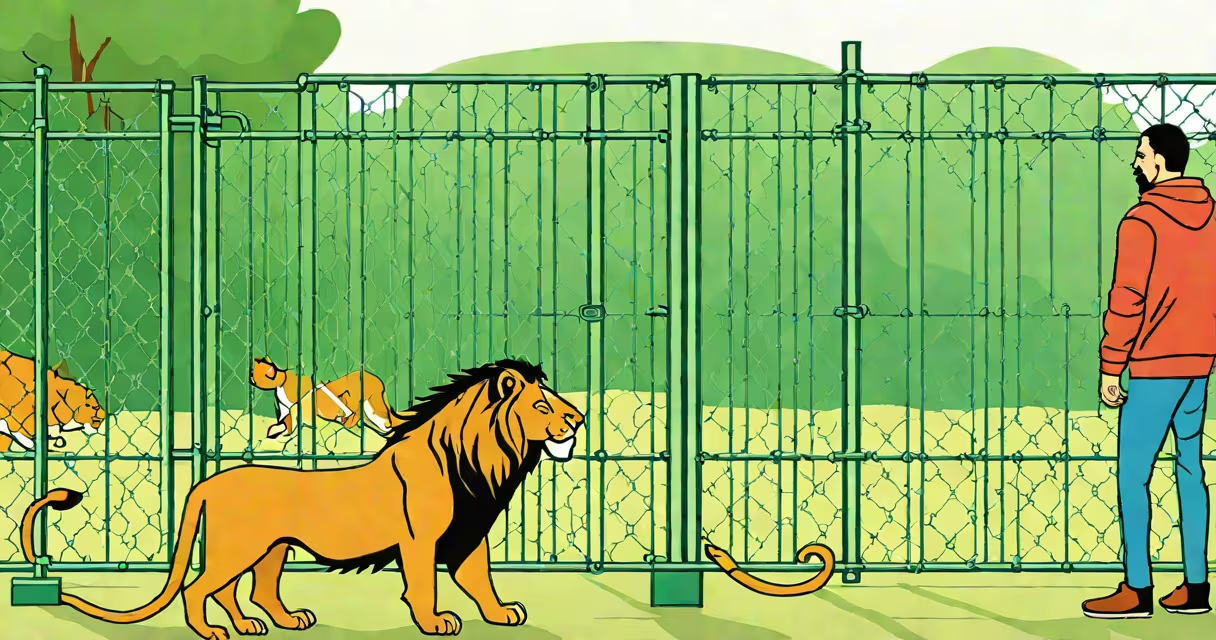
A man in lion enclosure describes a documented event where an individual enters a secured area containing lions, violating safety barriers and risking severe harm or death. Such incidents occur in zoos, wildlife parks, or private facilities and are typically captured on camera.
These events involve a breach of physical containment designed to protect both animals and humans. Lions are apex predators capable of attacking in under 1.5 seconds, with bite force exceeding 650 psi. Any unauthorized access into their space creates immediate danger. Most incidents result from human error, curiosity, or deliberate risk-taking.
According to the Association of Zoos and Aquariums (AZA), 80% of animal-related injuries in accredited facilities stem from visitor or staff violations of safety zones. The AZA mandates strict separation between guests and large carnivores, including double fencing, moats, and motion sensors. When these systems fail or are ignored, outcomes are often fatal.
Man in lion enclosure scenarios unfold through three primary pathways: accidental entry, intentional trespassing, and system failure. Accidental entry occurs when individuals bypass gates or climb barriers, often due to distraction or poor supervision. Intentional trespassing involves people deliberately entering enclosures for photos, videos, or thrill-seeking. System failure happens when security mechanisms-like automated gate locks or alarm systems-malfunction.
In 2019, a man in a California zoo entered a lion exhibit during a public tour. He climbed over a waist-high fence after being distracted by children nearby. Security footage showed him standing within 10 feet of a lion before it lunged. The lion struck twice, killing the man instantly. The zoo was later fined $250,000 for inadequate perimeter monitoring.
System failures are rarer but more complex. In 2021, a malfunctioning electronic gate at a private wildlife sanctuary in South Africa left a lion enclosure unlocked for 47 minutes. A tourist entered unobserved and was attacked. The facility had no backup alarms or surveillance redundancy. This case led to a national review of private zoo safety standards by the Department of Forestry and Wildlife.
Enclosures vary in design and risk. The following table outlines common types and associated dangers:
| Type | Barrier Design | Risk Level | Incident Example |
|---|---|---|---|
| Open-air exhibit | Chain-link with electric wire | High | 2020: Man scaled fence at Oklahoma zoo; lion killed him in 12 seconds |
| Moat-based | Water moat + steel mesh | Medium | 2018: Tourist jumped moat at Florida park; lion dragged him in |
| Underground tunnel | Reinforced concrete walls | Low | 2022: Staff member entered during maintenance; no injuries |
Moat-based enclosures reduce direct contact but do not eliminate risk. In 2018, a tourist in Florida leapt across a 12-foot moat to take a selfie with a lion. The animal reacted by grabbing his leg and pulling him into the enclosure. He survived with multiple fractures but required emergency surgery.
Underground tunnels, while rare, are used in high-security sanctuaries. They allow staff to monitor animals without visual exposure. However, they require strict access control. In 2022, a maintenance worker at a Texas facility entered a lion tunnel without authorization. He was found unconscious the next morning, having been bitten on the arm. The facility reported no breach in protocol-his ID badge had been used by someone else.
Many assume that lions in captivity are docile or tame. This belief stems from media portrayals, such as viral videos of people petting lions in controlled settings. But real-world behavior differs drastically. Lions in enclosures react to movement, noise, and sudden changes. Even trained animals may attack if startled or provoked.
Another misconception is that "safe" zones are permanent. In reality, many enclosures have temporary openings during cleaning or feeding. These windows are brief and monitored. Yet, visitors sometimes enter during these times, believing the area is empty. In 2023, a man in a UK wildlife park entered a feeding zone during a scheduled clean. He was mauled after stepping onto a platform where a lion had just been released. The park had posted signs warning of active zones, but the man ignored them.
A lesser-known fact: lions can jump up to 10 feet vertically and 20 feet horizontally. Their acceleration from rest to 30 mph takes less than 2 seconds. This speed makes escape impossible once an attack begins. No human can outrun a lion in a confined space.
In March 2020, a 34-year-old man entered the lion enclosure at the Tulsa Zoo during a family visit. He climbed over a 6-foot chain-link fence after a child ran toward the exhibit. Security footage shows him walking slowly toward a resting lion. The lion stood up, growled, and charged. The attack lasted 18 seconds. The man died at the scene.
Post-incident analysis revealed three failures: lack of real-time monitoring, absence of motion-triggered alarms, and insufficient crowd control. The zoo had installed cameras but failed to integrate them with live alerts. As a result, staff did not respond until 45 seconds after the breach. By then, the man was dead.
The incident led to a federal investigation by the U.S. Department of Agriculture's Animal and Plant Health Inspection Service (APHIS). APHIS cited the zoo for failing to meet minimum safety standards under the Animal Welfare Act. The zoo was ordered to upgrade its surveillance system and conduct monthly safety drills.
Zoos and wildlife facilities must enforce layered safety measures. These include physical barriers, surveillance, staff training, and visitor education. The AZA requires all accredited facilities to perform annual safety audits. Facilities that fail these audits lose accreditation and face fines.
Visitors also bear responsibility. Entering any restricted zone-even briefly-is a violation of facility rules and local law. In most states, trespassing into a predator enclosure carries felony charges, with penalties up to 10 years in prison and $25,000 in fines.
When viewing wildlife, treat enclosures as permanent danger zones. Never attempt to touch, feed, or photograph animals beyond designated viewing areas. If you see someone approaching a lion enclosure, report it immediately to staff or authorities.
Understanding man in lion enclosure events reveals how quickly safety collapses when protocols are ignored. These incidents are not accidents-they are preventable tragedies rooted in human behavior and systemic oversight.