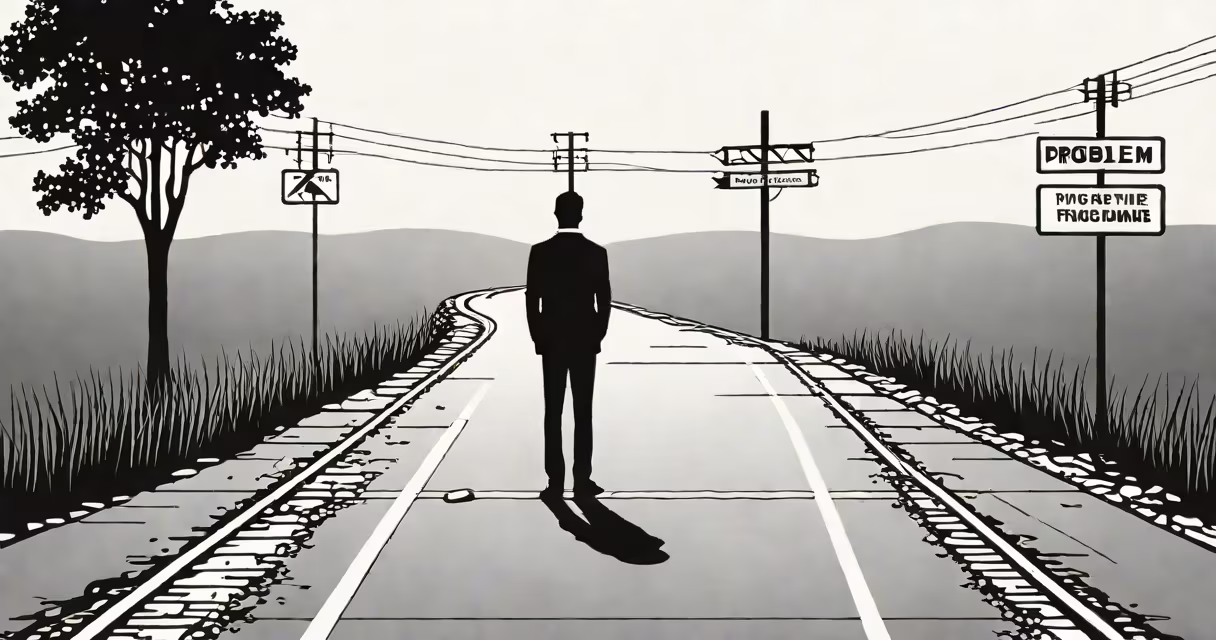
The phrase "the problem is not the problem" asserts that difficulty lies not in the obstacle itself, but in how we perceive and respond to it. This idea shifts focus from external circumstances to internal interpretation, emphasizing that resistance to reality often causes suffering more than the situation itself.
Originating in cognitive psychology and popularized through modern self-development circles, the quote reflects a core principle of mindfulness and constructive problem-solving. It does not deny the existence of challenges-it argues that our reaction to them shapes their impact. The real issue is not the event, but our narrative around it.
For example, a project manager facing a missed deadline might initially think, "This failure will ruin my career." That mental reaction creates anxiety, poor decisions, and avoidance. But reframing the moment as "I now have data on what went wrong and can improve" transforms stress into actionable insight. The deadline remains unchanged-but the emotional and behavioral response changes.
The quote operates on the principle that perception filters reality. What we label as "problem" is shaped by assumptions, fears, and past experiences. Cognitive science shows that people interpret events through mental models developed over time. These models influence attention, memory, and behavior.
Research from the University of California, Berkeley, confirms that individuals who practice cognitive reappraisal-reinterpreting stressful situations-report lower cortisol levels and improved performance under pressure. This aligns with the quote's logic: changing how you see the challenge reduces its psychological weight.
A real-world application appears in conflict resolution. A team leader told me they once faced a team member who repeatedly missed deadlines. Their initial reaction was frustration and blame. After reflecting on the quote, they asked, "What if the real issue isn't the delay, but my expectation of perfection?" They discovered the employee was overwhelmed due to unclear priorities. Fixing communication resolved the issue-without punishment.
The quote rests on three interlocking ideas: perception, agency, and reframing. Perception determines whether a situation feels threatening or manageable. Agency refers to the belief that you can influence outcomes. Reframing is the deliberate act of shifting perspective to reduce emotional charge and increase clarity.
These elements are measurable. A 2021 study published in *Journal of Personality and Social Psychology* found that participants who were trained in cognitive restructuring reduced negative emotions by 40% during high-pressure tasks. Those who applied reframing techniques reported higher confidence and faster recovery from setbacks.
Another layer involves language. The quote uses negation ("not the problem") to disrupt automatic thinking. This linguistic structure forces pause-a moment of cognitive dissonance that allows space for alternative interpretations. It's not a philosophical abstraction; it's a tool for interrupting habitual reactions.
Many assume the quote dismisses real problems. That's incorrect. It doesn't say "don't fix the broken system"-it says "don't let your mind sabotage your ability to fix it." The quote targets misattribution of cause: confusing symptoms with root issues.
For instance, someone struggling with chronic fatigue may blame lack of sleep. But if they're ignoring underlying stress or poor nutrition, fixing sleep won't resolve the deeper pattern. The real problem isn't sleep-it's the unexamined lifestyle choices driving exhaustion.
Another error is treating the quote as a quick fix. It's not a mantra to repeat during crises. It requires consistent practice. Like any skill, reframing takes repetition, feedback, and reflection. Without effort, the quote becomes empty repetition.
Understanding how problems are framed helps apply the quote effectively. Below are common patterns:
| Framing Type | Description | Impact |
|---|---|---|
| Blame framing | "The client ruined the project." | Creates defensiveness, shuts down collaboration. |
| Resource framing | "We don't have enough time or budget." | Focuses on limits, reduces creative options. |
| Opportunity framing | "This constraint forces us to innovate." | Encourages adaptation, increases resilience. |
Only the last type aligns with "the problem is not the problem." It acknowledges the barrier but shifts attention to what can be controlled. This is not denial-it's strategic redirection.
Use the quote when you feel stuck in emotional cycles: anger, fear, shame, or helplessness. These states signal that your current frame is blocking progress. Pause and ask: "Am I reacting to the event-or to my story about it?"
For example, a teacher received a low evaluation. Their first thought: "I'm a bad educator." That narrative leads to withdrawal. Applying the quote, they asked: "What if the real issue isn't my skill, but the feedback process?" They requested a follow-up meeting, reviewed student data, and revised lesson plans. The outcome wasn't just better evaluations-it was a deeper understanding of teaching effectiveness.
This shift isn't about positivity. It's about accuracy. The problem isn't the problem. The problem is your assumption that the problem defines you.
Understanding "the problem is not the problem quote" connects to broader frameworks. It shares roots with Stoic philosophy, particularly Epictetus's teaching: "It's not what happens to you, but how you react that matters." Modern psychology formalizes this in cognitive-behavioral therapy (CBT), where identifying distorted thoughts is the first step toward change.
Another related concept is the "premortem," a technique used in project management. Before launching a plan, teams imagine it failed and ask: "Why did it fail?" This prevents reactive thinking and surfaces hidden risks early. It's a structured way to apply the quote's logic-focusing on interpretation before action.
"The problem is not the problem" is not a slogan. It's a diagnostic tool. It invites you to look beyond surface events and examine your internal response. The most persistent barriers aren't external-they're the stories you tell yourself about them.