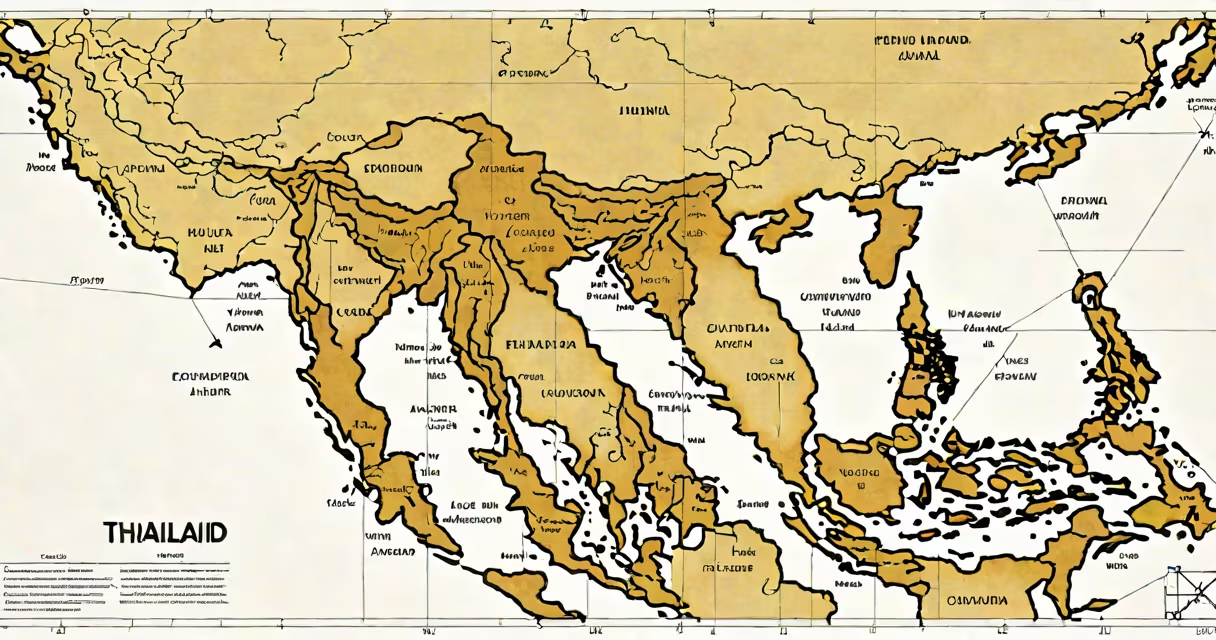
Thailand is located in Asia, specifically within the subregion of Southeast Asia. It lies between the Indian and Pacific Oceans, bordered by Myanmar to the west, Laos and Cambodia to the east, and Malaysia to the south.
Asia is the largest and most populous continent on Earth, spanning from the eastern Mediterranean to the western Pacific. It includes 48 countries and covers approximately 30% of Earth's land area. Thailand occupies a central position in mainland Southeast Asia, a zone known for its dense rainforests, river systems, and diverse cultures.
The country's geographic coordinates are 15°N to 20°N latitude and 98°E to 106°E longitude. This places it entirely within the tropics, contributing to its year-round warm climate and seasonal monsoon patterns. Thailand's terrain features lowlands along the Chao Phraya River basin, highlands in the north, and coastal plains along both the Gulf of Thailand and the Andaman Sea.
Geographic classification relies on physical boundaries, cultural continuity, and historical ties. While some may assume Thailand belongs to South Asia due to its tropical climate and proximity to India, its location and connections place it firmly in Southeast Asia.
South Asia includes nations such as India, Pakistan, Bangladesh, Sri Lanka, and Nepal-regions separated from Thailand by the Bay of Bengal and the Himalayan mountain range. In contrast, Southeast Asia comprises 11 countries: Brunei, Cambodia, Indonesia, Laos, Malaysia, Myanmar, the Philippines, Singapore, Thailand, Timor-Leste, and Vietnam. These nations share linguistic roots in Austroasiatic, Austronesian, and Sino-Tibetan families, as well as Buddhist and Hindu religious influences.
Historical trade routes through the Strait of Malacca connected Thailand to China, India, and the Middle East. The ancient kingdom of Sukhothai (1238-1438 CE) and later Ayutthaya (1351-1767 CE) were major centers of regional power, engaging in diplomacy and commerce across maritime and overland networks.
Some people mistakenly believe Thailand is in South Asia because of its warm weather and Buddhist majority. However, climate does not determine continental affiliation. Many countries in Central America and Africa also have tropical climates but are in North America and Africa respectively.
Another confusion arises from the term "Far East," a Cold War-era label that referred broadly to East and Southeast Asia. This outdated term often conflates distinct regions. Thailand is not in East Asia-home to China, Japan, Korea, and Taiwan-but in the adjacent Southeast Asian zone.
A third error involves confusing Thailand's location with island nations in the Pacific. Countries like Fiji, Papua New Guinea, and the Philippines are sometimes grouped incorrectly under "Southeast Asia." The Philippines is geographically part of Maritime Southeast Asia, while Thailand is a mainland nation.
Thailand is the only Southeast Asian country never colonized by a European power. Its independence was preserved through diplomatic skill and strategic alliances, particularly during the 19th century when Britain and France expanded their empires across the region.
Thailand ranks among the top 20 countries by population in Asia, with over 70 million people. It is also a major tourist destination, welcoming nearly 40 million international visitors annually-second only to France in global tourism volume.
For reference, the United Nations classifies Thailand as part of the Asia-Pacific region, which includes all countries bordering the Pacific Ocean. This classification supports its placement in Southeast Asia, not South or East Asia.
Consider the 2023 ASEAN Summit held in Phuket, Thailand. ASEAN (Association of Southeast Asian Nations) includes ten member states: Brunei, Cambodia, Indonesia, Laos, Malaysia, Myanmar, the Philippines, Singapore, Thailand, and Vietnam. All are located in Southeast Asia, confirming Thailand's regional alignment.
When flying from Bangkok to Tokyo, the flight path crosses the South China Sea and the East China Sea-routes that pass through the western Pacific, not the Indian Ocean. This confirms Thailand's position relative to East Asia, not South Asia.
For travelers planning trips, understanding Thailand's correct geographic placement avoids confusion in travel logistics. For example, flights from Bangkok to neighboring cities follow predictable regional patterns: direct flights to Kuala Lumpur (Malaysia), Siem Reap (Cambodia), and Yangon (Myanmar).
| Category | Details |
|---|---|
| Continent | Asia |
| Subregion | Southeast Asia |
| Borders | Myanmar (west), Laos and Cambodia (east), Malaysia (south) |
| Climate Zone | Tropical, with dry and wet seasons |
| Regional Organization | ASEAN (Association of Southeast Asian Nations) |
Understanding that Thailand is in Southeast Asia prevents misclassification in academic, travel, and geopolitical contexts. The country's role in regional stability, economic integration, and environmental cooperation stems from this accurate geographic foundation.
Thailand's placement in Asia is not debatable. It is a well-documented fact supported by cartographic standards from the United Nations and the International Cartographic Association. The country's identity, culture, and political relationships are shaped by its position in Southeast Asia-a region defined by shared history, ecology, and interdependence.