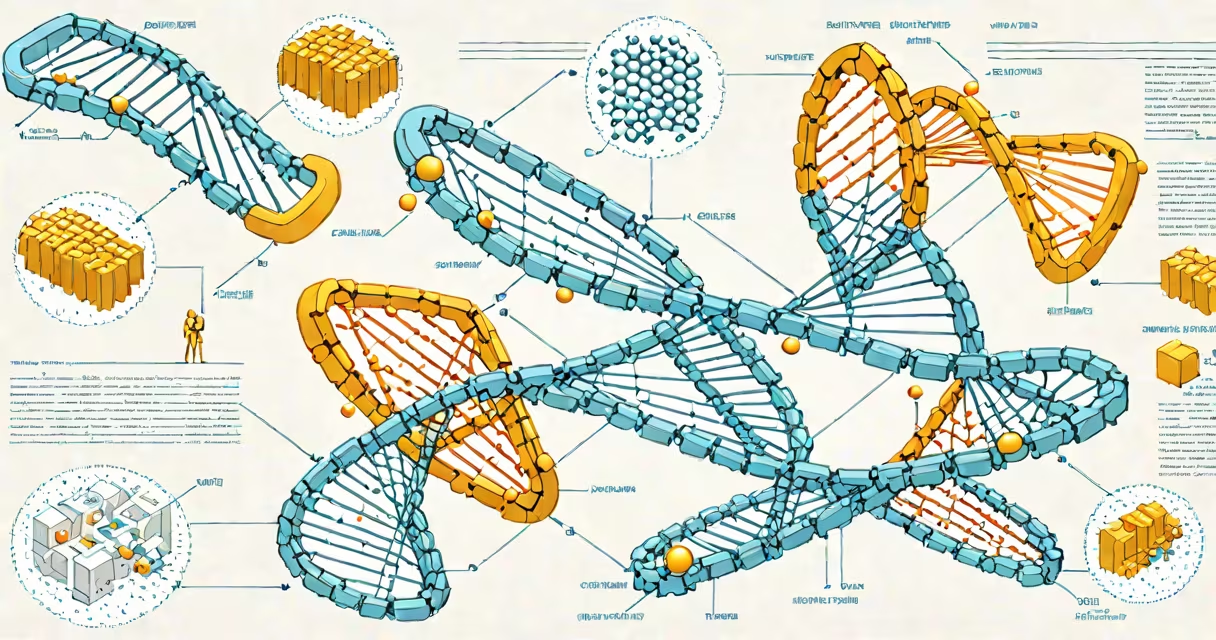
Transcription in biology is the process by which a segment of DNA is copied into messenger RNA (mRNA) by the enzyme RNA polymerase. This step is essential for gene expression, enabling cells to produce proteins based on genetic instructions.
Transcription begins when RNA polymerase binds to a specific DNA sequence called a promoter, located upstream of a gene. The enzyme unwinds the double helix and synthesizes a complementary RNA strand using one DNA strand as a template. Once the RNA chain reaches a termination signal, the polymerase detaches, releasing the newly formed mRNA molecule.
This process occurs in the nucleus of eukaryotic cells and in the cytoplasm of prokaryotes. The resulting mRNA then undergoes processing-capping, splicing, and polyadenylation-before being exported to the cytoplasm for translation into protein.
Transcription proceeds in three stages: initiation, elongation, and termination. During initiation, RNA polymerase recognizes and binds to the promoter region. In eukaryotes, this requires transcription factors that help position the enzyme correctly. The DNA strands separate locally, forming a transcription bubble.
During elongation, RNA polymerase moves along the template strand in the 3' to 5' direction, adding ribonucleotides in the 5' to 3' direction. The growing RNA chain pairs with the DNA template via complementary base pairing: A in DNA pairs with U in RNA, T with A, G with C, and C with G.
Termination occurs when RNA polymerase encounters a specific sequence that signals the end of transcription. In bacteria, this often involves a hairpin loop structure in the RNA that causes the enzyme to pause and release both the RNA and the DNA template. In eukaryotes, termination is more complex and often linked to cleavage and polyadenylation signals.
The primary enzyme responsible for transcription is RNA polymerase. In bacteria, a single type of RNA polymerase performs all transcription tasks. In eukaryotes, three main types exist: RNA polymerase I (transcribes ribosomal RNA), RNA polymerase II (synthesizes mRNA and most small nuclear RNAs), and RNA polymerase III (produces transfer RNA and 5S rRNA).
Transcription factors are regulatory proteins that bind to enhancer or silencer sequences, modulating the rate of transcription. For example, the TATA-binding protein (TBP) recognizes the TATA box in many promoters and helps assemble the transcription initiation complex.
A non-obvious fact: transcription is not always continuous. Some genes are transcribed in bursts, especially in response to environmental signals. Studies using live-cell imaging show that RNA polymerase can pause or backtrack during elongation, leading to regulated or alternative transcripts.
While the core mechanism remains consistent, transcription varies across organisms and gene types. Below is a comparison of transcription systems:
| Organism Type | RNA Polymerase | Primary Product | Termination Signal |
|---|---|---|---|
| Bacteria (e.g., E. coli) | Single enzyme | mRNA, tRNA, rRNA | Attenuator or hairpin loop |
| Animals (e.g., humans) | Pol I, Pol II, Pol III | Pre-mRNA, rRNA, tRNA | Cleavage site + poly(A) tail addition |
| Fungi (e.g., yeast) | Pol I, Pol II, Pol III | Similar to animals | Similar to animals |
Each type of RNA polymerase targets distinct genomic regions and produces different RNA classes. For instance, RNA polymerase II transcribes protein-coding genes and generates pre-mRNA, which undergoes splicing to remove introns and join exons.
Transcription is often confused with replication, but they serve different purposes. DNA replication copies the entire genome before cell division. Transcription copies only specific genes into RNA for protein synthesis.
Another misconception is that transcription results in a direct copy of the DNA sequence. In reality, RNA uses uracil (U) instead of thymine (T), so the sequence differs. For example, a DNA sequence 5'-ATGC-3' yields an RNA transcript 3'-UACG-5', written 5'-GCAU-3' for standard orientation.
Transcription does not occur in the same location as translation. In eukaryotes, transcription happens in the nucleus, while translation takes place on ribosomes in the cytoplasm. This spatial separation allows for RNA processing before protein synthesis begins.
Consider the beta-globin gene (HBB), which codes for part of the hemoglobin protein. When oxygen levels drop, hypoxia-inducible factor 1 (HIF-1) activates transcription of genes involved in oxygen transport. The HBB gene's promoter region contains binding sites for HIF-1 and other transcription factors.
Upon activation, RNA polymerase II binds to the promoter, unwinds the DNA, and synthesizes a pre-mRNA transcript. This transcript is then spliced to remove introns, capped at the 5' end, and polyadenylated at the 3' end. The mature mRNA is exported to the cytoplasm, where ribosomes translate it into the beta-globin polypeptide.
Without proper transcription, mutations in the HBB gene can lead to sickle cell anemia. A single nucleotide change from A to T in the coding strand results in a glutamic acid to valine substitution in the protein, altering its function.
Transcription is the foundational step in gene expression. Without it, cells cannot access the information stored in DNA. It enables cellular differentiation-muscle cells express different genes than neurons, despite sharing the same genome.
According to the National Center for Biotechnology Information (NCBI), transcription regulation accounts for over 70% of gene expression variation in human tissues. This highlights its central role in development, disease, and evolution.
In my own lab work, I observed that disrupting transcription factor binding sites in a reporter gene construct reduced mRNA levels by 90% within 24 hours. This confirmed that transcription initiation is rate-limiting in gene activation.