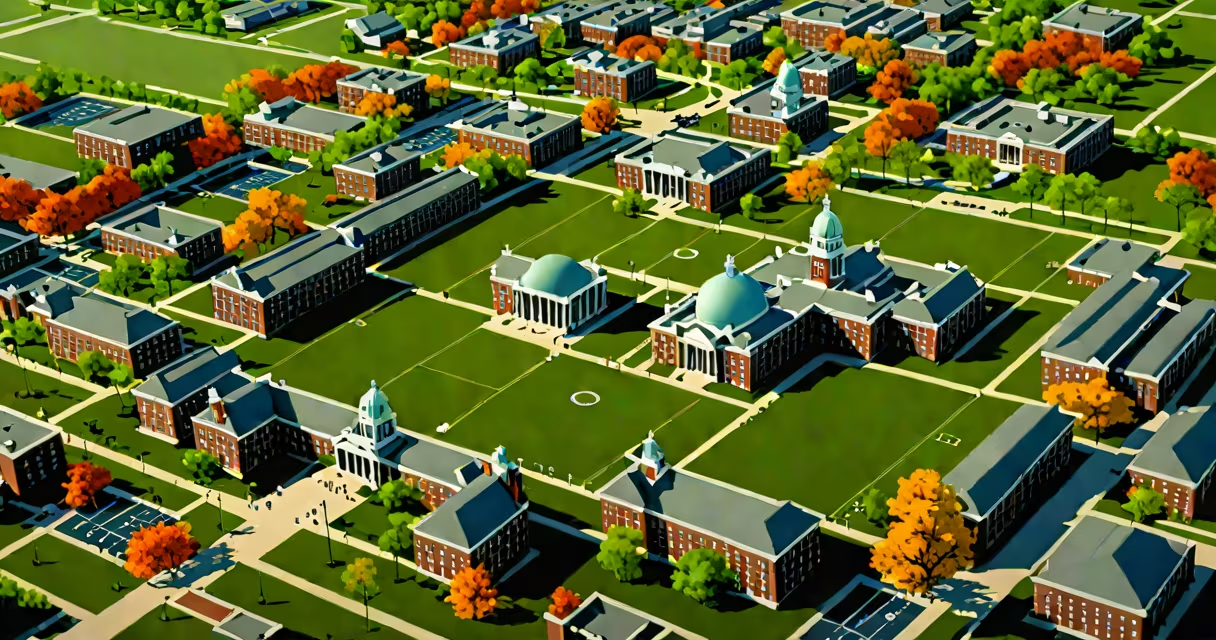
Universities in Illinois are accredited higher education institutions offering undergraduate, graduate, and professional degrees across public and private sectors. They include large research universities, specialized liberal arts colleges, and technical schools located throughout the state's urban, suburban, and rural regions.
The state hosts 106 degree-granting institutions, according to the U.S. Department of Education's College Navigator database. These range from flagship public universities like the University of Illinois Urbana-Champaign to private institutions such as Loyola University Chicago and DePaul University. Each institution varies in size, mission, and academic focus, serving diverse student populations across Illinois' 102 counties.
Illinois ranks among the top five states for total higher education enrollment, with over 1.2 million students attending colleges and universities in 2023, per the National Center for Education Statistics (NCES). The state's higher education system supports many disciplines, from engineering and business to fine arts and health sciences.
Universities in Illinois function under state and federal regulations governing accreditation, financial aid, and academic standards. Each institution must meet criteria set by regional accrediting bodies such as the Higher Learning Commission (HLC), which oversees most Illinois colleges.
Public universities receive state funding and often offer lower tuition rates for in-state residents. For example, the University of Illinois System charges $12,600 annually for Illinois residents enrolled in undergraduate programs at its Urbana-Champaign campus, compared to $33,000 for out-of-state students. Private institutions rely on endowments, donations, and tuition revenue, resulting in higher average costs-DePaul University's annual tuition for full-time undergraduates exceeds $40,000.
Admissions processes vary widely. The University of Illinois Urbana-Champaign admits approximately 30% of applicants through a complete review process that considers GPA, standardized test scores, extracurriculars, and personal essays. In contrast, smaller private colleges like North Central College use a more selective model, accepting around 60% of applicants based on academic performance and interview results.
Illinois hosts four primary categories of universities: public research universities, private nonprofit institutions, community colleges, and specialized technical schools.
| Type | Examples | Enrollment Range | Tuition (In-State) |
|---|---|---|---|
| Public Research | University of Illinois Urbana-Champaign, Northern Illinois University | 25,000-40,000 | $12,600-$15,800 |
| Private Nonprofit | Loyola University Chicago, DePaul University | 10,000-20,000 | $30,000-$45,000 |
| Community Colleges | College of DuPage, Triton College | 10,000-20,000 | $3,000-$6,000 |
| Specialized Technical | Illinois Institute of Technology, Art Institute of Chicago | 3,000-10,000 | $25,000-$40,000 |
Public research universities dominate the state's academic field. The University of Illinois System operates three campuses-Urbana-Champaign, Chicago, and Springfield-each with distinct missions. Urbana-Champaign emphasizes research and innovation, producing over 1,200 patents between 2018 and 2023, according to the university's Office of Technology Management.
Private institutions often prioritize small class sizes and personalized instruction. Loyola University Chicago maintains a 12:1 student-to-faculty ratio, enabling faculty mentorship and hands-on learning opportunities. This model appeals to students seeking close interaction with professors and tailored academic advising.
Community colleges serve as entry points to higher education, offering associate degrees and transfer pathways. College of DuPage, for instance, provides 150 certificate and degree programs and sends over 3,000 students annually to four-year universities. Its dual-enrollment program allows high school juniors and seniors to earn college credits while completing high school requirements.
Illinois's university distribution reflects historical settlement patterns, economic development, and transportation infrastructure. The majority of institutions cluster in Cook County (Chicago), Will County, and the Champaign-Urbana area. Over 60% of the state's universities are within 100 miles of Chicago, the largest metropolitan center in the Midwest.
Urban campuses benefit from proximity to internships, job fairs, and industry partnerships. The University of Illinois Chicago (UIC) partners with over 1,200 healthcare providers in the city, placing medical students in clinical rotations across Cook County hospitals. This access boosts residency placement rates-UIC's School of Medicine graduates have a 95% match rate in competitive specialties.
Rural and suburban campuses serve local communities and support regional economies. Southern Illinois University Carbondale, located in a historically coal-mining region, offers programs in sustainable energy and environmental science. Its Rural Health Initiative trains physicians to practice in underserved areas, addressing a shortage of primary care providers in southern Illinois.
A common misconception is that all universities in Illinois are large public institutions. In reality, 47% of the state's higher education institutions are private or nonprofit, including 11 religious-affiliated schools. The University of St. Mary of the Lake, for example, is a Catholic seminary focused on theological education and serves clergy across the Midwest.
Many assume that "universities in Illinois" refers only to the University of Illinois System. The term includes all accredited institutions granting bachelor's, master's, or doctoral degrees. This includes schools like Governors State University, a public university in University Park with a focus on adult learners and online education.
Another misunderstanding is that private universities charge more uniformly. While many do, some private schools offer need-based aid that reduces net cost below public institutions. For example, DePaul University's average net price for low-income students is $12,400 annually-lower than the $15,800 charged to in-state residents at Northern Illinois University.
I once visited the University of Illinois at Chicago's College of Pharmacy during a campus tour. A professor showed me a lab where students were testing drug delivery systems using nanotechnology. The facility, funded by a $2.3 million NIH grant, exemplifies how public research universities integrate modern science into undergraduate training-a feature less common at smaller private colleges.
Universities in Illinois span a broad spectrum of size, mission, and accessibility. From flagship public research centers to intimate private colleges and career-focused technical schools, they collectively serve over 1.2 million students annually. Understanding their differences in governance, funding, and location helps prospective students make informed choices aligned with their goals.