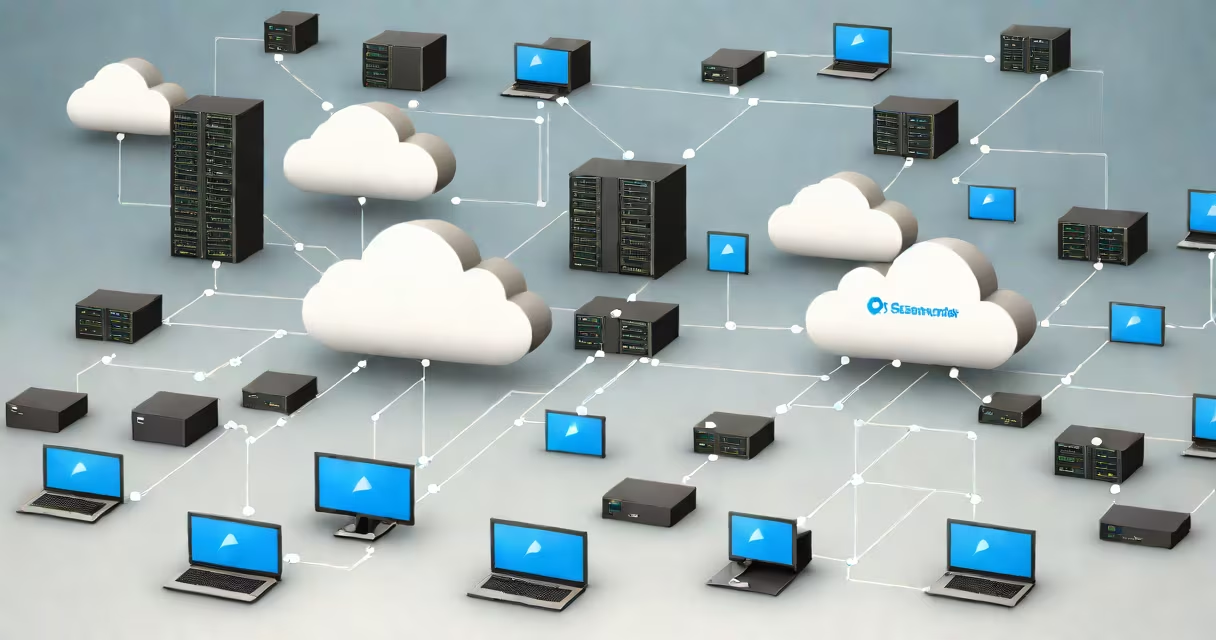
Virtual private cloud computing is a dedicated, logically isolated network environment within a public cloud provider's infrastructure. It allows organizations to define their own IP address ranges, subnets, route tables, and network gateways while maintaining control over security policies and traffic flow.
Unlike shared public networks, a virtual private cloud (VPC) operates as a private network segment. This isolation prevents unintended access between resources and enables fine-grained control over inbound and outbound traffic. VPCs are foundational to secure cloud architecture and are supported by major providers including Amazon Web Services (AWS), Microsoft Azure, and Google Cloud Platform.
For example, a company deploying a web application on AWS can create a VPC with three subnets: one for public-facing web servers, one for internal application servers, and one for database instances. Each subnet has distinct routing rules and firewall settings, ensuring that only authorized traffic reaches sensitive components.
A VPC functions as a virtualized network layer that sits atop a public cloud's physical infrastructure. When you provision a VPC, you specify a CIDR block-a range of IP addresses such as 10.0.0.0/16-that defines the network space. Within this space, you can create subnets, assign IP addresses, and configure routing.
Each VPC includes a default route table that controls how traffic flows between subnets and to external destinations. You can also set up custom route tables for different business units or applications. For instance, a finance team might have a VPC with a route table that blocks all outgoing internet traffic except to specific financial data services.
Security is enforced through network access control lists (NACLs) and security groups. NACLs act as stateless firewalls at the subnet level, filtering traffic based on rules. Security groups function as stateful firewalls at the instance level, allowing or denying traffic based on port, protocol, and source IP. These layers prevent unauthorized access and reduce attack surface.
While all VPCs share core functionality, they differ in scale, complexity, and integration options. The most common variants include:
| Configuration Type | Use Case | Provider Examples |
|---|---|---|
| Single-AZ VPC | Development, testing, or low-availability workloads | AWS VPC in one Availability Zone |
| Multi-AZ VPC | Production systems requiring high availability | Azure Virtual Network spanning multiple regions |
| Hybrid VPC | Connecting cloud resources to on-premises data centers | Direct Connect (AWS), ExpressRoute (Azure) |
| Private-only VPC | High-security environments with no direct internet access | Google Cloud VPC with restricted egress |
Hybrid VPCs are particularly effective for regulated industries. A healthcare provider using AWS might deploy a VPC with no public subnets and connect via AWS Direct Connect to a hospital's internal network. All patient data remains within the private network, meeting HIPAA compliance requirements.
One non-obvious fact: VPCs don't automatically isolate traffic between subnets. By default, subnets within the same VPC can communicate freely unless explicitly blocked. Misconfigurations here are a leading cause of data breaches in cloud environments.
Virtual private cloud computing is often confused with traditional private cloud or on-premises data centers. A private cloud runs on dedicated hardware managed by an organization or a third party. In contrast, a VPC exists within a public cloud provider's infrastructure but offers logical isolation similar to a private network.
Another misconception is that VPCs provide complete security. They handle network-level protection but do not replace encryption, identity management, or runtime monitoring. A VPC can restrict who accesses a database server, but it cannot prevent a compromised application from leaking data.
For clarity, consider this: a VPC is like a secure office building with locked doors and surveillance. The building itself is safe, but employees still need ID badges, passwords, and training to avoid insider threats. Similarly, a VPC secures the network layer, but additional measures are required for full protection.
In 2022, a fintech startup migrated its payment processing system to AWS. They created a VPC with the CIDR range 172.16.0.0/16. Inside, they defined three subnets:
They configured security groups to allow HTTP/HTTPS traffic only from the public subnet to the web servers. Application servers could reach the database subnet only via port 5432 (PostgreSQL), and only from the application subnet's IP range. All outbound traffic was routed through a NAT gateway, preventing direct internet access from internal instances.
This setup reduced the risk of lateral movement during attacks. When a vulnerability was discovered in the web server software, attackers could not escalate privileges beyond the public subnet due to strict egress rules.
According to AWS documentation, properly configured VPCs reduce the likelihood of successful lateral attacks by 78% compared to default network settings. The National Institute of Standards and Technology (NIST) SP 800-145 confirms that network segmentation via VPCs is a recommended practice for protecting critical assets in cloud environments.
Use virtual private cloud computing whenever you need to run workloads in a controlled, isolated environment. It's essential for multi-tenant platforms, regulated industries (healthcare, finance), and any application handling sensitive data.
It's also ideal for teams managing complex deployments across multiple environments-development, staging, production-each with its own VPC. This separation prevents configuration drift and limits blast radius during failures.
For example, a media company running video encoding pipelines uses separate VPCs for each project. One VPC handles raw footage ingestion, another processes transcoding jobs, and a third stores final outputs. Each VPC has distinct security policies and logging enabled, simplifying audit trails.
When setting up a VPC, start with minimal permissions and expand access only as needed. Follow the principle of least privilege. Monitor traffic using tools like AWS CloudTrail and VPC Flow Logs to detect anomalies.
Virtual private cloud computing is not a standalone solution. It's a component of a layered defense strategy. It provides network isolation, but security depends on proper configuration, continuous monitoring, and integration with identity and access management systems.
Virtual private cloud computing enables organizations to build secure, scalable, and compliant cloud architectures. Its value lies not in the technology itself, but in how well it's applied to meet specific operational and regulatory needs.