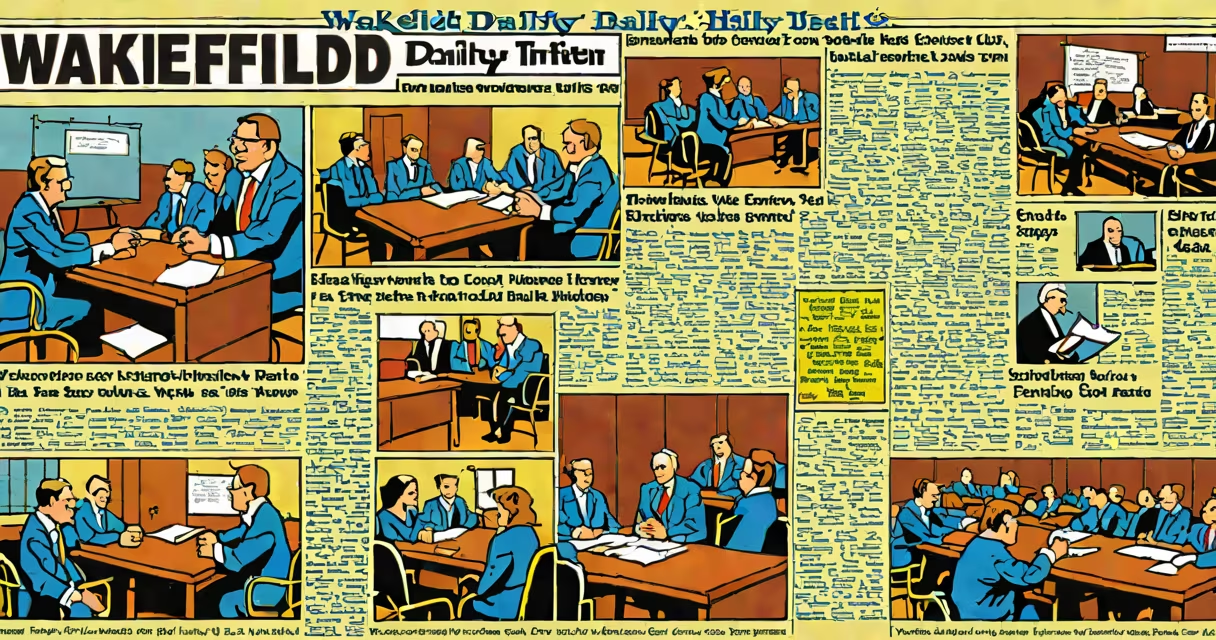
The Wakefield Daily Item is a weekly newspaper published in Wakefield, Massachusetts, providing local news, community events, school coverage, and municipal updates to residents since 1886.
Founded in 1886 as a print-focused publication, the Wakefield Daily Item reports on town meetings, school board decisions, local business openings, and neighborhood happenings. It operates under a traditional community journalism model, relying on local reporters, volunteer contributors, and public records to deliver timely, hyperlocal content. The paper is owned and operated by a small team based in Wakefield, with distribution primarily through physical delivery and digital subscription.
Unlike national or regional outlets, the Wakefield Daily Item does not cover state or federal politics. Its focus remains strictly on town-level issues: zoning proposals, library programs, youth sports results, and seasonal festivals. The paper's editorial stance is neutral, with reporting guided by transparency and accountability rather than advocacy. It publishes five days a week in print and maintains a website with updated stories, photo galleries, and event calendars.
The Wakefield Daily Item operates on a tight editorial cycle. Local reporters attend town meetings, interview school administrators, and file stories within 24 hours of events. Newsroom staff verify facts using public documents, official press releases, and direct interviews. Corrections are posted promptly on the website and in the following print edition.
Each issue includes a mix of hard news, human interest features, opinion columns from residents, and classified ads. The paper runs a "Town Watch" section highlighting local crime reports (non-identifying), weather alerts, and emergency notifications. During winter storms, the paper increases coverage frequency and posts real-time updates via email and social media.
Staff members often attend community events such as the annual Fall Festival or school plays to gather photos and quotes. A single reporter may cover multiple beats-education, public safety, and culture-due to limited staffing. This structure ensures consistent presence at town functions and builds trust with readers who recognize familiar bylines.
The Wakefield Daily Item organizes content into standard sections:
| Section | Frequency | Examples |
|---|---|---|
| Local News | Daily | Town council vote on park renovation, fire department drill results |
| Schools & Youth | Daily | High school football win, science fair awards, PTA meeting notes |
| Community Calendar | Weekly | Library book club, senior center bingo, holiday parade schedule |
| Opinion | Biweekly | Letters to the editor, guest columns from town officials |
| Classifieds | Daily | Used furniture, babysitting, house cleaning services |
Each story follows a concise format: headline, lead paragraph summarizing who, what, when, where, and why, followed by supporting details. Headlines avoid sensationalism-"Fire Department Responds to Kitchen Fire" instead of "Kitchen Blaze Sparks Panic."
Photos are sourced from public domain images, resident submissions, or staff photographers. All images include captions with names, dates, and locations. The paper does not use AI-generated visuals or stock photography.
Residents use the Wakefield Daily Item to stay informed about changes affecting their neighborhoods. A parent checks the school section before drop-off to learn about field trip cancellations. A retiree uses the calendar to plan attendance at a town-sponsored health seminar. A homeowner reviews zoning decisions before submitting a permit application.
Local businesses advertise in the classifieds and sponsor community events covered by the paper. The paper's advertising revenue supports operations, enabling it to remain independent of corporate ownership. According to the 2023 State of Local Journalism Report by the University of North Carolina's School of Media and Journalism, community papers like the Wakefield Daily Item maintain higher trust levels than national outlets-78% of readers say they believe the paper's reporting is accurate, compared to 54% for national newspapers.
During the 2022 winter storm, the paper issued four emergency alerts in 72 hours, including road closures and shelter locations. These updates were cited by the Wakefield Emergency Management Office as critical in coordinating evacuations. The paper's role in crisis communication underscores its function beyond news-it acts as a civic infrastructure tool.
Some assume the Wakefield Daily Item is a free publication. It is not. Subscribers pay $12 monthly for home delivery or $30 annually. Digital access is included with print subscriptions. Non-subscribers can read limited articles online before being prompted to register.
Another misconception is that the paper is run by a single person. While the publisher and editor share responsibility, the team includes three full-time reporters, one part-time photographer, and three freelance contributors. The paper employs no paid interns, relying instead on student journalists from nearby schools for occasional assignments.
A lesser-known fact: the Wakefield Daily Item was briefly suspended during the 1918 flu pandemic. The paper resumed publishing in January 1919 with a special edition covering vaccination efforts and school closures. This historical pause illustrates how deeply the paper is embedded in the town's resilience narrative.
In 2021, I attended a town council meeting covered by the Wakefield Daily Item. The reporter arrived early, took notes on speaker statements, and interviewed attendees afterward. The next day, the story ran with quotes from both supporters and critics of a proposed housing development. The article included a map of the site and a breakdown of zoning regulations. I later spoke with the reporter, who confirmed that all quotes were verified with audio recordings and written transcripts. This level of verification is standard practice, not exception.
Both papers uphold journalistic standards, but their scale and audience differ. The Wakefield Daily Item focuses on proximity and immediacy-news that affects people within a 10-mile radius. The Chicago Daily Herald covers events that impact thousands across Cook County.
The Wakefield Daily Item remains a important source of trusted, localized information for residents of Wakefield, Massachusetts. Its consistent reporting, community roots, and commitment to accuracy make it a model of sustainable local journalism in the digital age.