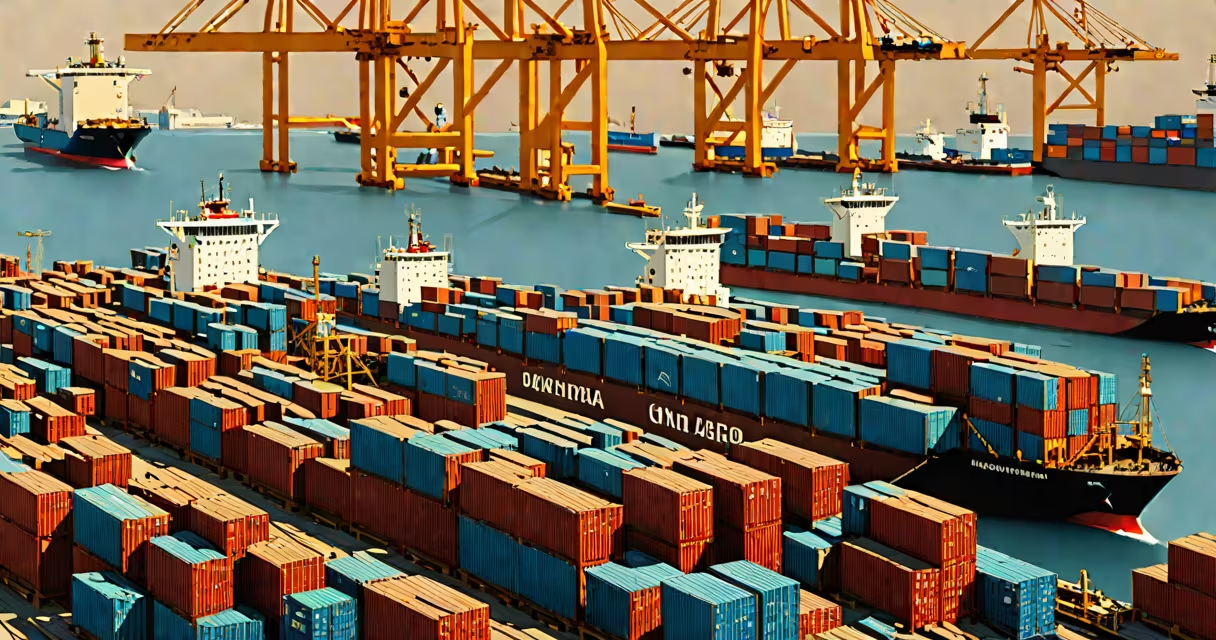
Free trade reduces barriers like tariffs and quotas between nations, allowing goods and services to move across borders with minimal restrictions. This system enables countries to specialize in producing what they make most efficiently, leading to greater economic output and lower prices for consumers.
When countries engage in free trade, they focus on industries where they have a comparative advantage-producing goods at a lower opportunity cost than others. This specialization increases productivity and allows nations to export surplus production while importing goods they cannot produce as efficiently. As a result, global supply chains become more efficient, and consumers gain access to a wider variety of products at lower costs.
The World Bank estimates that eliminating all trade barriers globally could increase world GDP by $1.2 trillion annually. The United Nations Conference on Trade and Development (UNCTAD) reports that developing countries benefit disproportionately from free trade due to their ability to scale labor-intensive manufacturing exports. These gains stem not from raw material abundance but from strategic positioning in global value chains.
Free trade operates through agreements that reduce or eliminate import duties, subsidies, and non-tariff barriers such as complex regulations or licensing requirements. For example, the United States-Mexico-Canada Agreement (USMCA) replaced NAFTA and updated rules for digital trade, intellectual property, and labor standards. Under USMCA, Canadian automakers exporting vehicles to the U.S. face no additional tariffs, provided they meet regional content rules.
Specialization drives efficiency. Vietnam produces textiles at lower cost than Germany due to lower labor expenses and established supply networks. Germany focuses on high-precision machinery and automotive engineering. When both countries trade freely, German consumers buy affordable Vietnamese clothing, and Vietnamese consumers access advanced industrial equipment. This exchange boosts living standards on both sides.
A 2021 study by the Peterson Institute for International Economics found that U.S. imports from China under free trade policies lowered consumer prices by 1.5% annually between 2000 and 2017. That equates to roughly $1,000 in annual savings per household, according to inflation-adjusted calculations.
Free trade exists in multiple forms, ranging from bilateral deals to multilateral frameworks. The table below outlines major types and their real-world applications.
| Type | Scope | Example | Impact |
|---|---|---|---|
| Bilateral agreement | Two countries | U.S.-South Korea Free Trade Agreement (KORUS) | Reduced tariffs on steel, autos, and agricultural goods; U.S. exports to South Korea rose 37% from 2012 to 2016 |
| Regional bloc | Multiple nations within a geographic zone | European Union Single Market | Eliminates internal tariffs among 27 member states; enables smooth movement of goods, capital, services, and people |
| Global structure | International organization covering many nations | World Trade Organization (WTO) rules | Establishes dispute resolution mechanisms and enforces transparency in trade practices across 164 members |
Each model serves different goals. Bilateral deals often resolve specific trade imbalances. Regional blocs deepen integration. Global frameworks provide stability and legal recourse. The WTO's dispute settlement system handled 580 cases between 1995 and 2020, resolving conflicts that threatened trade flows.
Free trade does not eliminate all job losses. While it creates new opportunities in export-oriented sectors, some domestic industries may shrink. For example, U.S. textile manufacturing declined by 30% between 2000 and 2010 due to competition from low-cost imports. However, the same period saw a 22% rise in U.S. exports of medical devices and aerospace components-industries where American firms hold technological advantages.
Another myth is that free trade favors large corporations over small businesses. In reality, small exporters benefit from reduced entry barriers. A 2020 OECD report showed that small and medium enterprises (SMEs) accounted for 40% of exports in OECD countries, up from 30% in 2000. Digital platforms like Alibaba and Amazon have enabled SMEs in Vietnam and Kenya to reach global buyers without physical storefronts.
Free trade does not require equal outcomes. Countries do not need to have identical wages or environmental standards to trade. The core principle is mutual benefit through voluntary exchange. Even if one nation has higher labor costs, it can still profit by exporting specialized services or high-value goods.
Apple designs iPhones in California, manufactures components in China, assembles them in Vietnam, and ships them worldwide. Without free trade agreements, each step would face tariffs and customs delays. Under the U.S.-China Phase One Trade Agreement, certain electronics components entered the U.S. duty-free, reducing final product costs.
According to Apple's 2022 supplier responsibility report, the company's global supply chain supports over 2 million jobs. Workers in Shenzhen assemble devices using parts sourced from Japan, South Korea, and Taiwan. Free trade enables this network to function efficiently. If tariffs were reintroduced on any component, Apple estimated it would raise the iPhone's base price by $25 to $35 per unit.
Free trade also fosters innovation. Access to diverse talent pools and materials accelerates research and development. A 2023 study published in *The Journal of International Economics* found that multinational firms with cross-border operations innovate 28% faster than purely domestic ones.
I once visited a family-run textile workshop in Dhaka, Bangladesh, that began exporting cotton scarves to U.S. boutiques in 2018. Prior to the U.S.-Bangladesh Trade and Investment Structure Agreement, shipping costs were inflated by customs inspections and inconsistent documentation. After the agreement took effect, delivery times dropped from 45 days to 21 days, and import duties fell from 12% to 3%. Sales grew 60% in two years.
This success wasn't due to lower wages alone. The business invested in design software and quality control systems, enabled by access to U.S. markets. They now export to 14 countries, including Canada and Germany, thanks to tariff reductions under the EU-Bangladesh Economic Partnership Agreement.
The benefits of free trade are measurable and widespread. Countries gain through specialization, consumers enjoy lower prices, and businesses expand beyond local markets. While adjustment costs exist, historical evidence shows net gains across economies. The World Trade Organization confirms that trade openness correlates strongly with long-term economic growth.
Understanding the benefits of free trade clarifies how interconnected economies grow stronger together. It is not a zero-sum game but a system where participation expands opportunity for all.