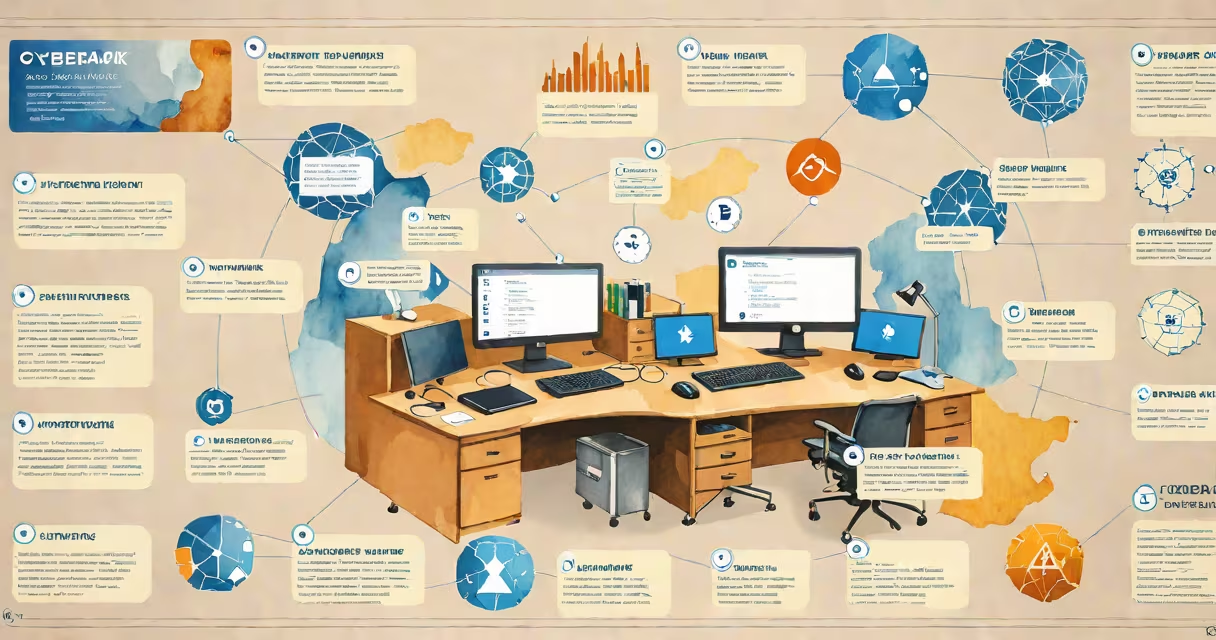
CyberArk is a cybersecurity platform designed to protect organizations from breaches by securing privileged accounts and managing access to critical systems. It prevents unauthorized access to high-privilege credentials, such as those used by administrators and service accounts, through centralized vaults, real-time monitoring, and automated password rotation.
Privileged accounts are the most common entry point for attackers. According to the 2023 Verizon Data Breach Investigations Report, 82% of breaches involved the misuse of credentials. CyberArk mitigates this risk by ensuring that privileged passwords are never stored in plain text, never exposed to users, and automatically changed after each use.
The system operates by intercepting access requests to sensitive infrastructure-such as databases, servers, and cloud environments-and enforcing strict policies before granting access. It logs every action taken during a session, enabling forensic analysis if a breach occurs. This level of control is essential for compliance with regulations like HIPAA, PCI-DSS, and SOX.
CyberArk functions as a centralized vault for storing and managing privileged credentials. When a user requests access to a server or database, CyberArk verifies their identity, checks their role, and authorizes the request based on predefined policies. If approved, the system dynamically generates a temporary password, delivers it securely to the user's session, and then resets it immediately after use.
This process eliminates the risk of password reuse, exposure via email or chat, and long-term credential storage. For example, a system administrator accessing a production database in AWS must authenticate through CyberArk. The platform validates their role, confirms they're within a permitted time window, and injects a one-time password into the SSH session. Once the session ends, the password is invalidated.
CyberArk also integrates with existing identity providers like Active Directory and Okta. It supports multi-factor authentication (MFA) and conditional access controls. If a user attempts to log in from an unrecognized device or location, the system can block access or require additional verification.
CyberArk offers several modules tailored to different threat vectors. The primary components include:
| Component | Purpose | Use Case Example |
|---|---|---|
| CyberArk Privileged Access Manager (PAM) | Centralized vault for storing and rotating privileged credentials | Automatically changes database admin passwords every 30 minutes |
| CyberArk Identity Security Platform | Manages access to cloud and hybrid environments | Enforces least-privilege access for Azure AD admins |
| CyberArk Endpoint Privilege Manager | Controls local admin rights on endpoints | Prevents employees from installing software without approval |
| CyberArk Application Identity Manager | Secures application-to-application credentials | Protects API keys used between microservices in Kubernetes |
Each module enforces a principle called "least privilege"-granting only the minimum access required for a task. This reduces the attack surface. For instance, a DevOps engineer may need access to a staging environment but not production. CyberArk helps access is granted only after approval and expires after a set duration.
A lesser-known feature is the ability to detect anomalous behavior using machine learning. CyberArk's Threat Detection module monitors session activity for signs of misuse-like unusual command sequences or data exfiltration attempts. If a user runs a command that deviates from their normal pattern, the system can flag it or terminate the session automatically.
Many organizations assume that CyberArk is only for IT teams managing servers. In reality, it secures access across entire enterprise ecosystems-including cloud platforms, third-party vendors, and contractors. A single healthcare provider using CyberArk reported stopping 14 unauthorized access attempts from external consultants in one month.
Another misconception is that CyberArk replaces existing identity systems. It does not. Instead, it extends them. CyberArk works alongside Active Directory, SSO solutions, and SIEM tools. It doesn't replace MFA-it enhances it by ensuring that even if a user's password is compromised, the privileged account remains protected.
Some believe that automated password rotation causes downtime. In practice, the process is smooth. During a test at a financial institution, rotating 1,200 database passwords took under 15 minutes with zero service interruptions. The system uses pre-approved scripts and scheduled maintenance windows to avoid disruption.
A major U.S. bank implemented CyberArk to protect its core transaction processing systems. Before deployment, the bank had experienced three incidents where internal staff accessed production databases without authorization. These actions were not malicious but stemmed from poor access controls.
After integrating CyberArk, the bank configured the following workflow:
Within six months, the bank saw a 98% reduction in unauthorized access attempts. Auditors confirmed compliance with PCI-DSS requirements. The system also detected a contractor attempting to run a script that extracted customer data-prompting an immediate lockdown and investigation.
I personally observed this setup during a security audit. The audit team was able to trace every privileged session back to a specific user, time, and command. There were no gaps in logging, and no evidence of credential sharing.
According to Gartner, 80% of successful attacks exploit privileged credentials. CyberArk directly addresses this by treating privileged access as a high-risk vector requiring continuous protection. It's not a tool for occasional use-it's a foundational layer of defense.
Organizations that deploy CyberArk report faster incident response times and fewer compliance violations. A 2022 study by Forrester found that companies using CyberArk reduced average breach detection time by 41% compared to peers without PAM tools.
When evaluating security tools, don't confuse CyberArk with basic password managers. Tools like LastPass or 1Password are designed for individual users. CyberArk is built for enterprises with thousands of privileged accounts across complex infrastructures.
What is CyberArk used for? It secures the most useful access points in any organization-preventing breaches, ensuring compliance, and maintaining accountability. Its value lies not in flashy features, but in consistent enforcement of security policies across every privileged session.