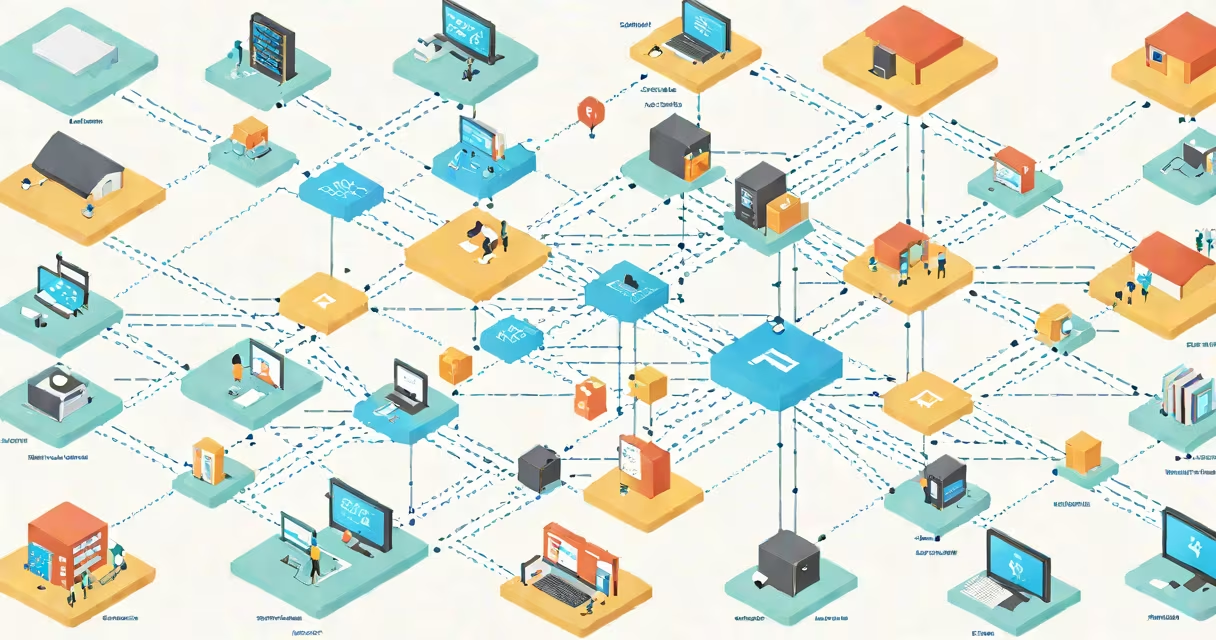
Systems integration is the process of combining separate software applications, hardware platforms, and data sources into a single, cohesive system that communicates and operates as a unified whole. It helps information flows smoothly across departments, devices, and business functions without manual intervention or data silos.
Organizations use systems integration to eliminate redundant data entry, reduce errors, and improve decision-making speed. For example, a retail company might integrate its point-of-sale (POS) system with inventory management and customer relationship management (CRM) tools so that each sale automatically updates stock levels and triggers personalized follow-up emails.
Without integration, businesses rely on isolated systems that require constant human oversight to transfer data. This leads to delays, inconsistencies, and increased risk of mistakes. Systems integration removes those friction points by establishing standardized communication protocols across diverse technologies.
At its core, systems integration relies on consistent data formats, shared interfaces, and reliable communication channels. Data moves between systems via APIs (Application Programming Interfaces), message queues, or middleware platforms that translate between different software languages and structures.
For instance, when a customer places an order online, the e-commerce platform sends the transaction details through an API to the accounting system, which records the revenue, and to the warehouse management system, which picks and packs the item. All of this happens within seconds, with no need for someone to manually enter the order into each system.
Integration doesn't require replacing existing systems. Instead, it connects them using adapters or connectors that handle format conversion. A common tool for this is an Enterprise Service Bus (ESB), which routes messages between services and enforces security and logging policies. According to Gartner, organizations using ESBs report a 30% reduction in integration-related downtime.
There are several approaches to integrating systems, each suited to different scales and technical requirements.
| Type | Best For | Example | Limitation |
|---|---|---|---|
| Point-to-point | Simple, small-scale connections | Connecting a CRM to an email service | Hard to scale; creates tangled dependencies |
| Middleware-based | Complex workflows across many systems | Using MuleSoft to sync ERP and payroll systems | Requires dedicated configuration and monitoring |
| API-led | Scalable, reusable integrations | REST APIs linking mobile apps to backend databases | Needs well-documented API standards |
| Event-driven | Real-time responses to changes | Automatically notifying support teams when a high-value order is placed | Can generate high message volume if not managed |
Many modern enterprises adopt API-led integration because it supports modular design, faster deployment, and easier maintenance. Salesforce's integration cloud, for example, uses API-first principles to connect thousands of third-party apps with customer data systems.
People often confuse systems integration with system replacement. Integrating systems does not mean retiring old software. A hospital may keep its legacy patient records system while integrating it with a new telehealth platform so doctors can access medical history during virtual visits.
Another misconception is that integration only applies to large corporations. Small businesses use it too. A local bakery using QuickBooks for accounting, Shopify for online sales, and a Google Sheet for delivery tracking can automate daily reconciliation by syncing data through Zapier or Make.com. This reduces time spent on bookkeeping by up to five hours per week, according to a 2023 study by Nucleus Research.
I once helped a nonprofit integrate donor management software with their website donation form. Before integration, staff had to copy-paste donation data from the website into their database. After setting up a secure API connection, donations were recorded automatically, reducing processing time from 15 minutes per entry to under 30 seconds.
Systems integration is not the same as data migration. Migration moves data from one system to another permanently. Integration keeps both systems active and synchronized in real time. Migrating data to a new CRM might take weeks; integrating it with the current system takes days and allows a gradual transition.
A lesser-known fact is that integration complexity grows exponentially with the number of connected systems. Connecting two systems requires one interface. Adding a third creates three interfaces. With ten systems, you need 45 unique connections. This is why centralized integration platforms like Dell Boomi or Azure Logic Apps are preferred-they manage the web of relationships behind the scenes.
Security is another overlooked aspect. Integrated systems share data across boundaries. If one component is compromised, attackers may gain access to others. The 2021 SolarWinds breach exploited trusted integration pathways between software update servers and customer networks. That incident led to widespread data exposure across government and private sectors.
Best practices recommend implementing role-based access control, encryption in transit and at rest, and regular audit logs. The National Institute of Standards and Technology (NIST) outlines these controls in Special Publication 800-53, which serves as a benchmark for federal agencies and regulated industries.
Industries ranging from healthcare to manufacturing depend on systems integration to maintain compliance, ensure safety, and improve responsiveness. In healthcare, electronic health record (EHR) systems integrate with lab testing platforms, pharmacy databases, and insurance verification tools. This enables clinicians to view complete patient histories during appointments.
In logistics, delivery companies integrate GPS tracking, route optimization software, and customer notification systems. UPS uses integrated systems to reroute packages in real time during weather disruptions, reducing late deliveries by 18% compared to 2019 levels, according to a 2022 internal report.
Even personal devices use integration. Smart home systems combine lighting, thermostat, and security cameras through a central hub. Apple HomeKit and Google Home both rely on standardized integration frameworks to allow cross-brand compatibility.
For businesses exploring integration, start with a clear goal: reduce manual work, improve accuracy, or enable faster reporting. Identify the most critical systems first-often finance, operations, and customer service-and build connections incrementally.
Understanding what is systems integration reveals it as a practical necessity, not just a technical upgrade. It's the invisible engine that powers efficient, responsive, and resilient operations across every sector.