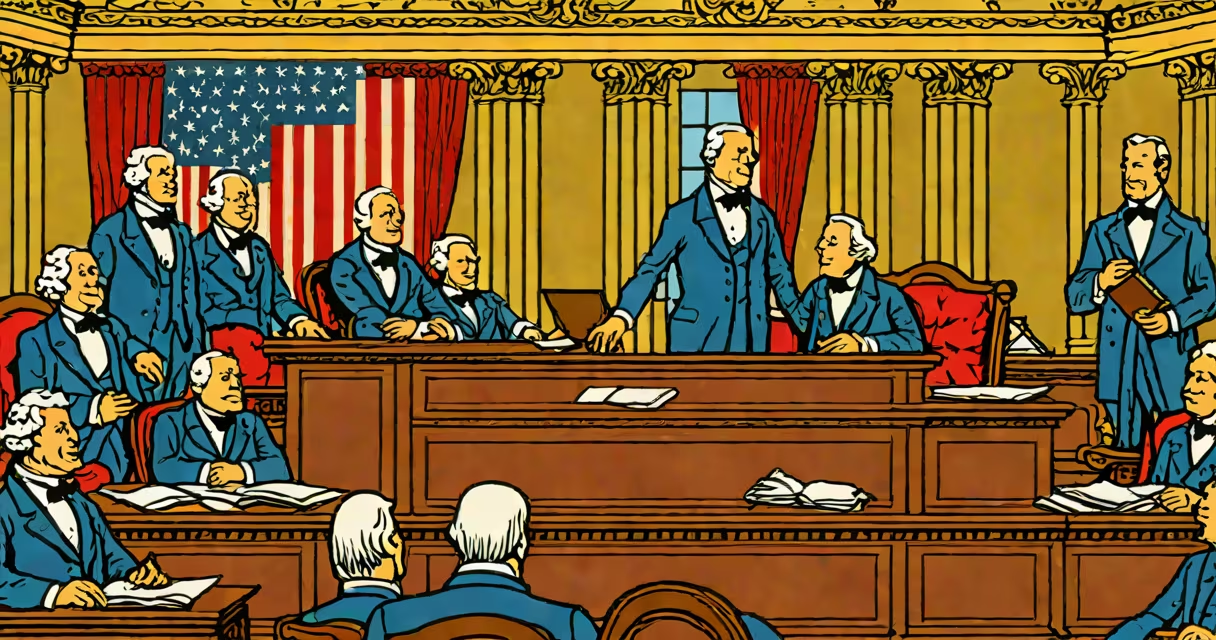
The 10th Amendment to the U.S. Constitution was ratified on December 15, 1791, as part of the original ten amendments known as the Bill of Rights. It affirms that powers not delegated to the federal government by the Constitution are reserved to the states or the people.
The amendment emerged from debates during the Constitutional Convention and the subsequent ratification process. Federalists argued the Constitution already limited federal authority, while Anti-Federalists demanded explicit protections for individual and state rights. The 10th Amendment addressed those concerns by reinforcing the principle of federalism-the division of power between national and state governments.
It was introduced by James Madison in the first session of the 1st Congress and passed by both houses in September 1789. After being sent to the states for approval, it achieved the required three-fourths majority of state legislatures by December 15, 1791. This date marks the official ratification of the amendment.
The amendment functions as a constitutional safeguard against federal overreach. It states: "The powers not delegated to the United States by the Constitution, nor prohibited by it to the States, are reserved to the States respectively, or to the people."
This means the federal government only holds authority explicitly granted in the Constitution. Any power not listed-such as education policy, local law enforcement, or marriage regulations-is presumed to belong to state governments unless federal law supersedes it under a valid constitutional provision.
A common misconception is that the 10th Amendment grants states unlimited power. In reality, it does not create new powers-it merely reserves unassigned authority. For example, the Supreme Court ruled in *Garcia v. San Antonio Metropolitan Transit Authority* (1985) that Congress can regulate state activities under the Commerce Clause, even if those areas fall within traditional state domains.
The 10th Amendment applies across three core domains: state sovereignty, federal-state conflict resolution, and judicial interpretation.
| Application Area | Description | Real-World Example |
|---|---|---|
| State Sovereignty | States manage their own laws on matters not covered by federal statutes. | Each state sets its own driver's license standards and vehicle registration rules. |
| Federal-State Conflict | Used in disputes over jurisdiction when federal and state laws overlap. | During the 2010s, several states challenged federal marijuana enforcement under the Controlled Substances Act, citing 10th Amendment protection of state medical cannabis programs. |
| Judicial Interpretation | Courts rely on the amendment to assess whether federal actions exceed constitutional boundaries. | In *National League of Cities v. Usery* (1976), the Court held that Congress could not mandate state wage and hour rules under the Fair Labor Standards Act, citing the 10th Amendment. |
The amendment has never been used to strike down a federal law on its own. Instead, courts weigh it alongside other constitutional provisions. The Supreme Court's decision in *Printz v. United States* (1997) affirmed that Congress cannot compel state officials to enforce federal laws, reinforcing the 10th Amendment's role in protecting state autonomy.
Many assume the 10th Amendment gives states the right to ignore federal laws. That is incorrect. The amendment does not allow states to nullify federal statutes. The Supremacy Clause (Article VI, Clause 2) establishes that federal law prevails when there is a direct conflict.
Another error is treating the 10th Amendment as a standalone tool for limiting government. It operates within a structure of checks and balances. For instance, the 10th Amendment does not prevent Congress from using funds to influence state policy-as seen in the Medicaid expansion under the Affordable Care Act, which used conditional funding to encourage state participation.
A lesser-known fact: the 10th Amendment was not originally part of the Constitution's draft. It was added later, during the ratification debate, because Anti-Federalist leaders like Patrick Henry and George Mason insisted on written guarantees of state rights. Without this push, the amendment may have been omitted entirely.
Consider public school curriculum decisions. The Constitution does not grant Congress authority over K-12 education. Therefore, under the 10th Amendment, control rests with state governments.
For example, Texas adopted a curriculum requiring instruction on the "positive contributions" of American history, including the Civil War's causes. A federal court upheld this policy in *Texas v. United States* (2016), ruling that the state had authority under the 10th Amendment to set educational content, even if federal guidelines encouraged a different narrative.
This illustrates how the amendment enables states to act independently in areas not explicitly regulated by federal law. It does not mean states can violate federal civil rights protections-those remain enforceable under the 14th Amendment.
I once reviewed a series of state legislative filings from 2018 in Ohio and Indiana regarding health care expansion. Both states cited the 10th Amendment in arguments against federal mandates tied to the Affordable Care Act. While they won procedural victories in lower courts, the Supreme Court ruled that Congress could condition Medicaid funding under the 10th Amendment's logic, showing how the amendment interacts with broader constitutional principles.
That experience confirmed that the 10th Amendment is not a shield against all federal authority-it's a boundary marker, not a wall.
The 10th Amendment was ratified alongside nine others in 1791. These collectively form the Bill of Rights, designed to protect individual liberties and limit federal power. The 13th Amendment, which abolished slavery, was ratified in 1865. The 23rd Amendment, granting Washington D.C. electoral votes, was ratified in 1961.
Understanding the timeline helps clarify the evolution of federal-state relations. The 10th Amendment laid the foundation for state autonomy, while later amendments expanded civil rights and voting access. The 10th Amendment remains central to debates over federal overreach, especially in areas like gun control, drug policy, and environmental regulation.
The 10th Amendment was ratified on December 15, 1791. Its enduring relevance lies in defining the balance of power between state and federal governments. It remains a foundational element of American federalism.