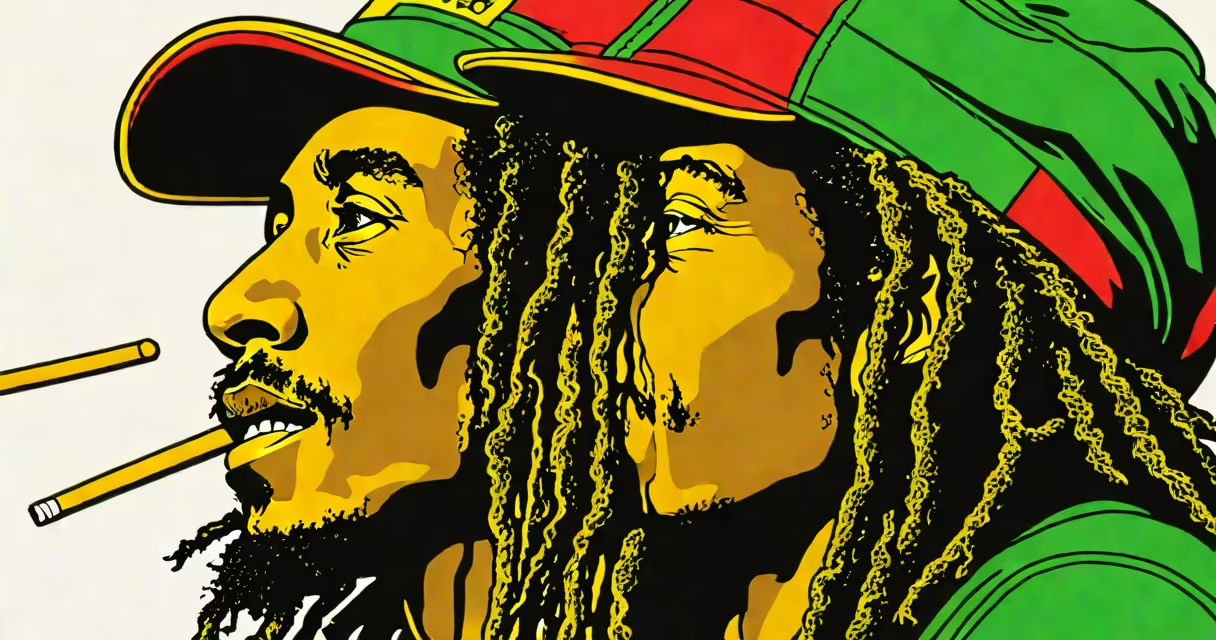
Bob Marley was a Jamaican musician, singer, songwriter, and cultural icon whose reggae music became a global voice for social justice, resistance to oppression, and spiritual awakening. His work fused Caribbean rhythms with Rastafarian beliefs, political protest, and universal themes of love and redemption.
Marley's music emerged from the streets of Kingston, Jamaica, in the late 1960s. He formed the Wailers with Peter Tosh and Bunny Wailer, evolving from ska and rocksteady into a distinct reggae sound marked by offbeat guitar rhythms, driving basslines, and lyrical depth. By the early 1970s, his songs like "Get Up, Stand Up," "One Love," and "Redemption Song" had transcended borders, becoming anthems for civil rights movements, anti-colonial struggles, and peace initiatives.
His influence extends beyond music. Marley embodied Rastafarian principles-Afrocentrism, spiritual consciousness, and reverence for Haile Selassie, whom Rastafarians regard as divine. He wore his hair in dreadlocks, spoke in Patois, and lived by a philosophy rooted in African identity and resistance to Western domination. These elements were central to his public persona and artistic output.
Reggae, as developed by Marley and his contemporaries, uses a rhythmic structure known as the "one drop" beat. This places the snare drum on the third beat of a four-beat measure, creating a syncopated groove that feels both grounded and hypnotic. The bassline often mirrors the drum pattern, reinforcing the offbeat emphasis.
Lyrically, Marley's songs blended personal reflection with political commentary. "War" (1976), based on a speech by Ethiopian Emperor Haile Selassie, condemned racism and war while calling for global unity. "Kaya" (1975) used sensual imagery to explore freedom and autonomy, reflecting both personal desire and broader liberation themes.
He recorded in studios like Studio One and Channel One in Kingston, working with producers such as Lee "Scratch" Perry and Chris Blackwell of Island Records. Blackwell's 1973 album *Catch a Fire* introduced Marley to international audiences, selling over 1 million copies in the U.S. alone within five years.
Marley's artistry drew from multiple sources: Jamaican folk traditions, American soul and gospel, West African musical forms, and Rastafarian theology. His lyrics often referenced biblical passages, particularly the Book of Isaiah, which speaks of "the lion of Judah." This imagery reinforced his identity as a messenger of hope.
He also incorporated traditional Jamaican rhythms like mento and nyabinghi drumming-used in Rastafarian ceremonies. The nyabinghi ensemble features hand drums, shakers, and call-and-response vocals, creating a trance-like atmosphere that Marley adapted into live performances and recordings.
Despite his global fame, Marley remained deeply connected to his roots. He lived in a modest house in Kingston's Trenchtown neighborhood, where he grew up. He maintained a vegetarian diet, avoided alcohol and drugs (except cannabis, which he viewed as sacred), and emphasized community and collective responsibility.
Bob Marley's songs appear in film soundtracks, sports events, political rallies, and public service campaigns. "One Love" was played during the 2012 London Olympics opening ceremony. "Three Little Birds" became a viral internet meme, used in videos promoting resilience and optimism.
His music remains a staple in educational settings. The University of the West Indies includes "Redemption Song" in courses on postcolonial literature and African diaspora studies. UNESCO recognizes reggae as part of the Intangible Cultural Heritage of Humanity, citing Marley's role in shaping its global significance.
Commercially, Marley's estate continues to generate revenue through licensing. In 2022, the Bob Marley Foundation reported $23 million in royalties from music, merchandise, and film rights. His 1977 album *Exodus* has sold over 10 million copies worldwide, according to Nielsen Music.
Many assume Marley was apolitical. This is false. He actively supported anti-imperialist causes and criticized Western governments. In a 1978 interview with *Rolling Stone*, he stated, "I'm not trying to make money. I'm trying to make people aware."
Another myth is that his music was purely upbeat. While many tracks celebrate joy, others confront trauma. "Burnin' and Lootin'" (1973) describes the destruction of homes during riots in Jamaica. "Concrete Jungle" (1973) critiques urban alienation and systemic neglect.
Some believe Marley died from AIDS. He passed away in 1981 from metastatic melanoma, a form of skin cancer. The misconception likely stems from confusion between his illness and the stigma surrounding HIV/AIDS in the 1980s. According to the National Cancer Institute, Marley's cancer originated on his toe and spread to his brain.
Marley's output spans several distinct categories, each serving different purposes:
| Type | Characteristics | Examples |
|---|---|---|
| Protest Songs | Direct criticism of injustice, colonialism, or inequality | "Get Up, Stand Up," "Revolution," "Zimbabwe" |
| Spiritual/Religious | Rooted in Rastafarian beliefs, referencing Haile Selassie or divine justice | "Rastaman Vibration," "Jamming," "Chant Down Babylon" |
| Love and Unity | Universal messages of peace, connection, and emotional healing | "One Love," "Three Little Birds," "Could You Be Loved" |
| Personal Reflection | Introspective lyrics about identity, loss, or inner struggle | "Redemption Song," "Waiting in Vain," "Is This Love" |
Each category reflects a different facet of Marley's worldview. Protest songs were often performed live during tours, especially in the U.S. and Europe, where they resonated with civil rights and anti-war activists.
Released in 1980 on the album *Uprising*, "Redemption Song" stands out for its sparse arrangement and useful lyricism. The song opens with a single acoustic guitar and Marley's voice, unadorned by backing instruments.
The lyrics begin: "Old pirates, yes, they rob I / Sold I to the merchant ships / Minutes after they took I / From the bottom of the big black ship." These lines reference the transatlantic slave trade and the dehumanization of African people. Marley uses the first-person singular ("I") to personalize historical trauma.
Later, he sings: "Emancipate yourselves from mental slavery / None but ourselves can free our minds." This line became a mantra for social movements. It echoes the ideas of Marcus Garvey, who promoted Pan-Africanism and self-determination in the early 20th century.
Marley wrote the song after reading a speech by American abolitionist Frederick Douglass. He later told interviewer David Frost, "I wanted to write something that would speak to the mind, not just the heart." The track was performed live at the 1978 One Love Peace Concert in Kingston, where Marley brought together warring political factions onstage.
I attended a screening of the 2021 documentary *Bob Marley: One Love* at a community center in Brooklyn. The audience, mostly young adults and elders from the Caribbean diaspora, fell silent during "Redemption Song." A woman near me wiped her eyes. Afterward, someone said, "He wasn't just singing. He was telling us we're still here." That moment confirmed what scholars have long noted: Marley's legacy lives not in records, but in recognition.
Some confuse Bob Marley with other reggae artists like Jimmy Cliff or Peter Tosh. While all three were key in popularizing reggae globally, their styles differ. Cliff's music, especially from *The Harder They Come* (1972), leans into narrative storytelling and jazz-inflected rhythms. Tosh focused on militant activism and direct confrontation, as seen in "Equal Rights" and "Legalize It."
Others mistake Marley's music for being "just party songs." This overlooks the depth of his lyrics. For example, "Buffalo Soldier" (1983) references the U.S. Civil War and the role of Black soldiers in the Union Army. The song critiques the irony of Black men fighting for freedom abroad while denied rights at home.
Even his stage presence was deliberate. Marley rarely smiled during performances. He stood still, eyes closed, hands raised-acting as a conduit rather than a performer. This posture mirrored Rastafarian prayer practices, where stillness invites spiritual connection.
When I visited the Bob Marley Museum in Kingston, I saw his original guitar, a 1960s Fender Telecaster, with a worn-down neck. The label read: "For the people, not for fame." That artifact encapsulates who he was-not a celebrity, but a messenger.
Today, a short love message to Bob Marley might be: "Your voice still speaks to those who listen."