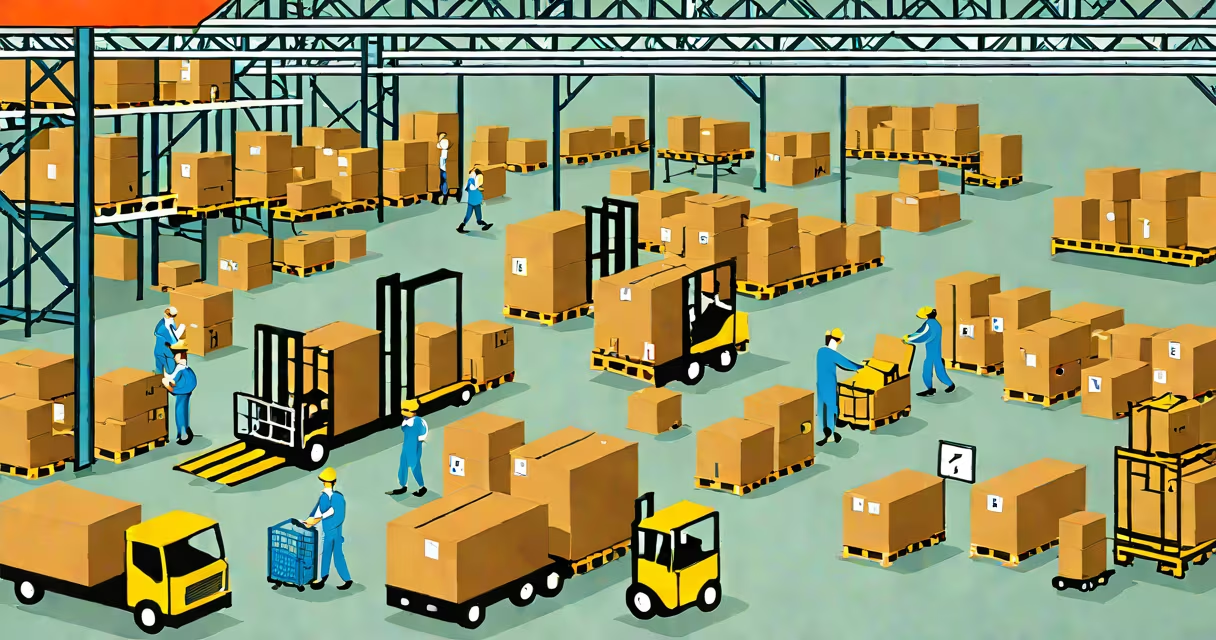
Fourth-party logistics (4PL) refers to a supply chain management model where a single external provider oversees and coordinates all aspects of a client's logistics network-including transportation, warehousing, procurement, and technology integration-acting as a central command center.
Unlike traditional third-party logistics (3PL) providers who execute specific tasks, 4PLs take ownership of the entire supply chain strategy. They don't typically operate trucks or manage warehouses themselves but instead design, monitor, and improve the flow of goods across multiple partners and systems.
The term "4PL" emerged in the late 1990s as companies sought better control over complex global supply chains. According to the Council of Supply Chain Management Professionals (CSCMP), 4PLs are defined by their ability to act as integrators, combining resources, capabilities, and technologies from multiple sources to deliver a smooth service.
A 4PL operates as a central orchestrator. It begins by analyzing a client's existing supply chain-assessing inventory levels, delivery timelines, carrier performance, and warehouse utilization. Based on this analysis, the 4PL designs a customized logistics strategy that reduces costs, improves speed, and increases visibility.
Once the plan is in place, the 4PL manages relationships with multiple vendors, including 3PLs, freight forwarders, customs brokers, and technology platforms. Instead of handling individual contracts, the 4PL negotiates volume-based rates and monitors performance through shared dashboards and KPIs.
For example, a consumer electronics company using a 4PL might have its products shipped from factories in China to distribution centers in the U.S. via air and sea freight. The 4PL would select optimal routes, assign carriers based on cost and reliability, track shipments in real time, and adjust plans during disruptions such as port delays or weather events-all through a unified digital interface.
4PL models vary based on client needs and industry complexity. The most common types include:
| Model Type | Description | Use Case Example |
|---|---|---|
| Full Integration 4PL | Manages all supply chain functions from sourcing to last-mile delivery. | Global retailer managing imports from Asia and domestic distribution. |
| Technology-Driven 4PL | Focuses on software platforms that connect suppliers, carriers, and customers. | E-commerce brand using AI-powered demand forecasting and changing routing. |
| Specialized 4PL | Serves niche industries like pharmaceuticals or automotive with compliance-heavy workflows. | Pharma firm requiring cold-chain logistics and FDA audit trails. |
Some 4PLs offer hybrid models. For instance, a 4PL may handle contract negotiation and performance tracking while relying on a partner 3PL for actual warehouse operations. This allows clients to retain flexibility without sacrificing oversight.
4PLs are most common in large-scale, global operations. Industries such as retail, manufacturing, healthcare, and e-commerce rely on them to reduce complexity. A 2023 CSCMP report found that 68% of Fortune 500 companies use 4PL services to manage cross-border logistics.
Companies adopt 4PLs when they face challenges like fragmented vendor networks, inconsistent delivery times, or lack of real-time data visibility. By consolidating decision-making under one entity, businesses gain faster response times and lower operational risk.
For example, a U.S.-based fashion brand with suppliers in Vietnam and Turkey might struggle to coordinate shipping schedules, customs documentation, and seasonal demand shifts. A 4PL would create a centralized dashboard showing inventory status, shipment progress, and predicted delivery windows-enabling the brand to respond quickly to market changes.
Many confuse 4PLs with 3PLs. While both are outsourced logistics providers, 3PLs focus on execution-like storing goods or moving them via truck or plane. 4PLs focus on strategy and coordination. A 3PL handles the "how," while a 4PL defines the "why" and "where."
Another misconception is that 4PLs own physical assets. They do not. A 4PL doesn't operate warehouses or fleets. Their value lies in integration, not infrastructure. This is a key difference from 1PLs (shippers who move their own goods) and 2PLs (carriers like FedEx or UPS).
Some assume 4PLs are only for large enterprises. But mid-sized firms with growing international sales are increasingly adopting 4PL models. A 2022 McKinsey study showed that SMEs using 4PLs saw a 22% reduction in supply chain costs over two years due to better route planning and vendor consolidation.
Consider a medical device manufacturer launching a new surgical tool in Europe. The product requires temperature-controlled packaging, customs clearance in five countries, and delivery within 48 hours to hospitals.
Without a 4PL, the company would need to manage separate agreements with a cold-storage 3PL, a customs broker, and multiple couriers. Delays in one step could disrupt the entire launch.
With a 4PL, the process is streamlined. The 4PL selects a certified cold-chain 3PL in Germany, books a dedicated air freight slot, coordinates customs documents with a local agent, and uses a blockchain-enabled tracking system to verify compliance. All data flows into a single portal accessible to the manufacturer's team.
When a border delay occurs in Belgium, the 4PL reroutes the shipment through the Netherlands and alerts the hospital. The entire event is logged and analyzed for future improvements. The manufacturer gains control without adding internal staff.
I once observed a 4PL implementation at a food distributor in Ohio. The company had 12 different 3PLs across the Midwest, leading to inconsistent delivery times and frequent stockouts. After switching to a single 4PL, they reduced average delivery lead time from 5.2 days to 2.8 days within six months.
The 4PL introduced a cloud-based platform that aggregated real-time data from all partners. When a storm delayed a shipment from Iowa, the system automatically rerouted it through a backup facility in Indiana. The change was invisible to customers but saved $180,000 in lost sales and penalties annually.
Understanding 4PL logistics meaning means recognizing it as a strategic partnership-not a service provider. It's not about who moves the boxes, but who ensures the entire supply chain runs smoothly, efficiently, and adaptively.
While 4PLs don't own trucks or warehouses, they control the logic behind them. They combine data, contracts, and technology to turn a fragmented network into a responsive system. For businesses scaling globally or facing supply chain volatility, this level of coordination is not optional-it's essential.