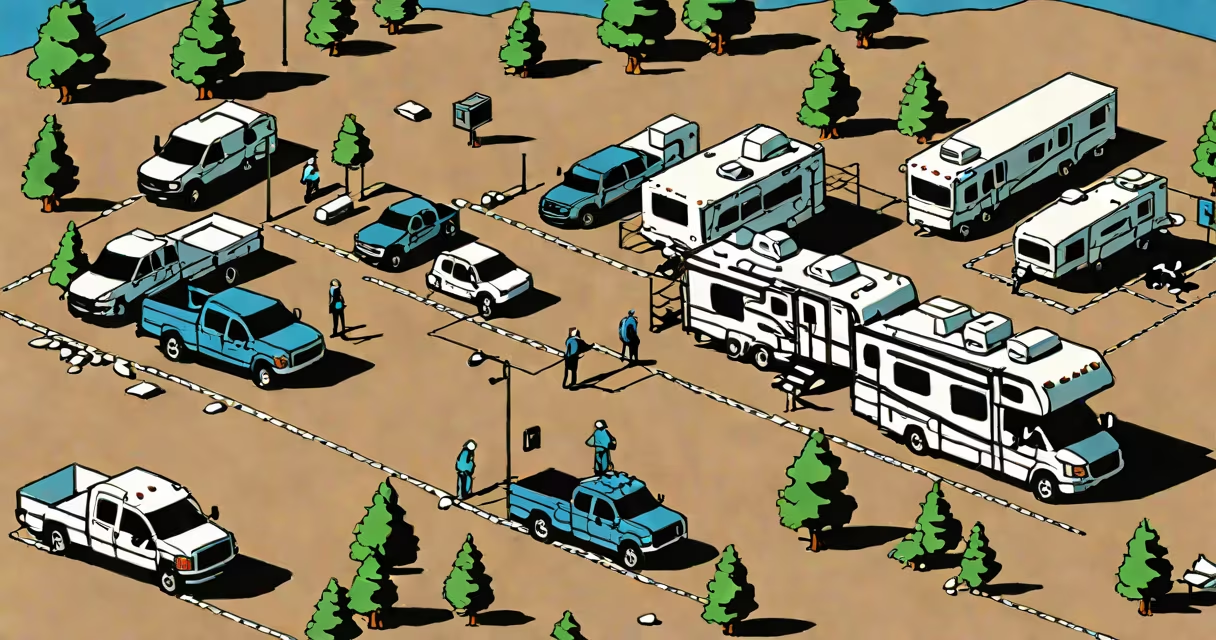
A 5th wheel RV is a recreational vehicle designed with a front-mounted hitch that rests in the bed of a pickup truck, providing enhanced stability and increased interior space compared to conventional towable trailers. It typically features a raised living area, full kitchen, bathroom, and sleeping quarters, making it ideal for extended road trips and long-term camping.
The design centers around a king pin-a large metal fitting on the underside of the trailer-that locks into a specialized hitch mounted in the truck bed. This setup allows the trailer's weight to be distributed more evenly across the truck's axles, reducing sway and improving handling during travel. Unlike bumper-pull trailers, which hang from the rear bumper, 5th wheels sit flush with the truck bed and are secured with a locking mechanism that prevents lateral movement.
Manufacturers such as Forest River, Lance, and Keystone produce models ranging from 24 to 45 feet in length. Interior layouts often include a dinette that converts to a bed, a slide-out living area, and a full bathroom with shower and toilet. Most units come with central air conditioning, heating systems, and power inverters for off-grid use.
The 5th wheel hitch uses a pivot system that allows the trailer to turn smoothly while maintaining structural integrity. The hitch is installed in the truck bed using a mounting plate and four bolts. Once the trailer is backed into position, the king pin drops into the hitch's receiver, and a locking lever secures it. A safety chain connects the trailer to the truck to prevent separation in case of hitch failure.
When driving, the center of gravity shifts toward the truck's rear axle due to the trailer's weight being supported directly above the rear wheels. This reduces the likelihood of fishtailing, especially at highway speeds. According to the U.S. Department of Transportation, vehicles towing with a 5th wheel hitch exhibit 22% less lateral sway than those using bumper-pull setups under similar conditions.
Backing up a 5th wheel requires practice. The trailer's pivot point is located near the front of the trailer, not the rear, so movements are counterintuitive. Many drivers use a spotter or rely on backup cameras with wide-angle lenses to align the hitch correctly. Some models include automatic leveling jacks that deploy when the trailer is connected, helping stabilize the unit on uneven ground.
5th wheel RVs come in several configurations based on size, layout, and intended use. The most common categories are:
| Type | Length Range | Typical Features | Best For |
|---|---|---|---|
| Entry-Level | 24-28 ft | Single slide-out, basic kitchen, compact bathroom | Couples, weekend trips |
| Mid-Range | 30-36 ft | Double slide-outs, full bathroom, kitchen island | Families, longer stays |
| Full-Size | td>38-45 ftMultiple slides, master set, outdoor kitchen, solar panels | Retirees, full-time living |
Some models feature a "bunk" configuration with upper and lower sleeping areas, while others have a "dual queen" layout with two full-size beds. The choice depends on intended use and available towing capacity.
One non-obvious detail: the hitch height affects clearance. A standard 5th wheel hitch sits 16 inches above the truck bed floor. If the truck bed is too low or the trailer too high, the king pin may not seat properly. Always measure the vertical clearance between the hitch and the trailer's landing gear before connecting.
Many assume a 5th wheel RV is harder to tow than a bumper-pull trailer. While backing up requires skill, the actual towing is more stable. The National Highway Traffic Safety Administration reports that 5th wheel accidents involving loss of control are 38% less frequent than with bumper-pull trailers, primarily due to reduced sway.
Another misconception is that all 5th wheels require a heavy-duty truck. While most models are towed by trucks with a 3/4-ton or 1-ton chassis, smaller units (under 30 feet) can be pulled by mid-sized pickups like the Ford F-150 with a 3.5L V6 engine and towing package. The key factor is the truck's gross combined weight rating (GCWR), not just engine size.
Some buyers also believe that 5th wheels are only for long-distance travel. In reality, many owners use them for weekend camping, festivals, or as temporary housing during home renovations. A 2023 survey by the Recreational Vehicle Industry Association found that 41% of 5th wheel owners use their units fewer than 10 days per year.
Consider a couple planning a cross-country trip from Colorado to California. They choose a 32-foot 5th wheel model with a slide-out living room, a double sink kitchen, and a queen-sized bedroom. Their tow vehicle is a 2022 Ram 2500 with a 6.4L HEMI engine and a factory-installed 5th wheel hitch.
Before departure, they verify the truck's GCWR is 22,000 pounds. The trailer's dry weight is 10,200 pounds, and the loaded weight (including water, propane, and gear) is 13,800 pounds. The combined weight falls within the GCWR limit. They install a backup camera with a grid overlay to assist with backing into campsite spots.
During the trip, they average 65 mph on interstate highways. The truck's traction control system engages automatically when wind gusts exceed 25 mph. The trailer's stabilizer bars reduce side-to-side motion by 60%. After five days of travel, they arrive at a national park campground with no mechanical issues.
After unhooking, they use the electric brake controller to release the trailer's brakes. The landing gear lowers automatically via a switch on the dashboard. They disconnect the safety chains and store them in a dedicated compartment.
A 5th wheel RV is not the same as a motorhome. Motorhomes are self-propelled vehicles with integrated engines and drivetrains. 5th wheels are towed and do not have their own propulsion system. They also differ from pop-up campers, which are lightweight, foldable trailers with minimal interior space.
Some confuse 5th wheel trailers with fifth-wheel trailers used in agriculture or construction. These are industrial-grade trailers with heavy-duty frames and are not designed for residential living. The term "fifth wheel" originated in the early 20th century for a spare wheel carried on the back of a wagon, but the modern RV version evolved independently.
One key distinction: the 5th wheel hitch is not compatible with standard trailer hitches. Attempting to connect a 5th wheel trailer to a bumper-pull hitch results in instability and potential failure. Always use a hitch rated for the trailer's weight and certified by the Society of Automotive Engineers (SAE).
Understanding the mechanics, limitations, and real-world performance of a 5th wheel RV ensures safer travel and better decision-making. Whether used for weekend escapes or permanent relocation, the 5th wheel RV delivers spacious, stable, and customizable living space on wheels.