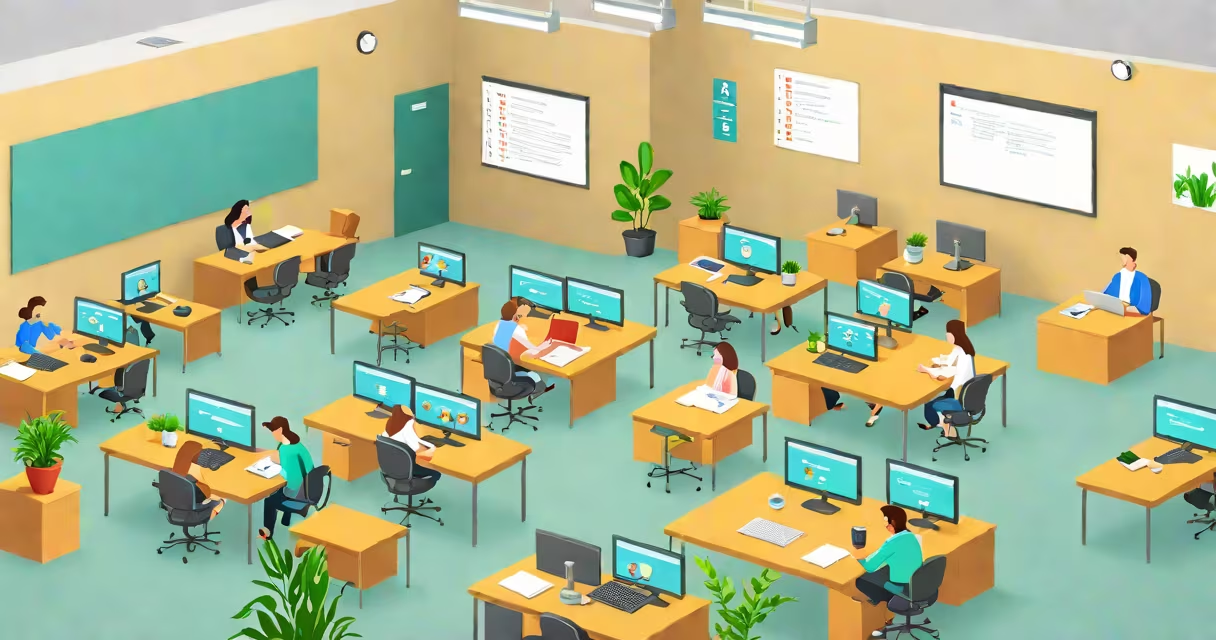
Aula virtual de is a digital learning platform used by educational institutions to host online courses, manage student progress, and help remote instruction. It functions as a centralized hub for course materials, assessments, communication tools, and administrative tasks.
These platforms are built on Learning Management System (LMS) architecture. They allow teachers to upload syllabi, videos, readings, quizzes, and discussion forums. Students access content through login credentials, track due dates, submit work, and receive feedback-all within a single interface. Institutions use aula virtual de to support hybrid and fully remote education models.
Major universities and public education systems rely on aula virtual de to standardize course delivery. For example, the Universidad Nacional Mayor de San Marcos (UNMSM) uses its own aula virtual unmsm portal to distribute lecture recordings, assign homework, and monitor participation. Similarly, the Comunidad de Madrid operates a regional aula virtual comunidad de madrid system for secondary and higher education, integrating state-curriculum standards into digital lessons.
When a teacher creates a course, they define modules-such as weekly units or thematic blocks. Each module contains structured content: video lectures (often recorded via Zoom or Loom), PDF handouts, interactive quizzes, and discussion threads. Students complete tasks in sequence, and the system logs their activity.
Behind the scenes, aula virtual de relies on secure servers, database storage, and role-based access control. Teachers have editing rights; students see only assigned content. Notifications trigger automatically when deadlines approach or grades are posted. Data is stored locally or in cloud environments compliant with national privacy laws, such as Spain's LOPD or Peru's Ley de Protección de Datos Personales.
For example, a history professor at UNMSM schedules a live session via Zoom embedded in the aula virtual unmsm interface. After the class, the recording is uploaded and tagged under "Week 4: Spanish Colonialism." Students who missed the session can watch it later. A quiz on the material appears the next day, and results update in real time on the gradebook.
Different institutions deploy aula virtual de with varying features based on scale, budget, and regulatory requirements. The following table outlines major implementations:
| Institution | Platform Name | Key Features | Access Model |
|---|---|---|---|
| Comunidad de Madrid | aula virtual comunidad de madrid | Curriculum-aligned content, teacher training modules, parent portal | Single sign-on via regional ID |
| UNMSM (Peru) | aula virtual unmsm | Integration with library databases, plagiarism detection, mobile app | Student ID and password |
| Ministry of Defense (Spain) | campus virtual de defensa | Secure file sharing, encrypted communications, military-grade authentication | Biometric login, restricted network access |
Each system reflects local priorities. The Comunidad de Madrid version emphasizes alignment with regional education standards and includes tools for guardians to monitor student engagement. UNMSM's platform integrates with academic databases to verify sources in research papers. The campus virtual de defensa system prioritizes security, using multi-factor authentication and end-to-end encryption for sensitive training materials.
Aula virtual de is often confused with general video conferencing tools like Zoom or Google Meet. While those enable live teaching, they don't manage course structure, grading, or long-term tracking. Aula virtual de combines live sessions with persistent content repositories and automated workflows.
Another misconception is that aula virtual de replaces face-to-face teaching entirely. In reality, most institutions use it as a supplement. A study by the OECD (2022) found that blended learning-where 60% of instruction occurs online and 40% in person-leads to better retention than fully remote models. The platform supports this balance by hosting pre-recorded lectures and reserving in-person time for labs, debates, and hands-on projects.
Aula virtual de is not a generic website. It requires technical infrastructure, ongoing maintenance, and trained staff. A 2021 report from the European Commission noted that 38% of EU schools failed to maintain stable aula virtual de access during peak enrollment periods due to underfunded IT departments. This highlights that functionality depends on consistent investment, not just software choice.
I observed a group of high school teachers in Madrid using aula virtual comunidad de madrid during a curriculum rollout. Their main challenge wasn't mastering the interface-it was creating content that met both pedagogical standards and accessibility guidelines. One teacher spent six hours converting a 20-page PDF into a series of short videos with subtitles and simplified language. The result improved student completion rates by 22% compared to previous years.
This experience confirmed that success with aula virtual de hinges less on technology and more on thoughtful design. Tools like drag-and-drop modules, auto-grading quizzes, and analytics dashboards reduce workload-but only if content is aligned with learning objectives.
Aula virtual de is not a single product. It's a category of digital education platforms tailored to specific institutions. The term refers to the function-not a brand. You'll find versions hosted by universities, government agencies, and private providers. What matters is whether the system supports clear navigation, reliable performance, and compliance with data protection laws.
Understanding aula virtual de as a functional structure-not a branded tool-helps avoid confusion. a student submitting a final paper, the core purpose remains the same: to make learning accessible, organized, and measurable.