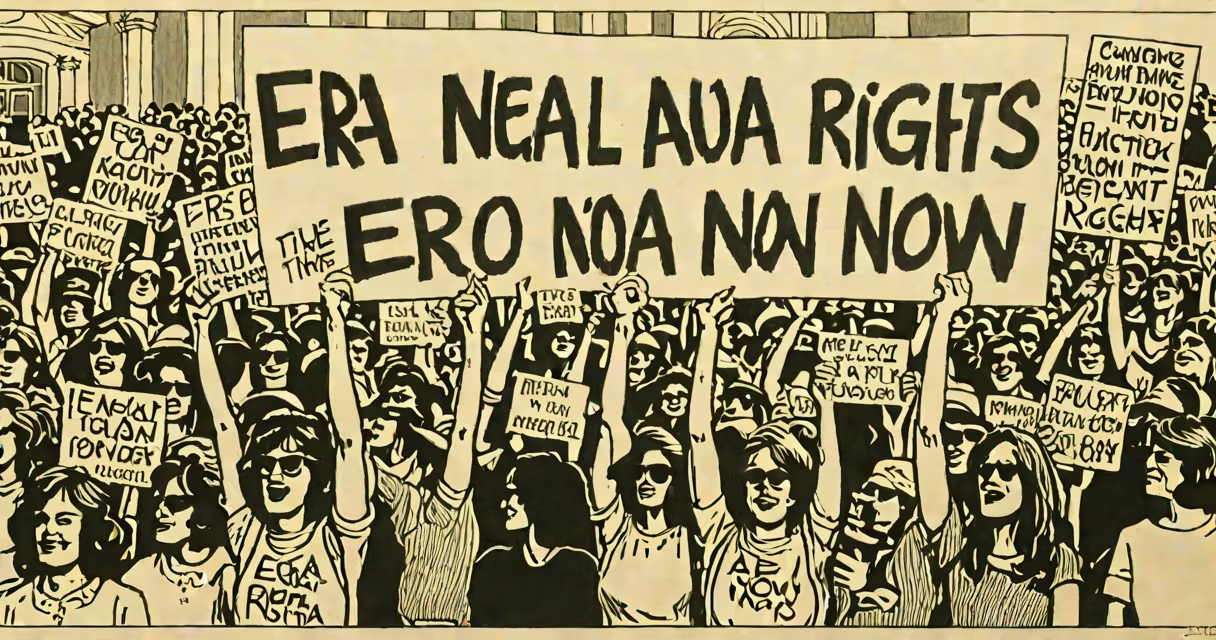
The Equal Rights Amendment (ERA) is a proposed addition to the U.S. Constitution that would prohibit discrimination based on sex. It was first introduced in Congress in 1923 and passed by both chambers in 1972, but it has not yet been ratified by the required 38 states.
The amendment's text reads: "Equality of rights under the law shall not be denied or abridged by the United States or by any State on account of sex." This language would make sex-based discrimination illegal in all areas covered by federal and state law, including employment, education, healthcare, and housing.
Despite decades of advocacy, the ERA remains unratified. The original ratification deadline expired in 1979, though Congress extended it to 1982. After that, no additional states ratified it. However, in recent years, several states have ratified the amendment retroactively, reigniting debate over whether it can still become part of the Constitution.
If ratified, the ERA would function as a constitutional ban on sex-based discrimination. Unlike existing laws such as Title VII of the Civil Rights Act or the Equal Pay Act, which rely on legislative interpretation and can be overturned by new Congresses, the ERA would be binding at the highest level of law.
This means courts would apply strict scrutiny to any law that treats people differently based on sex. For example, a law requiring only men to serve in combat roles or denying women access to certain jobs solely because of gender would likely be struck down under the ERA.
Under current precedent, courts often apply intermediate scrutiny to sex-based classifications. The ERA would eliminate that middle ground and require that any sex-based law serve a compelling government interest and be narrowly tailored to achieve it.
The ERA consists of just two sentences:
These words were drafted by Alice Paul and the National Woman's Party in 1923. The simplicity of the language was intentional: it avoids legal jargon and aims for broad, inclusive protection.
Unlike many constitutional amendments, the ERA does not define "sex" or specify which rights are protected. Instead, it establishes a principle-equal treatment-and delegates enforcement to Congress. This allows future lawmakers and courts to adapt protections to emerging issues, such as transgender rights or reproductive autonomy.
There is ongoing legal debate about whether the ERA can still be ratified. The dispute centers on whether the original 1972 deadline for ratification is binding.
| Ratification Path | Legal Basis | Status |
|---|---|---|
| Original 1972 deadline | Congress set a seven-year window; later extended to 1982 | Expired. No new ratifications accepted after 1982. |
| Retroactive ratification (post-1982) | Some states ratified after 1982; Nevada (2017), Illinois (2018), Virginia (2020) | Contested. Legal scholars argue Congress may have authority to extend the deadline. |
| Supreme Court review | No ruling yet. Pending cases challenge the validity of late ratifications. | Unresolved. The issue may reach the Supreme Court. |
A 2020 study by the Congressional Research Service concluded that while the 1972 deadline was established, Congress retains authority to modify or extend it. This supports the argument that states ratifying after 1982 are valid.
Nonetheless, opponents claim that the deadline cannot be ignored without undermining constitutional process. They argue that allowing late ratifications would create instability in the amendment process.
The ERA is not currently in effect. But its principles influence policy and litigation. For example, the U.S. Supreme Court cited the spirit of the ERA in cases like United States v. Virginia (1996), where it struck down the male-only admissions policy at the Virginia Military Institute.
State courts have also applied ERA-like reasoning. In 2021, the California Supreme Court ruled that the state constitution's equal protection clause protects against gender-based discrimination in public employment-even without a federal ERA.
Advocates argue that the ERA would close gaps in existing civil rights laws. For instance, Title IX bans sex discrimination in education, but it doesn't cover private schools or certain federal programs. The ERA would apply uniformly across all levels of government and private activity.
Many people assume the ERA would mandate gender-specific policies, such as quotas or forced integration. This is incorrect. The amendment does not require equal outcomes-it requires equal treatment under the law.
Another misconception is that the ERA would abolish traditional family roles or eliminate single-sex spaces. Courts have consistently ruled that sex-based classifications are permissible when they serve a legitimate purpose, such as protecting privacy or ensuring safety. The ERA does not override those exceptions.
A less obvious point: the ERA does not automatically invalidate all existing laws that treat men and women differently. It only invalidates those that lack a substantial governmental interest. For example, military draft registration for men only is still legal under current law-but the ERA could force Congress to justify it.
In January 2020, Virginia became the 38th state to ratify the ERA. This triggered a formal request to the Archivist of the United States to certify the amendment's adoption.
However, the Department of Justice challenged the validity of Virginia's ratification, arguing that the 1972 deadline had expired. The Office of Legal Counsel stated that "the Constitution does not permit Congress to revive a dormant ratification process."
As of 2024, the case remains unresolved. A federal district court in Washington, D.C., dismissed a lawsuit challenging the certification, citing lack of standing. The case may eventually reach the Supreme Court.
I attended a 2018 march in Washington, D.C., where thousands gathered to demand ratification. One woman carried a handmade banner with the ERA text in bold letters. She told me she'd been organizing since the 1970s. Her voice cracked when she said, "I never thought I'd see this happen in my lifetime."
The ERA is not the only constitutional amendment related to rights. The 13th Amendment abolished slavery, and the 11th Amendment limits lawsuits against states by citizens of other states. These amendments address different issues, but they share a common goal: expanding individual rights through constitutional change.
While the 13th Amendment ended chattel slavery, it did not address gender-based oppression. The ERA seeks to fill that gap by explicitly banning sex-based discrimination in the nation's supreme law.
The fight for the ERA is not just about past injustices. It's about preventing future ones. Without a constitutional guarantee, protections can erode. Laws that pass today may be repealed tomorrow. The ERA would make equality a permanent feature of American law.
Even if the amendment is not ratified, its presence in the national conversation shapes how we think about fairness. It reminds us that rights are not granted-they are claimed, fought for, and embedded in the foundational documents of a nation.