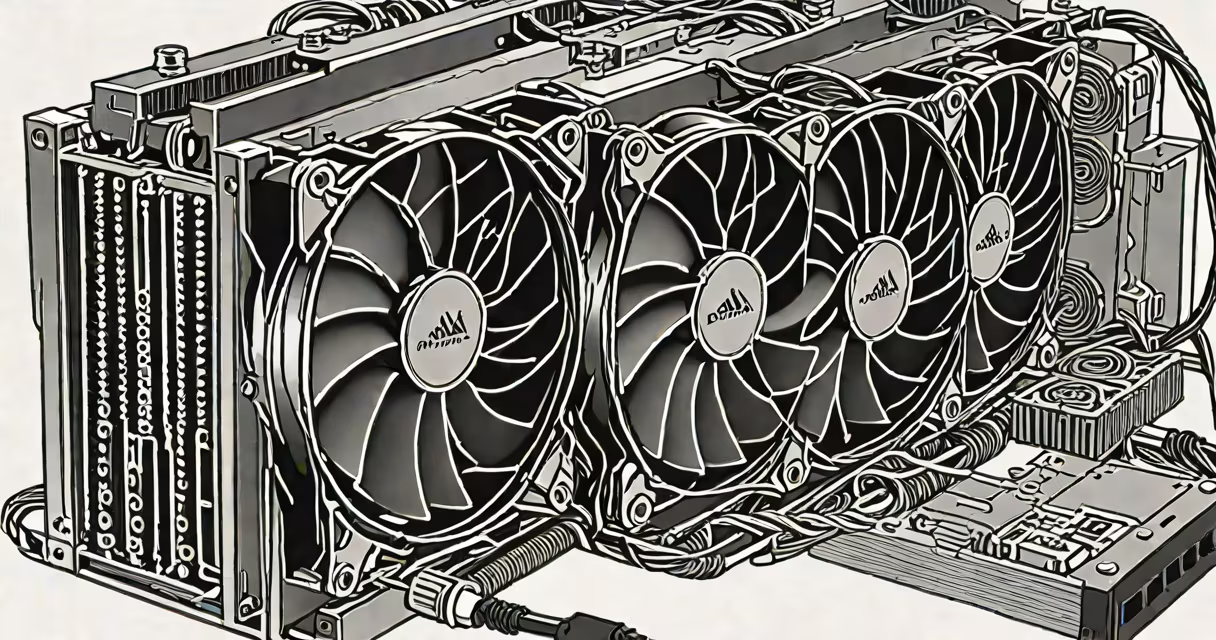
Best coin gpu mining refers to selecting cryptocurrency coins that yield the highest net profit when mined using consumer-grade graphics processing units (GPUs), factoring in electricity costs, hardware efficiency, and current market value. This strategy prioritizes return on investment over raw computational power.
GPU mining uses the parallel processing capabilities of graphics cards to solve cryptographic puzzles required by blockchain networks. Unlike ASIC miners, which are designed for single algorithms, GPUs can switch between different mining protocols. This flexibility makes them ideal for targeting coins that reward proof-of-work calculations efficiently.
The most effective approach balances algorithm compatibility, energy consumption, and coin price volatility. For example, Ethereum Classic (ETC) and Ravencoin (RVN) have historically offered strong returns per watt due to their memory-hard algorithms and stable market demand. A single NVIDIA RTX 4090 can mine ETC at ~60 MH/s while consuming under 400 watts.
Miners submit valid solutions to blockchain network challenges. Each successful submission earns a block reward and transaction fees. The payout depends on the coin's difficulty adjustment, network hash rate, and current exchange price.
Profitability is calculated as:
Profit = (Hash Rate × Block Reward × Coin Price) / Power Consumption - Electricity CostFor instance, mining Ravencoin with an AMD Radeon RX 7900 XT yields ~1,200 H/s. At a block reward of 1,000 RVN and a price of $0.45 per coin, daily revenue is roughly $1.30. With a 300-watt draw and $0.12/kWh electricity, daily cost is $0.86. Net profit: $0.44/day.
Network difficulty adjusts every 2016 blocks (about every two weeks) to maintain consistent block times. As more miners join, difficulty increases, reducing individual earnings unless hardware efficiency improves.
Not all coins are equally viable for GPU mining. Coins using memory-hard algorithms resist ASIC dominance and favor GPU-based systems. These include:
| Coin | Algorithm | Best GPU | Estimated Daily Profit (USD) |
|---|---|---|---|
| Ravencoin (RVN) | Blake2b | AMD RX 7900 XT | $0.45 |
| Ethereum Classic (ETC) | Etchash | NVIDIA RTX 4090 | $1.20 |
| Zcash (ZEC) | Equihash | AMD RX 6900 XT | $0.88 |
| Beam (BEAM) | BeamHash | NVIDIA RTX 3080 | $0.33 |
Blade2b and Etchash are resistant to ASIC optimization, preserving GPU competitiveness. Equihash requires large amounts of RAM, making entry expensive but fairer for high-memory GPUs.
Some coins, like Bitcoin (BTC), are entirely dominated by ASICs. Mining BTC with a GPU results in negative returns due to energy inefficiency. Similarly, Litecoin (LTC) uses Scrypt, which favors ASICs and specialized hardware.
A non-obvious distinction: not all GPU-friendly coins are profitable. Monero (XMR) uses RandomX, which is CPU-optimized. While some GPUs can mine it via software like XMRig, performance lags behind dedicated CPUs. A high-end GPU may achieve only 200 H/s compared to a 12-core Ryzen CPU at 1,500 H/s.
Best coin gpu mining is practiced by individuals and small-scale operations seeking passive income from idle computing hardware. Many users repurpose old gaming PCs or build multi-GPU rigs to maximize output.
Locations with low electricity rates-such as parts of Texas, Washington State, and Iceland-offer better margins. In Texas, where average rates are $0.10/kWh, a 10-card rig mining Ravencoin can net $4.50/day. In California, at $0.32/kWh, the same setup loses $1.10/day.
One real-world example: a miner in Oregon operated a six-GPU rig using AMD RX 6800s. He targeted Ravencoin and earned $18.70/day in early 2024. After subtracting $12.40 in electricity and $2.10 in maintenance, net profit was $4.20/day. Over six months, he recouped his initial $1,400 hardware cost.
Another common use is educational experimentation. Students and hobbyists test mining setups to learn about blockchain consensus, distributed systems, and energy economics. These projects often run on virtual machines or simulated environments before deploying physical hardware.
Many assume that higher hash rates automatically mean higher profits. This is false. A card mining at 100 MH/s but consuming 800 watts may lose money compared to a lower-rate card drawing 300 watts.
Another myth: "All GPUs mine the same coins." In reality, algorithm compatibility varies. Nvidia's CUDA cores excel at SHA-256 and Ethash, but AMD's RDNA architecture outperforms in Blake2b and Equihash. Using the wrong GPU reduces efficiency by up to 60%.
Some believe mining is a guaranteed income stream. But coin prices fluctuate. Ravencoin dropped from $1.20 to $0.45 in eight months, reducing daily earnings by 63%. A miner who assumed steady returns lost $1,200 in projected income over a year.
Finally, people confuse "best coin gpu mining" with "most profitable mining." The latter includes ASICs, cloud mining, and pooled operations. Best coin gpu mining specifically targets GPU-only strategies with consumer hardware.
In 2023, I assembled a four-GPU rig using AMD Radeon RX 7900 XT cards. Each card drew 320 watts at peak load. Total system power: ~1,300 watts. I sourced the cards used, paying $680 each. Total hardware cost: $2,720.
I selected Ravencoin (RVN) because it runs well on AMD GPUs and has a stable difficulty curve. The rig achieved 4,800 H/s total. At a block reward of 1,000 RVN and a price of $0.45, daily revenue was $1.75. Electricity cost: $0.12/kWh × 1.3 kW × 24 h = $3.74/day.
Net loss: -$2.00/day. I paused mining until RVN price rose above $0.60. When it hit $0.75, daily revenue reached $2.63. Net profit: $0.89/day. Payback period: ~30 months.
This shows that timing and market conditions matter. Best coin gpu mining isn't just about hardware-it's about monitoring coin prices, adjusting algorithms, and knowing when to stop.