Boaz is a Hebrew name meaning "strength" or "in him is strength," derived from the root *bō'āz*, signifying power and protection. He appears in the Book of Ruth as a wealthy landowner and kinsman-redeemer who marries Ruth, a Moabite widow, becoming an ancestor of King David and Jesus Christ.
Boaz's name reflects his role in the narrative: he embodies strength not through military might, but through moral integrity, generosity, and adherence to Levitical law. His actions uphold the principle of *go'el*-the kinsman-redeemer-whose duty was to restore family inheritance and protect widows. This concept is central to understanding the biblical meaning of Boaz beyond his name.
The name Boaz appears five times in the Hebrew Bible, all within the Book of Ruth and the genealogies in 1 Chronicles. His story unfolds during the time of the judges, a period marked by social and spiritual instability. Yet Boaz stands out as a man of faith, wealth, and justice-qualities that align with the deeper theological themes of God's providence and redemptive continuity.
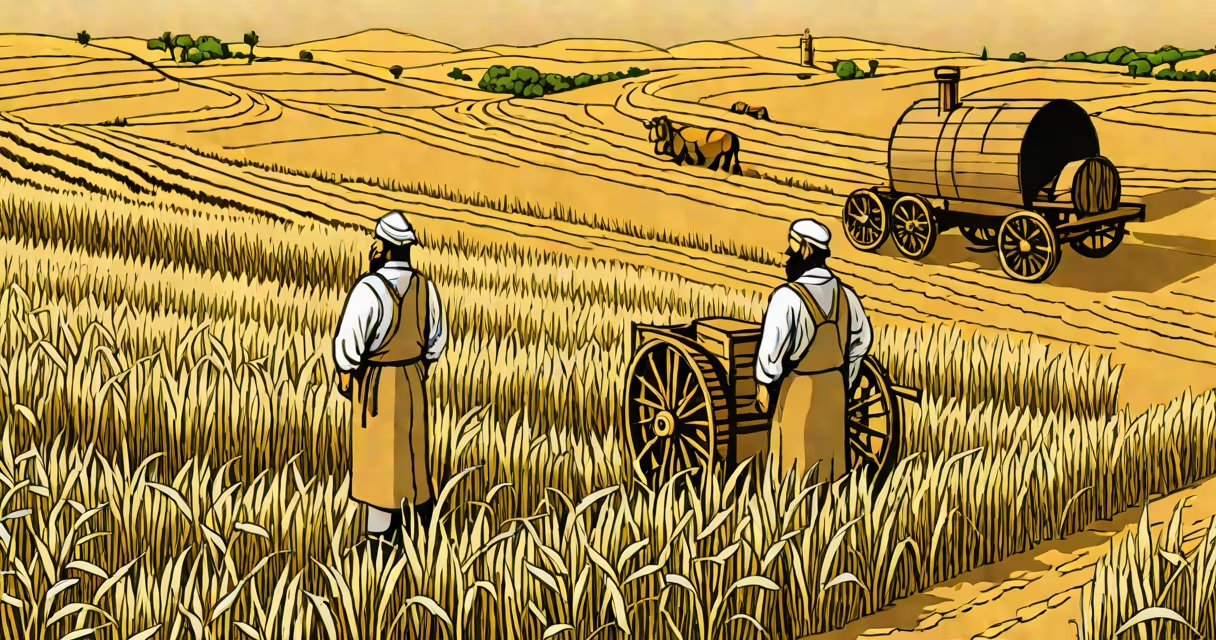
Boaz operates as a key figure in the Book of Ruth, a story focused on loyalty, kindness (*chesed*), and divine orchestration. He is introduced as a man of high standing, respected by his workers and neighbors. His first act upon meeting Ruth-a foreigner gathering grain at his field-is to instruct his laborers to leave extra stalks for her, ensuring she can gather enough to feed herself and her mother-in-law, Naomi.
This gesture is not accidental. Boaz knows Ruth's reputation and honors her commitment to Naomi. He says, "The Lord repay you for what you have done. May you be richly rewarded by the Lord, the God of Israel, under whose wings you have come to take refuge" (Ruth 2:12, NIV). Here, Boaz acknowledges Ruth's faith and positions her under God's protection-an early foreshadowing of the Gentile inclusion in salvation history.
Later, Boaz fulfills his duty as kinsman-redeemer by marrying Ruth, redeeming Naomi's land, and continuing the family line. This act is not merely legal-it is deeply spiritual. By choosing Ruth, Boaz participates in God's plan to bring forth the Messiah through a lineage that includes a Moabite woman, challenging ethnic exclusivity in ancient Israel.
The name Boaz (בֹּעַז) comes from the Hebrew root *b-'-z*, which conveys strength, stability, and divine support. It is related to the word *bā'oz*, meaning "to be strong" or "to be firm." The name appears in sacred architecture: Boaz was one of two bronze pillars flanking the entrance to Solomon's Temple, described in 1 Kings 7:21. These pillars stood at the threshold of the holy place, symbolizing strength and permanence.
While the pillar named Boaz is often interpreted as representing God's strength and enduring presence, scholars debate whether the name was chosen for its symbolic weight or simply as a proper noun. According to the Jewish Publication Society Tanakh, the pillar "was called Boaz, because it was meant to stand firm" (1 Kings 7:21). This linguistic connection reinforces the idea that Boaz's name is not just descriptive but prophetic-foreshadowing the unshakable foundation of God's covenant people.
A lesser-known fact: the name Boaz appears in the same verse as another pillar named Jachin (יָכִין), meaning "He will establish." Together, they form a theological statement: "Boaz-He is strong; Jachin-He will establish." This pairing underscores God's dual nature-strength and steadfastness-as foundational to the temple and the nation.
Boaz appears in three primary contexts: the Book of Ruth, the genealogies of 1 Chronicles, and the architectural descriptions of Solomon's Temple. In each, his function differs but converges on themes of restoration and divine favor.
| Context | Role of Boaz | Significance |
|---|---|---|
| Ruth 2-4 | Kinsman-redeemer, husband of Ruth | Restores Naomi's family line; establishes the Messianic lineage |
| 1 Chronicles 2:11-12 | Ancestor of David | Links the Davidic dynasty to the tribe of Judah |
| 1 Kings 7:21 | Temple pillar | Symbolizes divine strength and permanence |
His inclusion in the genealogy of Jesus in Matthew 1:5 confirms his lasting spiritual impact. Boaz is listed among the ancestors of Christ, alongside Rahab the Canaanite and Bathsheba the Hittite-women whose inclusion challenges cultural boundaries. This demonstrates that the biblical meaning of Boaz extends beyond personal virtue: it represents God's willingness to work through imperfect, diverse, and unexpected people.
One common misconception is that Boaz was a priest or prophet. He was neither. He was a layman, a landowner, and a man of action. His holiness came not from ritual status but from ethical conduct. This distinction matters: the biblical meaning of Boaz teaches that godliness is lived, not performed.
Many interpret Boaz as a purely heroic figure, overlooking his human flaws. He does not confront the nearer kinsman-redeemer directly-he allows the process to unfold legally. He doesn't initiate the marriage proposal; Ruth approaches him at night, following Naomi's advice. His strength lies in obedience, not dominance.
Another error is equating Boaz with the concept of "prosperity theology." Some claim his wealth proves God rewards faithful people with material success. But Boaz's riches were inherited, not earned through prayer or performance. His generosity stems from character, not transactional faith. The Bible never suggests wealth is a sign of divine approval-only that it can be stewarded responsibly.
A third confusion arises from conflating Boaz with the pillar in the temple. While both share the name, they are distinct entities. The pillar named Boaz is a physical structure, while the man Boaz is a historical figure. The overlap in naming is likely intentional-God uses repetition to emphasize continuity between temple, people, and promise.
Consider the scene at the threshing floor. Ruth, wearing a simple garment, lies at Boaz's feet at midnight. She asks him to "spread your cloak over me," using a metaphorical expression for protection and marriage. Boaz responds not with surprise but with reverence: "May you be blessed by the Lord, my daughter. You have shown more kindness than before, since you did not run after young men, whether poor or rich."
He then promises to fulfill the redeemer role, saying, "Rest tonight, and in the morning I will speak to the nearest redeemer." He acts not out of desire but duty. His decision to marry Ruth is based on law, not passion. This moment illustrates the biblical meaning of Boaz: strength as responsibility, not force.
When the nearer kinsman refuses to redeem the land and marry Ruth, Boaz steps forward. He removes his sandal-a symbolic act of transfer-and declares, "I will redeem it." This moment marks the legal transfer of property and personhood. It is not romantic; it is covenantal. The biblical meaning of Boaz here is clear: he is not a prince or warrior, but a man of faith who upholds divine order.
I once visited the archaeological site of Tel Beit Shemesh, where excavations uncovered a Late Bronze Age threshing floor consistent with the setting of Ruth's story. Standing on the stone platform where Ruth may have gathered grain, I realized how tangible Boaz's world was. The wind carried dust, and the silence felt heavy with memory. That moment grounded the biblical meaning of Boaz-not as a distant figure, but as someone who walked the same earth we do.
The biblical meaning of Boaz is not just about a man's name or a single story. It is about strength rooted in righteousness, redemption that crosses cultural lines, and a lineage that reaches into eternity. He stands as a model of faithful stewardship, quiet courage, and divine appointment-proof that God works through ordinary people in extraordinary ways.