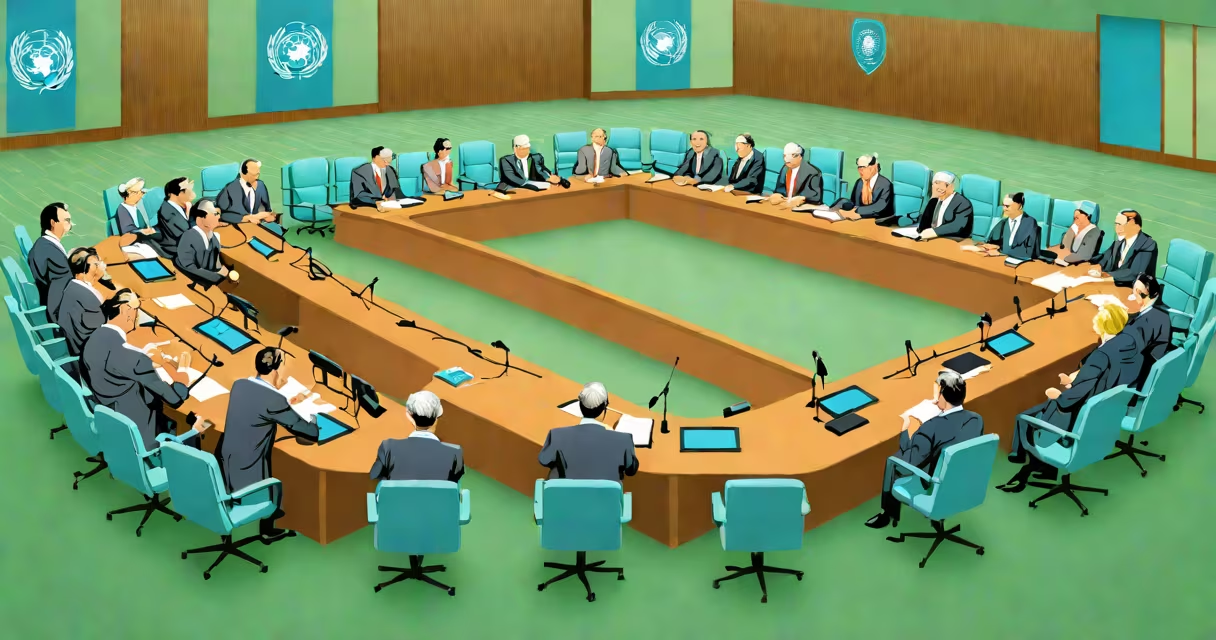
International affairs is the study of relationships between nations, international organizations, and transnational actors, focusing on diplomacy, global security, economic interdependence, and human rights. It examines how states and non-state entities interact across borders through treaties, trade, military alliances, and cultural exchange.
At its core, international affairs analyzes power dynamics, conflict resolution, and cooperation in a world where national decisions increasingly affect populations far beyond a country's borders. This field integrates political science, economics, history, law, and cultural studies to understand global events and shape policy responses.
For example, the 2022 Russian invasion of Ukraine prompted immediate international reactions: sanctions from the EU and U.S., humanitarian aid from the UN, and military support from NATO members. These coordinated actions reflect the mechanisms studied in international affairs-diplomatic pressure, multilateral institutions, and strategic alliances.
International affairs operates through formal and informal networks of state and non-state actors. Governments negotiate treaties, participate in international courts, and join global bodies like the United Nations, World Bank, and World Health Organization. Non-governmental organizations (NGOs), multinational corporations, and advocacy groups also influence outcomes.
Decision-making often involves consensus-building. For instance, climate change agreements such as the Paris Accord require countries to submit nationally determined contributions (NDCs) and report progress annually. The process relies on trust, verification, and enforcement mechanisms negotiated over years.
Conflict resolution is another central function. The 1998 Good Friday Agreement ended decades of violence in Northern Ireland through sustained diplomatic engagement involving the UK, Ireland, and U.S. mediators. This outcome illustrates how international affairs facilitates dialogue, manages grievances, and supports peacebuilding.
International affairs encompasses several subfields, each with distinct focus areas and methodologies:
| Type | Focus Area | Example |
|---|---|---|
| Diplomacy | Negotiation between states | U.S.-China trade talks under Biden administration |
| Global Security | Military alliances, arms control | NATO's response to Russia's 2022 invasion |
| Development & Human Rights | Poverty reduction, refugee protection | UNHCR's aid operations in Syria since 2011 |
| Economic Interdependence | Trade, investment, financial regulation | WTO dispute settlement over Chinese steel subsidies |
These domains often overlap. Climate change, for example, requires environmental science, economic modeling, and diplomatic coordination. The 2015 Paris Agreement involved 196 parties agreeing to limit warming to below 2°C-a goal requiring national policies, funding mechanisms, and monitoring systems.
A lesser-known aspect is the role of track II diplomacy-informal dialogues between experts, former officials, and civil society leaders. These sessions, often held outside official channels, helped de-escalate tensions during the Iran nuclear negotiations in 2013. They demonstrate that international affairs isn't limited to government-to-government talks.
International affairs is frequently confused with international relations, though they differ in scope and methodology. International relations is a social science discipline focused on theoretical models of state behavior, while international affairs emphasizes applied policy, program implementation, and real-time crisis management.
Another misconception is that international affairs is solely about war and diplomacy. While conflict resolution is a major component, the field also addresses sustainable development, public health, migration, and digital governance. The 2020 Global Vaccine Access initiative, led by COVAX, shows how international coordination enables equitable distribution of medical resources across low-income nations.
Some assume all international work happens in Geneva or New York. In reality, field operations are common. During the 2014 Ebola outbreak in West Africa, WHO teams deployed to Liberia, Sierra Leone, and Guinea to coordinate containment efforts. These missions required rapid deployment, local partnerships, and logistical planning-all part of operational international affairs.
I once worked on a project assessing the impact of EU agricultural subsidies on smallholder farmers in Senegal. We traveled to rural villages, interviewed cooperatives, and analyzed policy documents. The findings informed a revised aid structure that prioritized local food sovereignty over export-oriented farming. That experience confirmed how international affairs translates theory into tangible change.
Careers in this field include roles in government agencies (State Department, USAID), international organizations (UN, World Bank), NGOs (Human Rights Watch, Mercy Corps), and private sector consultancies. A bachelor's degree in international affairs provides foundational training in policy analysis, research methods, and cross-cultural communication.
Understanding define international affairs means recognizing it as both a scholarly pursuit and a practical toolkit for addressing global challenges-from pandemic preparedness to cyber warfare norms. It is not passive observation but active engagement in shaping a more stable, equitable world.