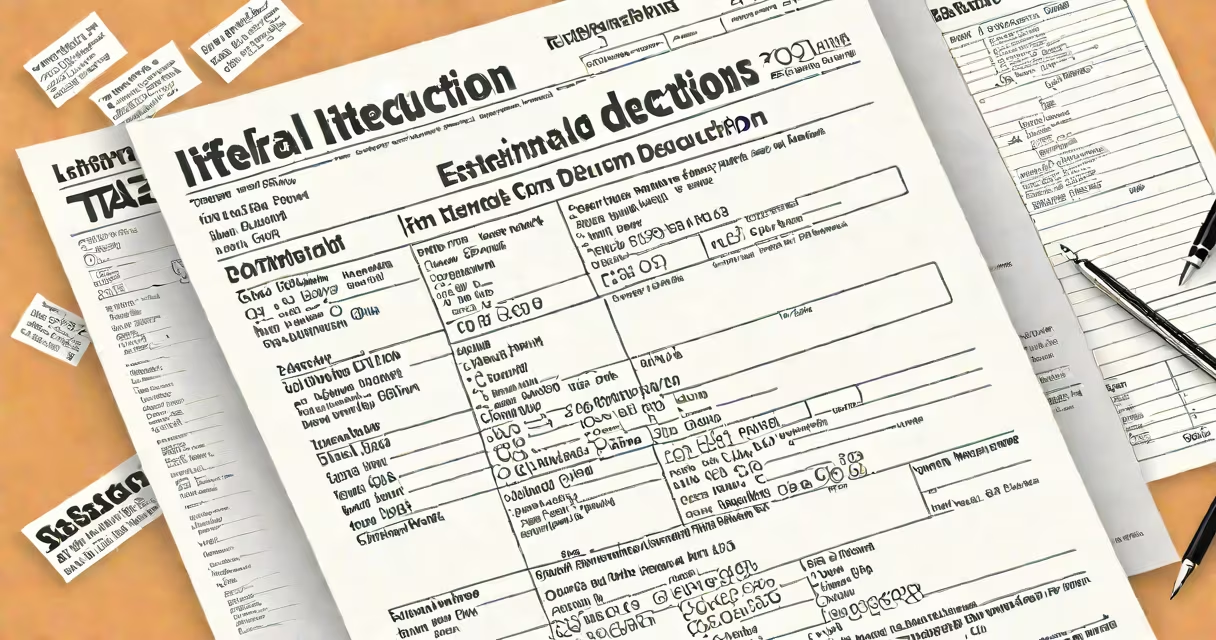
Federal estimated itemized deductions are the total allowable expenses claimed on IRS Schedule A of Form 1040 to reduce taxable income, replacing the standard deduction when they exceed it. These deductions include state and local taxes, mortgage interest, charitable contributions, and medical expenses exceeding 7.5% of adjusted gross income.
Itemized deductions are available only to taxpayers who choose not to take the standard deduction. The IRS allows this option when the sum of qualifying expenses exceeds the standard deduction amount for the taxpayer's filing status. For 2023, the standard deduction was $13,850 for single filers and $27,700 for married couples filing jointly. If a taxpayer's total itemized deductions surpass these amounts, itemizing provides greater tax savings.
Claiming federal estimated itemized deductions requires documentation such as receipts, canceled checks, and Form 1099-INT for interest payments. The IRS mandates that deductions be substantiated to avoid audits. The threshold for medical expenses is particularly strict: only costs above 7.5% of adjusted gross income (AGI) qualify. For example, if AGI is $60,000, only medical expenses over $4,500 may be deducted.
Itemized deductions are listed on Schedule A, which is attached to Form 1040. Taxpayers calculate their total eligible deductions and report them on the form. The IRS uses this information to determine taxable income, which affects the final tax bill.
Common categories include state and local income or sales taxes, property taxes, mortgage interest, charitable donations, and unreimbursed medical expenses. For 2023, the cap on state and local tax (SALT) deductions was $10,000. This limit applies to combined state income tax, state sales tax, and local property taxes.
A taxpayer earning $120,000 with $15,000 in mortgage interest, $8,000 in property taxes, $12,000 in charitable contributions, and $6,000 in qualified medical expenses would have total itemized deductions of $41,000. Since this exceeds the $27,700 standard deduction for married filers, itemizing reduces taxable income by $41,000.
The following table outlines major categories of federal estimated itemized deductions, their limits, and required documentation.
| Deduction Type | Limit (2023) | Documentation Required |
|---|---|---|
| State and Local Taxes (SALT) | $10,000 total | State tax return, payment records |
| Mortgage Interest | Unlimited, subject to loan limits | Form 1098, loan agreement |
| Charitable Contributions | 60% of AGI for cash donations to public charities | Receipts, acknowledgment letters |
| Medical Expenses | Only amounts over 7.5% of AGI | Itemized bills, insurance statements |
Some deductions require special rules. Charitable contributions of appreciated stock held over one year may be deducted at fair market value, avoiding capital gains tax. However, donations of non-cash items valued over $500 require Form 8283 and a qualified appraisal.
The IRS does not allow deductions for personal living expenses such as groceries, utilities, or car insurance. Even if a taxpayer spends $10,000 on home repairs, those costs do not qualify unless tied to a business or rental activity.
Most taxpayers benefit from taking the standard deduction because it simplifies filing and avoids recordkeeping. However, itemizing makes sense when total deductions exceed the standard amount.
For example, a single filer with $70,000 AGI and $18,000 in medical expenses, $12,000 in mortgage interest, $5,000 in charitable giving, and $10,000 in property taxes would have $45,000 in itemized deductions. Since this exceeds the $13,850 standard deduction, itemizing saves $31,150 in taxable income.
However, itemizing increases audit risk. The IRS targets high-value deductions, especially charitable contributions over $500 and medical expenses near the 7.5% threshold. In 2022, the IRS audited 0.6% of returns claiming itemized deductions, compared to 0.3%.
Many taxpayers assume all out-of-pocket expenses are deductible. This is false. Only IRS-approved categories count. For example, a parent spending $3,000 on private school tuition cannot deduct it-even if the child is claimed as a dependent.
Another error is double-counting. A taxpayer might claim both mortgage interest and home office expenses on the same property. But if the home office is used for a business, the mortgage interest is allocated between personal and business use. Claiming it entirely as a business expense violates IRS allocation rules.
I once reviewed a client's return where they listed $12,000 in "donations" to a friend's nonprofit. The organization had no 501(c)(3) status, so the contribution was not tax-deductible. The IRS disallowed the deduction and imposed a 20% penalty on the unclaimed amount.
Tools like TurboTax automatically assess whether itemizing benefits the user. The software prompts users to enter eligible expenses and calculates both the standard and itemized deduction options. If itemizing yields a lower tax bill, the program highlights it.
For higher-income earners, professional tax software or a CPA may be necessary. Complex situations-such as owning multiple rental properties or donating rare art-require detailed tracking and IRS Form 8283 filings.
Federal estimated itemized deductions are not automatic. They require accurate reporting and verification. Taxpayers must weigh the time and effort against potential savings. If deductions exceed the standard deduction, itemizing reduces taxable income and lowers the tax bill.
Reviewing past returns and using tools like federal itemized deductions guides can clarify eligibility. Always keep records for at least three years, as the IRS can audit returns within that window.