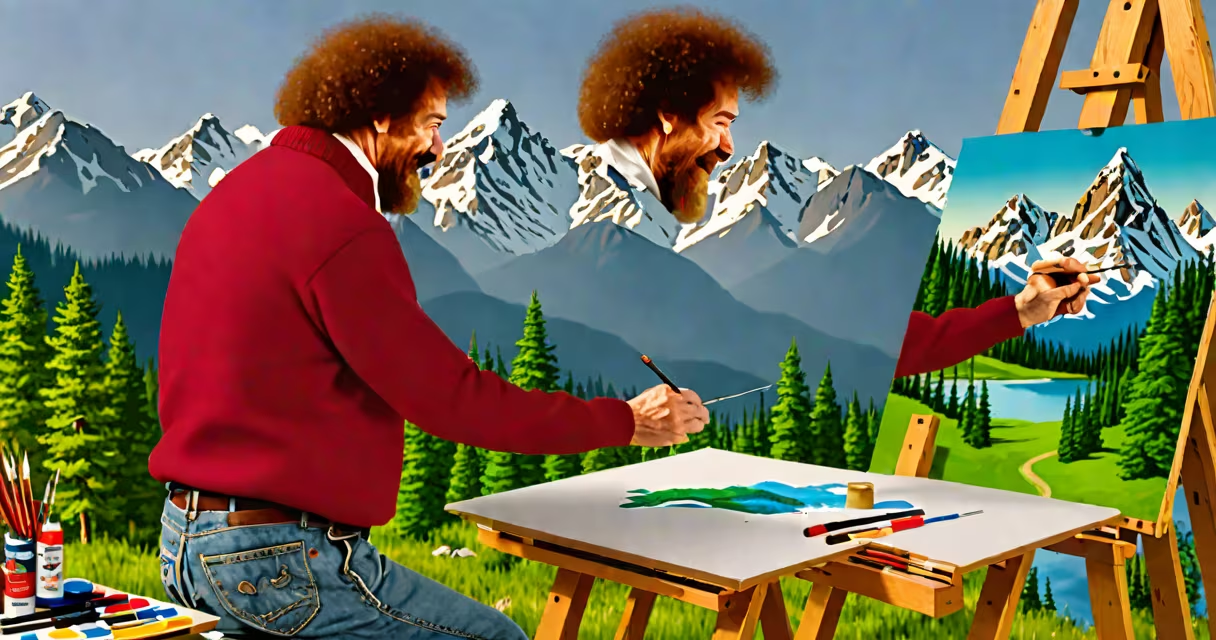
Bob Ross painter refers to the American television host and field artist who became a cultural icon through his 1980s and 1990s show, The Joy of Painting, where he taught viewers to paint serene nature scenes using a specific oil-painting technique called wet-on-wet.
His signature style features soft, rounded mountains, calm lakes, and "happy little trees" rendered in gentle brushstrokes. He painted live on camera, often completing a piece in 22 minutes, narrating each step with a soothing voice and encouraging tone. His work was accessible-no prior skill required-and emphasized creativity over precision.
The wet-on-wet method allowed Bob Ross to blend colors directly on the canvas while the paint was still wet, minimizing drying time and simplifying the process. This technique reduced the need for multiple layers or corrections, making it ideal for beginners. He used a limited palette: titanium white, cadmium yellow, ultramarine blue, and burnt sienna, among others.
Each episode began with a blank canvas and a simple prompt: "Let's make a happy little tree." He applied base layers quickly, then added texture with a dry brush or palette knife. He rarely corrected mistakes-instead, he incorporated them into the scene, saying, "We don't have any mistakes, only happy accidents."
He used a 2-inch flat brush for broad strokes, a fan brush for clouds, and a small round brush for details. His tools were basic: a standard set of oil paints, brushes, and a canvas. He never used a reference photo-everything came from imagination and memory.
For example, in Episode 176, titled "The Mountain Lake," he painted a snow-capped peak behind a calm lake with a pine tree on the shore. He started with a wash of blue and gray for the sky, layered in the mountain with darker tones, then added water reflections using horizontal strokes. The entire piece took under 20 minutes, with no erasing or overworking.
Unlike traditional art instructors who focus on anatomy or perspective, Bob Ross painter prioritized emotional expression and mental ease. He believed everyone could create art, regardless of formal training. His philosophy centered on joy, patience, and the idea that "there are no mistakes-only happy accidents."
He painted with a consistent, rhythmic pace. His voice remained calm, even when describing complex steps. He avoided technical jargon, replacing terms like "chiaroscuro" with "light and shadow." This made his lessons feel welcoming, not intimidating.
A lesser-known fact: Bob Ross did not start painting until age 30. Before that, he was a U.S. Air Force sergeant and trained as a flight instructor. He discovered painting during a therapy session after being diagnosed with hepatitis. His therapist suggested art as a stress-relief tool. He later said, "I didn't know I had talent until I tried."
Many assume Bob Ross painter was a professional fine artist with decades of academic training. In reality, he studied art informally and never attended art school. His success came from performance, not gallery credentials.
Another myth: that his paintings were sold for high prices. Most were destroyed after filming. Only a few survive in private collections. The originals weren't meant for sale-they were tools for teaching.
Some confuse him with other instructional artists like Norman Rockwell or Andrew Wyeth. But unlike those figures, Bob Ross painter never focused on realism or portraiture. His work was intentionally stylized, simplified, and emotionally comforting.
| Feature | Bob Ross Painter | Traditional Field Artist |
|---|---|---|
| Primary medium | Oil paint, wet-on-wet | Oil or acrylic, layered over days/weeks |
| Time per piece | Under 25 minutes | Hours to weeks |
| Goal | Emotional satisfaction, accessibility | Visual accuracy, artistic mastery |
| Viewing audience | General public, beginners | Art collectors, galleries |
His influence persists in online art communities. Platforms like YouTube and TikTok feature thousands of videos recreating his scenes. Search terms like "Bob Ross tutorial" generate over 1.2 million results, according to Google Trends (2023).
Art therapists cite his work as a model for mindfulness-based creative practice. A 2021 study published in the Journal of Art Therapy found that participants who recreated Bob Ross-style landscapes reported lower anxiety levels and higher engagement than those using traditional methods.
I once spent a weekend attempting to replicate his "Sunset Over the Lake" painting. I used the same brushes and palette. The result wasn't perfect-but the act of painting it felt like meditation. That's the core of what Bob Ross painter offered: not a masterpiece, but a moment of peace.
His legacy lives on through the Bob Ross Foundation, which supports arts education programs in underserved schools. Since 2006, they've distributed over 12,000 free art kits to students nationwide.
Today, anyone can access his episodes on platforms like Amazon Prime and Apple TV. His work continues to teach people that art doesn't require perfection-it requires presence. As he often said, "You're all talented. You just have to believe it."