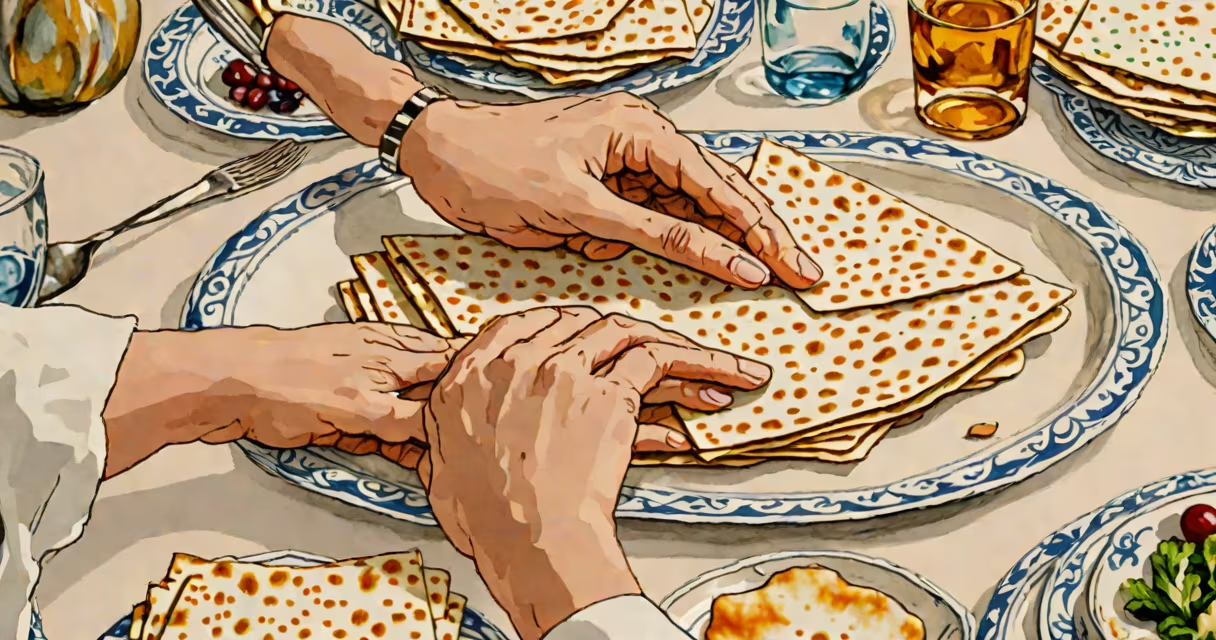
Matzah, unleavened bread, symbolizes the haste with which the Israelites fled Egypt during the Exodus, marking their liberation from slavery and affirming faith in divine redemption. It is central to Passover, observed annually in spring, and serves as both a historical reminder and a spiritual practice.
Matzah is baked without leavening agents such as yeast or sourdough. This absence of rising prevents fermentation, resulting in a flat, brittle cracker-like bread. The process takes less than 18 minutes from flour to oven, ensuring no time for dough to rise. This strict timeline reflects the urgency of the Exodus-there was no time to prepare regular bread, so the people ate what they could carry.
The Torah explicitly commands the eating of matzah during Passover. In Exodus 12:18, it states: "On the fourteenth day of the month at evening, you shall eat unleavened bread, until the twenty-first day of the month at evening." This directive establishes matzah as a core element of the holiday's rituals, not merely a food but a covenantal act.
During the Seder meal, matzah appears on the seder plate alongside other symbolic foods. It is broken into pieces, often hidden and later searched for by children-a game called "afikoman" that reinforces themes of loss and recovery. The act of breaking and hiding matzah mirrors the fragility of freedom and the effort required to preserve it.
Each participant eats three pieces of matzah during the Seder: one at the beginning of the meal, one during the recitation of the Haggadah, and one at the end. The first piece is eaten while reclining, symbolizing freedom. The second is dipped in salt water, representing tears shed during slavery. The third is consumed with bitter herbs, recalling the harshness of bondage.
According to the Talmud (Pesachim 4:1), matzah is not just food-it is a mitzvah. The commandment to eat matzah is not optional; it is a religious obligation. Failure to consume matzah during Passover is considered a violation of halakha (Jewish law), underscoring its spiritual weight beyond mere dietary custom.
There are two primary forms of matzah used in Jewish homes and synagogues:
| Type | Ingredients | Preparation Method | Use Case |
|---|---|---|---|
| Handmade (Shmurah) | Wheat flour, water, kosher supervision from harvest to baking | Baked by hand under continuous rabbinic oversight | Used for ceremonial meals, especially the Seder |
| Mechanical (Machine-Baked) | Wheat flour, water, no additives | Mass-produced using automated machines | Common for daily consumption during Passover |
Shmurah matzah is considered more spiritually pure because every step-from harvesting the wheat to baking-is monitored by a rabbi. This level of control ensures compliance with the 18-minute rule and prevents accidental leavening. Machine-baked matzah, while acceptable for most purposes, lacks this intensive supervision and is generally not used for the Seder in Orthodox communities.
A lesser-known fact: Some Hasidic groups believe that shmurah matzah contains a higher spiritual energy due to the intention (kavanah) behind its creation. This belief is rooted in Kabbalistic teachings that suggest focused prayer during production elevates the food's sacred quality.
Matzah is not simply "poor man's bread" or a symbol of poverty. While the Israelites were poor in Egypt, the deeper meaning lies in their sudden departure-not in material hardship. The focus is on speed, not scarcity. As Rabbi Jonathan Sacks wrote in *The Koren Sacks Passover Haggadah*, "Matzah is not the bread of affliction-it is the bread of freedom."
Another common error is equating matzah with all unleavened bread. In reality, many cultures have unleavened bread-such as Indian chapati or Italian piadina-but none carry the same theological weight. Only matzah, as defined by halakha and tied to the Exodus narrative, holds religious significance in Judaism.
Even within Jewish communities, confusion arises over whether matzah can be eaten outside Passover. The answer is yes-but only under specific conditions. For example, Ashkenazi Jews traditionally avoid chametz (leavened products) during Passover, but may eat matzah in other contexts. Sephardic Jews, however, permit matzah year-round unless it is used in a ritual context.
In 2022, my family hosted a Passover Seder in Brooklyn. We used handmade shmurah matzah from a local bakery certified by the Orthodox Union. The host, a rabbi's daughter, emphasized that each piece had been prepared under constant supervision. During the meal, we broke the middle matzah and hid it. My nephew found it beneath a pillow, earning a small prize. Later, we dipped the remaining matzah in salt water and passed it around. The act wasn't just ritual-it was memory-making.
That night, the youngest child asked, "Why do we eat this hard bread?" The host replied, "Because freedom doesn't come easy. It's not soft. It's not sweet. But it's ours." That moment captured the essence of matzah: not comfort, but commitment.
Understanding what matzah symbolizes requires looking beyond the physical object. It is a living artifact of collective memory, a tangible expression of faith, and a weekly invitation to reflect on liberation. Its simplicity-flour and water, baked in 18 minutes-makes it useful. It demands attention, not because it is complex, but because it is true.