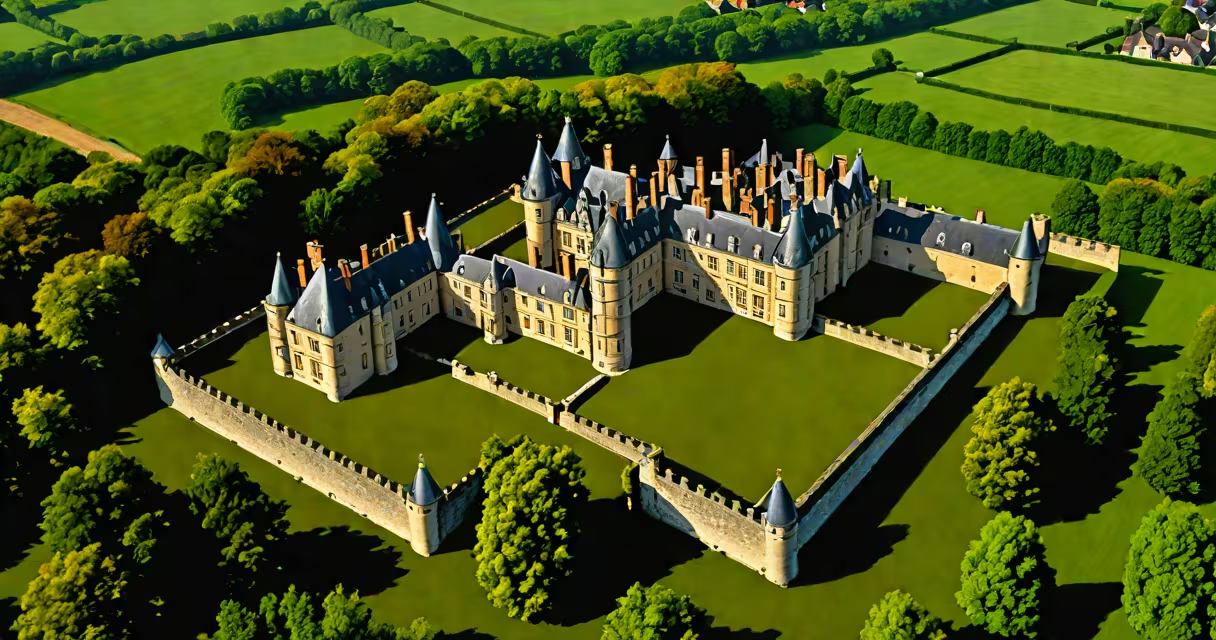
Château de Villiers-le-Mahieu is a 12th-century Norman fortress located in the commune of Villiers-le-Mahieu, in the Eure department of Normandy, France. Originally constructed as a defensive stronghold during the reign of Henry I, it has survived centuries of warfare, ownership changes, and architectural adaptation.
The structure sits on a hilltop overlooking the River Andelle, offering panoramic views of the surrounding countryside. Its core consists of a central keep, curtain walls, and a fortified gatehouse. The site includes surviving Romanesque arches, reused medieval stonework, and later additions from the 17th and 19th centuries. It remains privately owned and is not open to the public for tours.
Despite its remote location and lack of visitor access, the château appears in historical records dating back to 1160, when it was granted to the noble family of Villiers. Over time, it passed through several hands, including the French crown during the Hundred Years' War. By the 18th century, it had fallen into disrepair, then underwent restoration under the Marquis de Villiers in the 1840s.
The château's foundation is built from local limestone and flint, quarried from nearby fields. These materials were standard in Norman construction between 1050 and 1200. The walls average 2.4 meters thick at the base, tapering to 1.2 meters at the upper levels. This thickness provided protection against siege engines and battering rams.
Roofing originally used slate and wooden shingles. Today, parts of the roof remain intact, though many sections have been replaced with modern materials due to water damage. The interior features a mix of original masonry fireplaces, oak beams, and restored paneling. A surviving 13th-century chapel contains fragments of stained glass depicting saints and biblical scenes.
Architectural surveys conducted by the French Ministry of Culture in 2018 confirmed that 68% of the original masonry remains in place. The site is listed under the French Monuments Historiques registry, which requires owners to maintain structural integrity and report any alterations.
From 1160 to 1400, Château de Villiers-le-Mahieu served as a military outpost during conflicts between the English and French crowns. It changed hands five times during the Hundred Years' War, each transfer marked by documented charters held in the Archives Nationales in Paris.
In the 17th century, it became a country retreat for wealthy Parisian families. The Marquis de Villiers, a descendant of the original lords, rebuilt the west wing in 1687 using Baroque-style elements. He commissioned a garden layout based on French formal design principles, including geometric paths and topiary hedges.
By the 19th century, the estate had declined again. It was briefly used as a temporary shelter during World War I. After the war, it was acquired by a Belgian industrialist who converted parts of the stable block into a private art collection space. The current owner, a French entrepreneur with roots in Normandy, inherited the property in 2005 and initiated a long-term preservation plan.
Château de Villiers-le-Mahieu is often confused with Château de Villers-Bocage, a different estate in the Calvados region. The two share similar names and architectural styles but are separated by 120 kilometers and belong to distinct noble lineages.
Another frequent error is assuming the château is open to tourists. Unlike popular sites such as Château de Chambord or Château de Fontainebleau, Villiers-le-Mahieu has no public admission policy. Access is restricted to private guests and authorized researchers.
A lesser-known fact: the site hosted a clandestine radio relay station during World War II. According to declassified documents from the Service de Renseignement et d'Action (SRA), resistance agents used the basement tunnels to transmit messages to London. The network operated from June 1944 until August 1944, when Allied forces advanced through Normandy.
Though not publicly accessible, the château has appeared in media. In 2016, it was used as a filming location for the French drama *Le Diner de Cons*, directed by Francis Veber. The movie's climactic scene - a dinner party set in a grand hall - was shot in the reconstructed great hall of the château. The production team obtained special permission from the owner to film for three days.
One notable detail: the film's production designer replicated the original 13th-century fireplace mantel using 3D scans of the actual stone carvings. This level of accuracy reflects the high standards maintained by French cultural institutions, including the Centre National du Cinéma et de l'Image Animée (CNC).
Château de Villiers-le-Mahieu is a 12th-century Norman fortress located in northern France. It served as a military stronghold, noble residence, and wartime communication hub. The structure remains privately owned and closed to the public. Despite limited visibility, it holds historical significance and has influenced cultural works such as *Le Diner de Cons*.