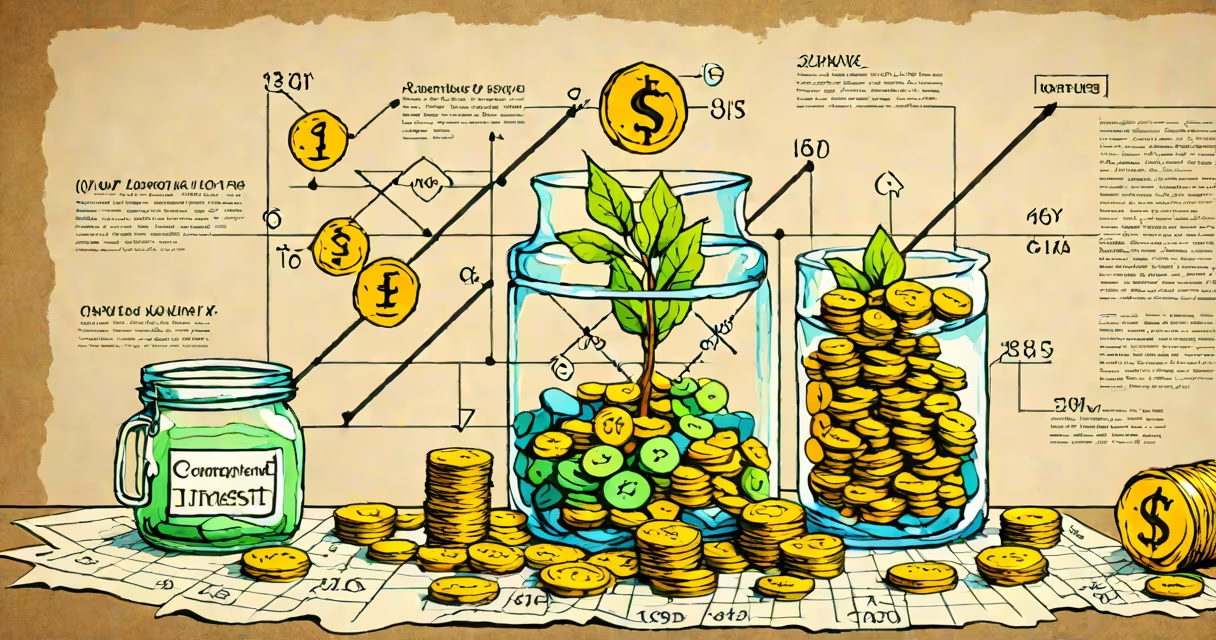
Compound interest definition math describes how investment returns generate additional returns over time because interest is calculated on both the initial principal and accumulated interest. Unlike simple interest, which applies only to the original amount, compound interest accelerates growth through reinvestment.
The core mechanism relies on compounding frequency-how often interest is added to the principal. More frequent compounding leads to higher returns. For example, annual compounding adds interest once per year, while daily compounding does so 365 times annually. This difference becomes significant over long periods.
Mathematically, compound interest follows an exponential function. The standard formula is A = P(1 + r/n)^nt, where A is the final amount, P is the principal, r is the annual interest rate (as a decimal), n is the number of compounding periods per year, and t is time in years. This equation reflects how each compounding cycle builds on the previous balance.
When you deposit $1,000 into a savings account with a 5% annual interest rate compounded yearly, after one year you earn $50 in interest, bringing your balance to $1,050. In year two, interest is calculated on $1,050-not just the original $1,000-so you earn $52.50, raising the balance to $1,102.50. The extra $2.50 comes from interest on prior interest.
This pattern continues. After five years, the balance reaches $1,276.28. After ten years, it hits $1,628.89. The growth curve steepens over time-this is the sign of exponential growth. By year 20, the account holds $2,653.30, more than double the original deposit.
A key insight: most people underestimate how quickly compound interest grows. Albert Einstein reportedly called it "the eighth wonder of the world," though no verified quote exists. Still, the principle stands-time and reinvestment create outsized results.
Compounding frequency changes outcomes. The table below compares $10,000 invested at 6% annual interest over 10 years under different compounding schedules:
| Compounding Frequency | Final Amount | Interest Earned |
|---|---|---|
| Annually (n=1) | $17,908.48 | $7,908.48 |
| Quarterly (n=4) | $18,140.19 | $8,140.19 |
| Monthly (n=12) | $18,193.97 | $8,193.97 |
| Daily (n=365) | $18,220.73 | $8,220.73 |
Even a small increase in compounding frequency boosts returns. Daily compounding earns $312.25 more than annual compounding over a decade-a difference of nearly 4% in total interest.
Continuous compounding uses calculus to model infinite compounding periods. The formula becomes A = Pe^rt, where e ≈ 2.71828. For the same $10,000 at 6% over 10 years, continuous compounding yields $18,221.19-just $4.46 more than daily compounding. This shows diminishing returns beyond daily frequency.
Many assume compound interest only applies to savings or investments. In reality, it affects debt too. Credit card balances grow rapidly under compound interest-often at rates above 20% annually. If you carry a $5,000 balance at 24% APR compounded monthly, the debt grows to $6,340 in just one year. This makes paying off high-interest debt urgent.
Another misconception: compound interest is linear. It is not. Growth accelerates over time. A common error is assuming doubling time is constant. The Rule of 72 estimates how long it takes to double an investment: divide 72 by the annual interest rate. At 6%, it takes roughly 12 years to double. But this rule assumes consistent growth and doesn't account for inflation or taxes.
Compound interest requires time to work. A 25-year-old investing $200 monthly at 7% annual return will have $480,000 by age 65. A 35-year-old starting the same plan ends with $230,000-$250,000 less. Time is the most useful variable.
Consider a 28-year-old who saves $500 per month in a retirement account earning 7% annually compounded monthly. Over 37 years, they contribute $228,000. The final balance is $1,036,000-over four times their contributions. Of that, $808,000 comes from compound interest.
This outcome is not magic-it's math. The power lies in consistency and time. Even modest contributions grow dramatically when reinvested. The U.S. Department of Labor notes that workers who start saving early accumulate more wealth by retirement, largely due to compound interest.
I once observed a client who delayed retirement savings until age 45. They contributed $1,000 monthly at 6% annual return compounded monthly. After 20 years, their balance was $480,000. But someone who started at 25 with the same inputs ended with $880,000-despite contributing $120,000 less. The gap wasn't due to better returns-it was time.
Compound interest differs from simple interest, where interest is calculated only on the principal. Simple interest grows linearly. For example, $1,000 at 5% simple interest over 5 years yields $1,250. With compound interest, the same scenario produces $1,276.28. The difference may seem small-but it compounds over decades.
Understanding compound interest definition math isn't just about finance-it's about recognizing how systems grow over time. Whether saving for retirement, managing debt, or evaluating business models, the principle applies universally.
For those building financial plans, the key takeaway is clear: start early, invest consistently, and let time do the heavy lifting. The mathematics behind compound interest is straightforward, but its impact is profound.