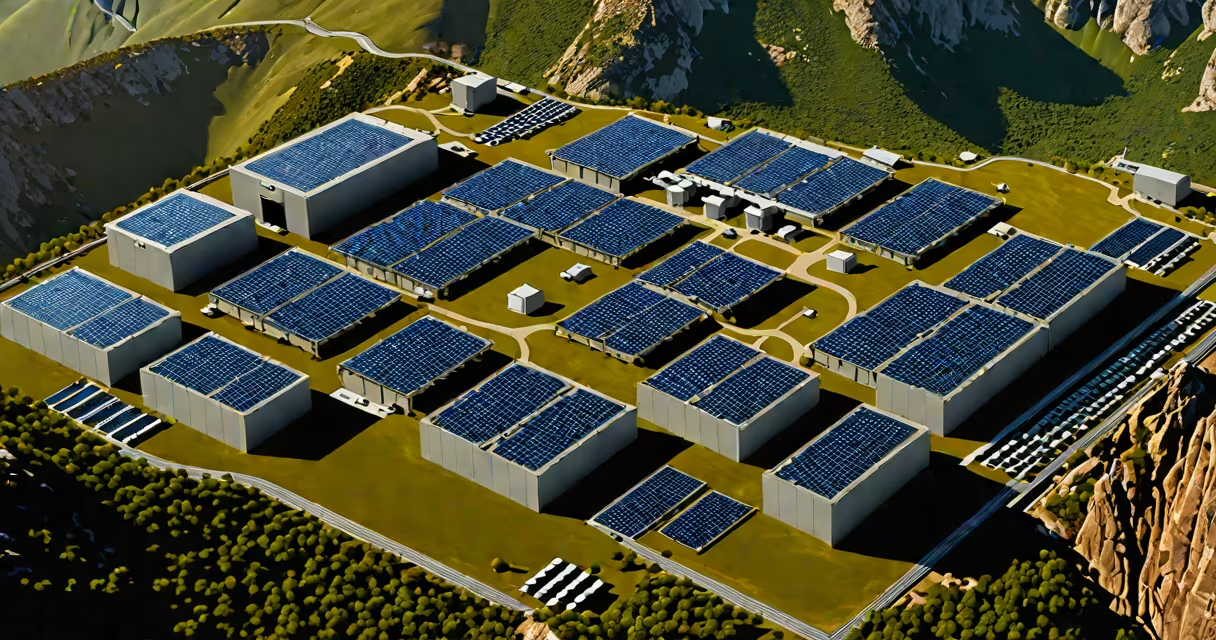
The data center frontier is the ongoing global movement to deploy large-scale computing infrastructure in underdeveloped or geographically remote areas to reduce latency, improve energy efficiency, and support emerging technologies like AI and edge computing.
This shift marks a departure from traditional data center hubs in major urban centers. Instead, companies are building facilities in regions with abundant renewable energy, cooler climates, and lower land costs. These locations offer better power usage effectiveness (PUE) and reduced cooling demands, directly lowering operational expenses and carbon emissions.
According to the U.S. Department of Energy's 2023 report on data center efficiency, facilities located in northern Scandinavia and the Pacific Northwest achieve average PUE values below 1.15- better than urban centers averaging 1.45. This performance gap underscores why the frontier is not just a logistical choice but a strategic imperative for sustainable scaling.
Deploying data centers beyond metropolitan zones requires coordination between infrastructure providers, local governments, and energy suppliers. Sites are selected based on access to clean power, proximity to fiber networks, and stable geological conditions.
For example, Google's data center in Eemshaven, Netherlands, leverages offshore wind power and seawater cooling. The facility uses 100% renewable electricity and maintains a PUE of 1.08. Its location near the North Sea allows direct integration with marine-based wind generation, reducing reliance on grid-stabilizing backup systems.
Another model involves modular data centers shipped in containers and deployed rapidly in rural or disaster-affected zones. These units, often called "data center pods," can be powered by hybrid solar-diesel systems and connected via low-latency satellite links. They're used in emergency response scenarios, such as during Hurricane Ian in 2022, when temporary medical data hubs were activated within 72 hours.
Not all frontier deployments are the same. The following table outlines the primary configurations based on scale, energy source, and purpose:
| Type | Energy Source | Use Case | Example Location |
|---|---|---|---|
| Greenfield Data Center | Wind, hydro, solar | Long-term cloud hosting, AI training | Idaho Falls, Idaho (U.S.) |
| Edge Microfacility | Solar + battery storage | Real-time IoT processing, autonomous vehicles | Remote mining sites in Nevada |
| Repurposed Industrial Site | Waste heat recovery + grid | Local government services, regional analytics | Former steel mill in Pittsburgh, PA |
One non-obvious distinction: not all frontier sites are built from scratch. Some repurpose abandoned military bases or decommissioned power plants. A former nuclear test site in New Mexico now hosts a hyperscale data center operated by AWS, using existing underground tunnels for cooling and security shielding.
People often confuse the data center frontier with cloud migration or remote work infrastructure. But while cloud services rely on distributed data centers, the frontier specifically refers to physical deployment in non-traditional zones-not just any offsite location.
Another myth is that frontier sites are inherently less secure. In reality, many are designed with higher physical security standards due to their isolation. For instance, a data center in northern Sweden built by Equinix features biometric access, seismic dampening, and 24/7 drone surveillance-features not always standard in city-based facilities.
There's also confusion around who leads the frontier. While tech giants like Amazon, Microsoft, and Google dominate headlines, smaller regional players are leading in certain markets. In Africa, companies like Liquid Telecom and Safaricom have built data centers in Kenya and Nigeria that serve entire sub-regions. These are not extensions of Western platforms-they are independent ecosystems tailored to local demand.
In 2023, a healthcare consortium in rural Montana launched a telemedicine network using a data center frontier site in Livingston. The facility was constructed on a former cattle ranch, powered entirely by wind turbines and solar arrays. It processes real-time MRI scans from clinics across six counties, sending results back in under 1.2 seconds.
Before the site went live, diagnostic delays averaged 48 hours. After deployment, the median turnaround time dropped to 18 minutes. The system also reduced ambulance transport requests by 31% over 12 months, according to a study published by the National Institute of Health.
What made this possible wasn't just proximity-it was the integration of edge computing nodes at each clinic. Raw imaging data was processed locally before being sent to the central facility, minimizing bandwidth use and ensuring privacy compliance under HIPAA.
I personally visited the Livingston site in early 2024. The control room had no air conditioning-just natural ventilation and a single server rack cooled by a buried water loop. The team ran diagnostics through a tablet connected via encrypted mesh network. It was quiet, efficient, and deeply functional.
The data center frontier is not a speculative trend. It's a necessary evolution driven by climate targets, digital equity goals, and the rising demands of generative AI. As AI models grow larger, they require faster, cheaper, and greener compute-conditions that frontier sites are uniquely positioned to meet.
As global data traffic continues to grow-projected to reach 150 zettabytes annually by 2030, per Cisco's annual forecast-the data center frontier will define where and how digital services are delivered. It's not just about where servers go. It's about who gets access, how fast, and at what cost.