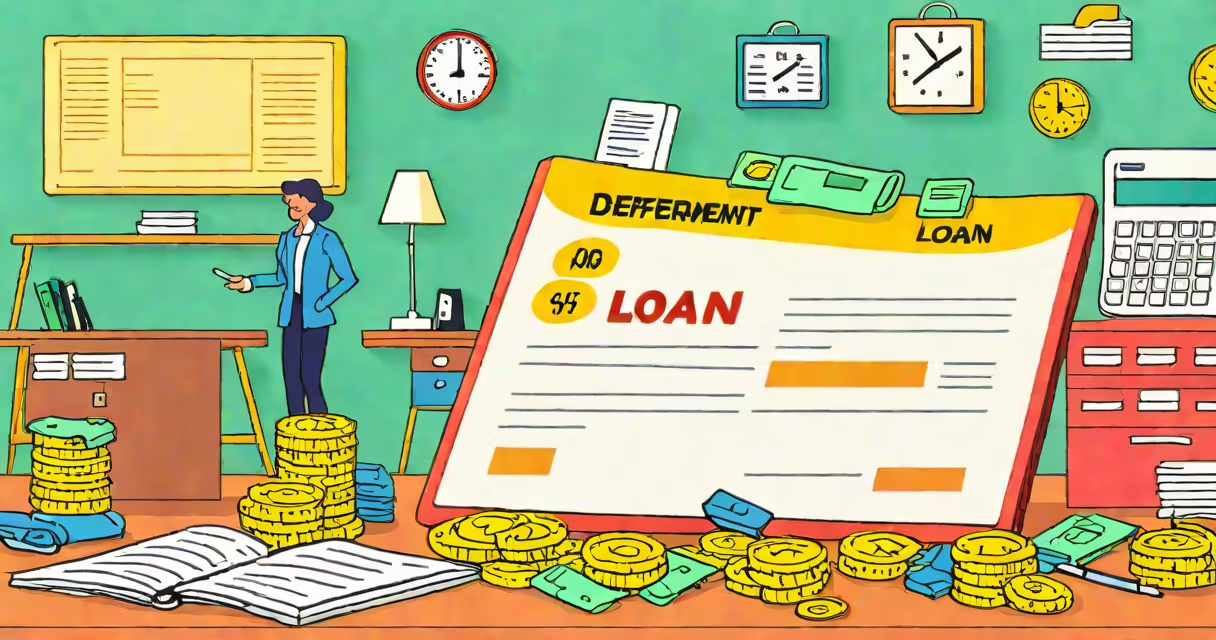
A deferred loan is a temporary pause on required payments for a loan, typically granted due to financial hardship, enrollment in school, or other qualifying circumstances. This pause does not cancel the debt, and interest may continue to accrue depending on the loan type.
Deferment is most common with federal student loans, but it also applies to certain private loans and vehicle financing. It allows borrowers to delay payments without penalty during periods of instability, such as unemployment, medical issues, or full-time enrollment. The deferment period ends when payments resume under the original terms or a revised schedule.
The U.S. Department of Education defines deferment as "a temporary postponement of loan payments" for eligible borrowers. According to Federal Student Aid, deferments can last up to 12 months and may be renewed under qualifying conditions. Not all loans qualify-private lenders set their own rules, often requiring proof of hardship and charging fees for approval.
Borrowers apply for deferment through their lender or loan servicer. The process requires submitting documentation proving eligibility-such as a letter from a school registrar for students or recent pay stubs for those facing job loss. Approval is not automatic, and delays can occur if forms are incomplete.
During deferment, the borrower is not required to make principal or interest payments. However, interest continues to accumulate on unsubsidized federal loans and most private loans. For example, a $20,000 unsubsidized student loan with a 5% interest rate accrues approximately $83 in interest per month. Over a 12-month deferment, that adds $996 in unpaid interest, which is capitalized when payments restart.
Payments resume automatically after the deferment period ends unless the borrower requests an extension. Failure to resume payments leads to delinquency and potential default. Borrowers should confirm their new payment amount with their servicer before the resumption date.
Deferment types vary by loan purpose and borrower situation. The following table outlines common categories:
| Type | Eligibility Requirement | Max Duration | Interest Accrual |
|---|---|---|---|
| Federal student loan (economic hardship) | Unemployment or income below 150% of poverty level | 3 years total | Yes |
| Federal student loan (school enrollment) | Enrolled at least half-time in an accredited program | Up to 3 years per academic period | No (subsidized loans only) |
| Vehicle loan (financial hardship) | Proof of job loss or medical crisis | 6-12 months (lender-dependent) | Yes |
| Private student loan (temporary hardship) | Lender-specific criteria; often requires credit check | Up to 12 months | Yes |
Subsidized federal student loans do not accrue interest during deferment. Unsubsidized loans and private loans do. This distinction matters: a $10,000 unsubsidized loan deferred for 12 months at 6% annual interest grows by $600 in unpaid interest-adding to the balance upon resumption.
Nonprofit organizations and military service members may qualify for special deferment programs. For example, the U.S. Department of Veterans Affairs offers deferment options for veterans returning from deployment who face employment gaps.
Many borrowers assume deferment eliminates interest or extends the loan term. Neither is true. Deferment pauses payments but does not reduce the principal or alter the original repayment timeline. Interest continues to build on most loan types, increasing the total cost over time.
Another mistake is assuming all lenders offer deferment. Private lenders are not federally mandated to provide it. A borrower with a $15,000 auto loan from a regional bank may be denied deferment despite being unemployed. Only 42% of private lenders surveyed by the Consumer Financial Protection Bureau offered any form of hardship relief in 2023.
Some borrowers confuse deferment with forbearance. Forbearance allows temporary pause but always accrues interest. Deferment may avoid interest on subsidized loans. Confusing the two can lead to higher long-term costs. For example, a borrower using forbearance on a $25,000 loan at 7% interest over 12 months pays $175 in interest monthly-$2,100 total-compared to $0 for subsidized loans under deferment.
In 2022, Maria, a graduate student in public health, had a $30,000 federal unsubsidized student loan. She applied for deferment based on her enrollment status. Her servicer approved a 12-month deferment. During that time, interest accrued at 4.5% annually-$112.50 per month. Total unpaid interest: $1,350.
When payments resumed, her new monthly payment increased by $12.50 to cover the added balance. Over the remaining 10-year term, she paid $1,200 more in total interest compared to if she had continued paying during school. Still, the deferment prevented default and preserved her credit score.
She later refinanced her loan to lower the interest rate. Refinancing is not available during deferment, so timing matters. Borrowers should evaluate whether deferring is better than continuing payments or seeking alternative funding.
Use deferment only when absolutely necessary. It's ideal for short-term crises-job loss, medical emergencies, or unexpected school enrollment. It prevents late fees and credit damage. But it increases long-term costs due to accruing interest.
For vehicle loans, deferment is rare. Most lenders require continuous payments. If a borrower faces hardship, they should contact the lender early. Some banks, like Wells Fargo, offer temporary payment reductions or extensions under specific hardship programs. These are not formal deferments but serve similar purposes.
Always confirm terms with your lender. Some deferments require written notice within 30 days of the event. Missing deadlines can result in denial. Keep records of all communications and approvals.
Understanding the deferred loan definition ensures informed decisions during financial stress. It's not a permanent fix, but a tool to maintain stability while avoiding default.